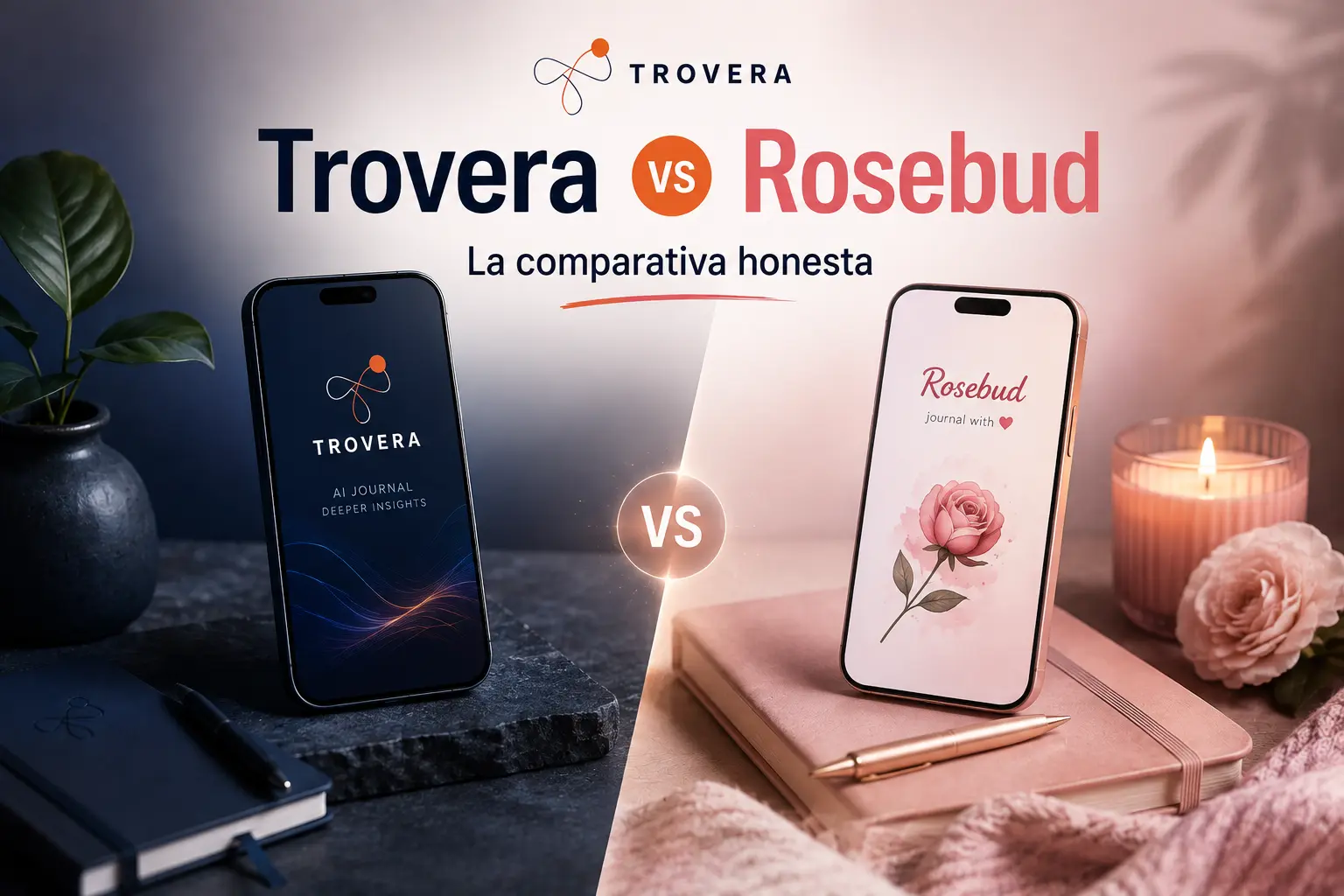
This comparison is written by Trovera. We have an obvious financial interest in you choosing Trovera over Rosebud. We are going to tell you anyway — clearly and specifically — when Rosebud is the better choice. Not as a gesture of false humility, but because a comparison that only makes one side look good is not a comparison, it is a sales pitch, and you can read those anywhere. The most useful thing this post can do is tell you when Rosebud is right and when Trovera is right, and trust you to choose correctly.
Here is what Rosebud does better than Trovera. Here is what Trovera does better than Rosebud. Here is the single question that determines which one is right for you. And here is the scenario — played out with the same person using each app on the same difficult day — that makes the architectural difference concrete rather than abstract.
The Single Question That Decides
Do you want an AI that knows your emotional history across months — or an AI that responds to what you said today with maximum specificity and privacy?
Rosebud's structural advantage is longitudinal memory. The AI connecting your current anxiety to something you wrote four months ago. The weekly insight report that summarises your emotional patterns across weeks. The sense of being known over time rather than freshly encountered every session.
Trovera's structural advantages are voice-first architecture, on-device privacy, persona adaptation for different emotional states, and a KI that generates a specific follow-up question from what you said — not from a template or a cross-session analysis.
Neither advantage eliminates the other's value. But they produce different outcomes in practice, and understanding which outcome you need is what makes this comparison actually useful. The question is which one matches what you actually need from a journaling app.
Trovera vs Rosebud: Full Comparison Table
| Feature | Trovera | Rosebud |
|---|---|---|
| Price/year | $59.99 | $119.88 |
| Price/month | $6.99 | $12.99 |
| Voice-first | ✅ Built for voice | ⚠️ Text-first, voice added |
| On-device storage | ✅ On-device | ❌ Server-based |
| AI training clause | ❌ No | ✅ Yes (anonymized) |
| Personas | ✅ 5 clinical personas | ❌ One AI voice |
| Clinical perspectives | ✅ 7 perspectives | ❌ None |
| Cross-session memory | ❌ Not yet | ✅ Strong |
| Weekly insight reports | ❌ No | ✅ Yes |
| Languages | ✅ 30+ | ❌ English only |
| Free trial | 7 days full access | Trial only |
| Journal modes | ✅ 6 modes | ❌ None |
| Blank page eliminated | ✅ Yes (voice-built) | ❌ No (text interface) |
Where Rosebud Is Better Than Trovera
Longitudinal Memory
This is Rosebud's genuine structural advantage and it is significant. When Rosebud references something you wrote four months ago in today's response — connecting a pattern from a previous relationship to what you're describing now — it creates a continuity that Trovera cannot currently replicate. Trovera responds to today's entry specifically. Rosebud responds to today's entry in the context of your entire journaling history.
For users who have been journaling consistently for months and want the AI to understand their emotional trajectory — to notice when a theme recurs, to connect dots across time, to provide the kind of insight that only comes from knowing someone over time — Rosebud's memory architecture is the feature no alternative currently matches.
Weekly Insight Reports
Every week, Rosebud produces a summary report: your emotional patterns, recurring themes, mood trajectory, and notable changes from the previous week. For users who want to track their mental health longitudinally — to see whether things are actually improving, to identify the conditions that correlate with better or worse emotional states — these reports are truly valuable and unique in the category.
Therapist-Designed Prompt Quality
Rosebud's prompt library was designed with therapeutic expertise and it shows. The daily and evening reflection prompts are among the best-designed in any journaling app. For users who need external structure to guide what they write about, Rosebud's prompts provide better guidance than most alternatives.
Where Trovera Is Better Than Rosebud
Voice-First Architecture
Rosebud is a text journaling app. You can speak your entries using voice input, but the product defaults to a text box, the AI is optimised for written language, and the blank page problem persists in the text interface. Voice is an option, not the architecture.
Trovera has no text box. You open the app and speak. The blank page doesn't exist. For users whose journaling habit has failed because of the blank page — which is most people who have tried journaling more than once — voice-built architecture is the structural fix that text-based voice input isn't.
Research by Fogg on habit formation shows that the habits that become automatic have minimal initiation friction, require no setup, and attach to existing anchors (Fogg, 2019, doi:10.1093/oxfordhb/9780190227197.013.14). Opening an app and speaking has lower friction than opening an app, navigating to voice input, and speaking. Trovera's voice-built architecture produces better habit formation than Rosebud's voice-added approach.
On-Device Privacy
Trovera uses secure on-device processing to transcribe your thoughts — your entries live in your phone's local storage, not on our servers.
Rosebud's ToS explicitly permits anonymized entries to be used for AI model training. Their founder has confirmed this publicly. Your entries — in some anonymized form — contribute to training data. For users journaling about narcissistic abuse recovery, sobriety, mental health crises, professional conflicts, or anything truly sensitive, this is a structural concern.
Research by Pennebaker and Seagal on expressive writing shows that the therapeutic benefit depends on genuine disclosure — the kind that only happens when you fully trust the privacy of the space (Pennebaker & Seagal, 1999, doi:10.1207/s15327752jpa7302_12). Any subconscious awareness that your entries might be used for something beyond journaling reduces this authenticity. On-device architecture removes the concern entirely, which may make your journaling more honest and therefore more effective.
5 Clinical Personas for Different Emotional States
Rosebud gives you one conversational AI voice for every session. Whether you're in crisis, calm, stuck, or clear — Rosebud responds with the same therapist-adjacent warmth and the same conversational register.
Trovera is the only voice-first journaling app that offers 7 clinical perspectives and 5 AI personas — with all data stored on your device.
The clinical significance: acute emotional distress needs de-escalation before examination. The Balm provides calming, stabilising response when the nervous system is activated. The Presence witnesses without pushing. The Hearth provides warmth for loneliness. The Catalyst challenges stuck patterns. The Meridian clarifies decisions. Giving all of these the same therapeutic response is like prescribing the same treatment for different conditions. Trovera adapts. Rosebud doesn't.
Price: $59.99 vs $119.88
At $59.99/year, Trovera costs exactly $60/year less than Rosebud. Stated differently: two years of Trovera costs $7 less than one year of Rosebud. The $60 annual difference is the most concrete comparison: what does Rosebud's price premium buy you? If the longitudinal memory and weekly insight reports are features you use and value, the premium is defensible. If you don't use these features consistently, you're paying $60/year for features that don't match your journaling practice.
30+ Languages
Rosebud is English-only. Trovera supports 30+ languages for voice input, transcription, and full KI response. For non-English speakers, multilingual speakers, or expats who process emotionally in a language other than English, this is not one consideration among many. It is the deciding factor.
No AI Training Clause
Research by Nolen-Hoeksema on rumination shows that genuine self-reflection — the kind that interrupts rather than feeds negative thought loops — requires authentic expression (Nolen-Hoeksema, 2000, doi:10.1006/jado.1999.0370). On-device architecture enables this authenticity by removing any subconscious awareness that entries might be used externally.
The Privacy Question in Detail
This deserves a dedicated section because it's the most consequential difference for many users.
Rosebud's architecture: your entries travel from your device to Rosebud's servers, encrypted in transit and at rest. The company has the technical infrastructure to access them if legally compelled. Anonymized versions contribute to AI model training — confirmed publicly by the founder.
Trovera's architecture: your entries never leave your device. The transcription of your voice happens on your phone. The KI response is generated locally. There is no server for the entries to be on. Legal compulsion to produce your entries yields nothing — there is nothing on any external server to produce.
For most journaling content — daily reflection, gratitude practice, general processing of ordinary life — Rosebud's privacy is probably sufficient. For anyone journaling about:
- Recovery from narcissistic abuse or domestic violence
- Addiction and sobriety
- Mental health crises including suicidal ideation
- Professional situations that could be damaging if disclosed
- Anything you would not want in any external dataset
— the architectural difference is material. Not a privacy preference. A safety consideration.
Who Should Choose Trovera
- You want voice-first journaling where the blank page doesn't exist
- Privacy matters — on-device means entries never leave your phone, with no AI training clause
- You need different AI responses for different emotional states (The Balm vs The Catalyst vs The Meridian)
- You journal in a language other than English
- You want to pay $59.99/year instead of $119.88/year
- You're building a journaling habit from scratch and need minimum friction
Who Should Choose Rosebud
- Longitudinal memory is your primary need — the AI knowing your complete emotional history across months
- Weekly insight reports on your emotional patterns are truly valuable to you
- You journal primarily in English
- Text journaling works well for you and voice isn't the priority
- The privacy trade-off (AI training clause) is acceptable given what you journal about
- $119.88/year is proportionate to the specific value Rosebud's memory features provide
A Day in the Life: Trovera vs Rosebud
Understanding the architectural difference is easier in a specific scenario. Here is the same person using each app on the same day.
The scenario: Kezia is 35, works in marketing in Manchester. Today was a difficult day — a presentation that didn't land, a comment from her manager that stung, and the familiar pattern of leaving work feeling like she's not as good as she thought she was.
Using Rosebud: Kezia opens Rosebud. The interface shows a text box with today's prompt: "What's one thing that happened today that you'd like to reflect on?" She types about the presentation, the manager's comment, the familiar feeling. She writes for seven minutes. The AI responds with warmth: "It sounds like today challenged your sense of competence. Rosebud has noticed this theme coming up in your entries — particularly after presentations. In your entry from three months ago, you described a similar feeling after a client meeting that also didn't go as planned. Is this pattern something you'd like to explore?" She writes more. The session continues. When she's done, the entry is stored on Rosebud's servers.
Using Trovera: Kezia opens Trovera. She chooses The Balm because she knows she's activated and doesn't want to be pushed toward analysis yet. She speaks for four minutes about the presentation, the manager's comment, the familiar feeling. The KI responds: "You mentioned feeling like you're not as good as you thought. That's a specific thought — not just a feeling. When did you first have that specific thought today, and what happened immediately before it?" She answers. The session closes. The entry is on her phone and nowhere else.
Both sessions helped. They helped differently. Rosebud gave Kezia the longitudinal context — this is a pattern, it's been here before. Trovera gave Kezia a specific question about a specific moment that changed how she was thinking about the day.
Neither is better. They produce different insights through different mechanisms.
The Switching Decision: Questions to Ask Yourself
Before choosing between Trovera and Rosebud, answer these questions truthfully:
1. Do I journal consistently enough for longitudinal memory to matter? Rosebud's memory advantage is only valuable if you've built a consistent journaling practice over months. For new journalers or inconsistent journalers, the memory has nothing to work with. If you're building the habit from scratch, Trovera's voice-first architecture is more important than Rosebud's memory.
2. How sensitive is my journaling content? For general reflection — daily processing, gratitude, career thoughts — Rosebud's privacy is probably sufficient. For anything you'd consider truly sensitive (trauma, relationship abuse, mental health crises, professional conflicts), the AI training clause and server-based storage are material concerns. On-device architecture eliminates these concerns architecturally rather than through policy.
3. Do I journal across the full range of emotional states? If you journal when you're calm and reflective (one register), Rosebud's single AI voice serves you well. If you journal when you're distressed, exhausted, grieving, stuck, and clear on different days, persona adaptation is more valuable than conversational consistency. A single AI voice that gives the same response in crisis as in clarity is clinically inappropriate for one of those states.
4. Does the blank page stop me? If the blank page has killed previous journaling habits, voice-built architecture is the fix — not a better prompt or a nicer interface. Trovera eliminates the blank page architecturally. Rosebud reduces it without eliminating it.
5. Is $60/year a meaningful difference for my budget? $59.99 vs $119.88 is a concrete financial difference. If the $60 is meaningful, Trovera provides a different set of genuine advantages at half the price. If the $60 isn't meaningful and Rosebud's memory features are what you need, the premium is justified.
What Happens If You Switch from Rosebud to Trovera
Your entry history: Export from Rosebud account settings before cancelling. Your entries, insights, and weekly reports can be downloaded and kept regardless of which app you use going forward.
The memory gap: Trovera starts fresh. There is no equivalent to Rosebud's longitudinal memory on day one of Trovera. This is the real cost of switching — not price or features, but the cross-session context that Rosebud has built from your history.
The adjustment period: Voice journaling feels different from text journaling. The first week of Trovera will feel unfamiliar — not necessarily worse, but different. Speak anyway. The 7-day trial gives you enough sessions to find the rhythm.
What you gain immediately: On-device privacy from session one. Voice-first format with no blank page. 5 personas to match your emotional state. A KI that responds with a specific question rather than a programmatic prompt. 30+ languages if relevant. And $60/year staying in your pocket.
Kezia's Decision
Kezia used both apps through their respective trials. She chose Trovera.
Her reason was specific: "Rosebud remembered me in a way that felt helpful for understanding patterns. But it couldn't change its tone based on the kind of day I'd had. On hard days, I needed to be calmed down before being reflected back at. Rosebud always reflected me back at myself at the same volume. Trovera turned down the volume first."
She still has her Rosebud export. She checks the weekly reports occasionally as historical documents. The memory that Rosebud built across eleven months is preserved. But the daily practice — the entry she makes most evenings — now happens in Trovera, where the persona matches the day rather than the history.
Start your 7-day free trial at gettrovera.com/pricing. No credit card required. See all features at gettrovera.com/features.
Rosebud and Trovera are not the same product at different price points. They have meaningfully different structural advantages for meaningfully different types of users.
Rosebud is the answer if cross-session memory and weekly insight reports are the features you'll actually use consistently. The longitudinal continuity is real value that no current alternative replicates.
Trovera is the answer if voice-first architecture, on-device privacy, clinical persona adaptation, multilingual support, and a KI that responds specifically to what you said today matter more than the AI knowing what you said four months ago. At $60/year less.
The deciding question is simple: which structural advantage matches what you actually need from a journaling app?
Start your Trovera 7-day free trial at gettrovera.com/pricing. No credit card required. All 5 personas, all 7 perspectives, full on-device privacy from day one. See all features at gettrovera.com/features. For the full category comparison: Best AI Journaling App 2026. For privacy specifically: Most Private Journaling App 2026. For why people switch from Rosebud: Rosebud Alternatives 2026.
Frequently Asked Questions
Is Trovera or Rosebud better in 2026?
Neither is universally better — they have different structural advantages. Trovera wins on voice-first architecture, on-device privacy, clinical persona adaptation (5 personas vs one voice), price ($59.99 vs $119.88/year), and multilingual support (30+ languages vs English-only). Rosebud wins on longitudinal memory (the AI knowing your emotional history across months) and weekly insight reports. The right choice depends on which advantage matches your actual journaling practice.
What is the price difference between Trovera and Rosebud?
Trovera costs $6.99/month or $59.99/year. Rosebud costs $12.99/month or $119.88/year. The annual difference is $60 — two years of Trovera costs $7 less than one year of Rosebud. Whether this premium is justified depends on whether Rosebud's specific advantages (longitudinal memory, weekly insight reports) match your actual usage.
Does Rosebud use your journal entries for AI training?
Yes. Rosebud's ToS permits anonymized entry data for AI model training, confirmed publicly by their founder. Trovera does not — on-device architecture means entries never exist on any external server and cannot be used for any purpose beyond your own journaling session.
Is Trovera more private than Rosebud?
Yes, architecturally. Trovera processes entries on-device — there is no server for your data to be on. Rosebud stores entries on external servers (encrypted) and permits anonymized versions for AI training. For sensitive journaling content, Trovera's on-device architecture is the most private AI journaling option available.
Can I use Trovera in languages other than English?
Yes — Trovera supports 30+ languages for voice input, transcription, and full KI response. Rosebud is English-only. For non-English speakers or multilingual users who process emotionally in their native language, Trovera is the only serious option.
Which is better for building a journaling habit — Trovera or Rosebud?
Trovera's voice-first architecture is better for habit formation. Voice eliminates the blank page, reduces initiation friction, and allows 60-second sessions that make "I journaled today" achievable on the hardest days. Rosebud's text-first interface preserves the blank page and the performance standards of written language, which increases friction for users who haven't established the habit yet.
The Bottom Line: Trovera vs Rosebud
Rosebud and Trovera are meaningfully different products with meaningfully different structural advantages for meaningfully different types of users.
Choose Rosebud if: You've built a consistent journaling habit, you want the AI to know your emotional history across months, you value weekly insight reports on your emotional patterns, text journaling works well for you, and the privacy trade-off (AI training clause) is acceptable given what you journal about.
Choose Trovera if: You want voice-first journaling where the blank page doesn't exist, you need on-device privacy for sensitive content, you want clinical persona adaptation for different emotional states, you journal in a language other than English, and you want to pay $59.99/year instead of $119.88/year.
The $60 annual difference, the architectural privacy difference, and the persona adaptation difference are real and consequential. So is Rosebud's longitudinal memory advantage. Neither app is universally better. The right choice is the one whose specific structural advantages match your specific journaling practice.
Start your Trovera 7-day free trial at gettrovera.com/pricing. No credit card required. Seven days to find out whether voice-first, on-device, persona-adaptive journaling changes what the practice feels like for you.