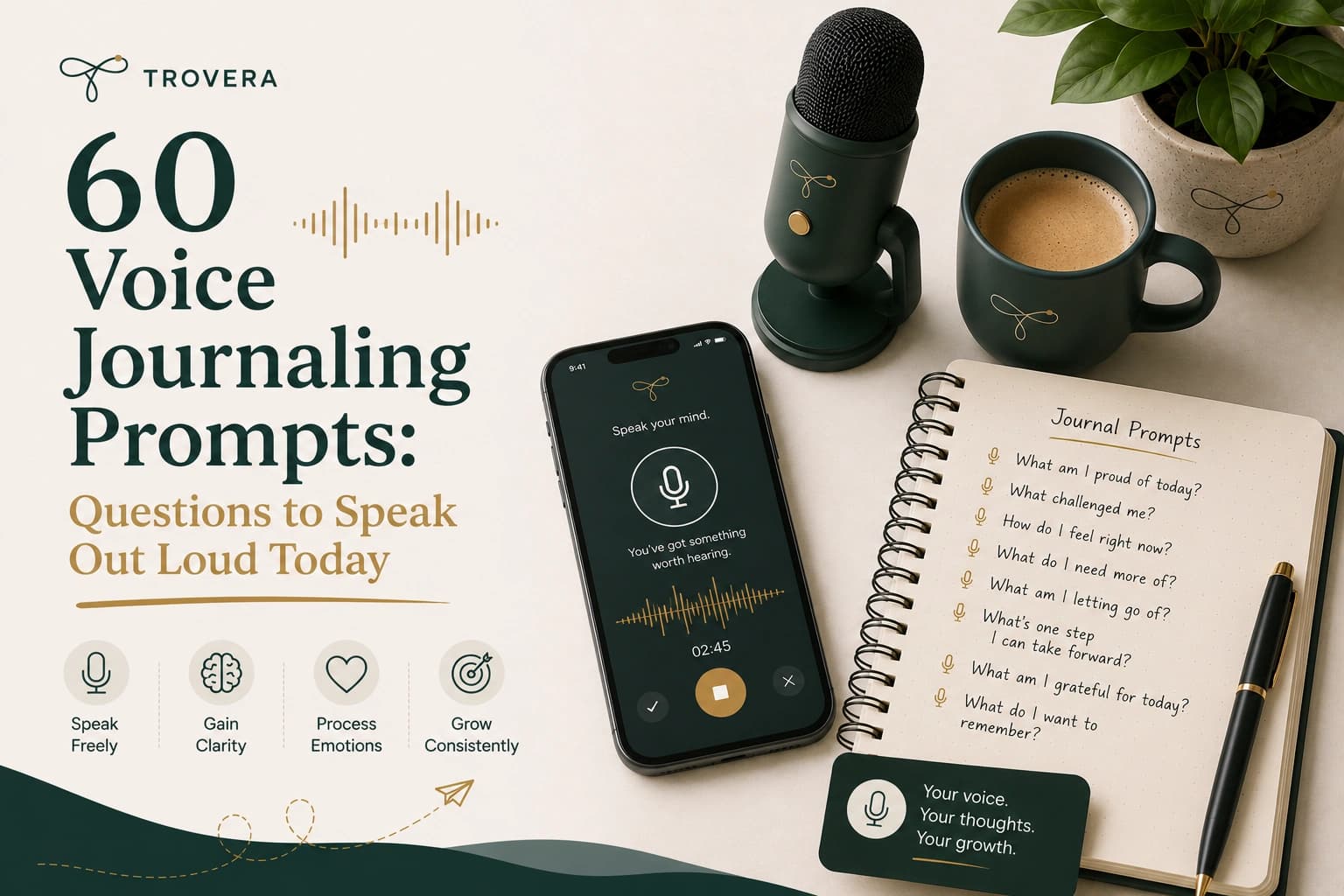
Most journaling prompts are designed for writing. They assume you have a blank page in front of you, time to think, and the inclination to craft sentences.
Voice journaling is different. When you press record and speak, you need a prompt that works at the speed of conversation — something that gets you talking immediately, captures what actually matters, and works in sixty seconds on a difficult day.
The 60 prompts in this post are built specifically for voice. Each one is conversational, open enough to generate a genuine response, and structured to activate the psychological mechanism that makes journaling work — affective labeling, the act of putting real feelings into words.
They are organized by what you are actually trying to do right now, not by abstract life categories.
Quick Summary
- 60 prompts specifically engineered for speaking out loud, not writing
- Organized by situation: daily check-in, anxiety, work stress, relationships, self-discovery, gratitude, and weekly review
- Each prompt is designed to activate affective labeling — the neuroscience behind why journaling reduces stress
- Every prompt works inside a 60-second entry
- Trovera includes 62 built-in prompts — these complement and extend that library
Why Prompts Matter More for Voice Than for Writing
When you write in a journal, a blank page is uncomfortable but manageable. Your hand moves slowly enough that thoughts form as you write. The medium itself slows you down in a useful way.
When you press record on a voice journal, the silence is immediate. You have a microphone and thirty seconds before the moment starts to feel awkward. Without a prompt, most people say something like "um, today was okay I guess" and stop.
A good voice journaling prompt does three things:
- It gets you talking within the first five seconds. The prompt gives you a direction so you are not standing at a crossroads deciding which part of your day to cover.
- It points you toward feeling, not just fact. "What happened today" produces a summary. "What surprised you about how you felt today" produces self-awareness. The difference is the mechanism — affective labeling, the act of naming an emotion, is what produces the neurological benefit.
- It is short enough to answer completely in sixty seconds. A prompt like "reflect on everything you want to achieve in the next five years" cannot be answered honestly in sixty seconds. A prompt like "what is one thing you want to be different a year from now" can be.
Every prompt in this list meets all three criteria.
Category 1: Daily Check-In Prompts
Use when: Opening your daily 60-second entry, no particular mood or topic
These are your default prompts — the ones that work on an ordinary Tuesday when nothing dramatic happened and you still want to show up for the habit.
The science: Regular emotional monitoring builds what psychologists call emotional granularity — the ability to distinguish between similar emotional states with more precision. People who can tell the difference between anxious and frustrated, or between satisfied and genuinely happy, regulate their emotions more effectively. These prompts build that skill over time.
- What is taking up the most space in my head right now?
- How does my body feel today — and what might that be telling me?
- What is one thing that happened today that I want to remember?
- What emotion best describes my day, and when did I feel it most strongly?
- What did I do today that felt like the real me?
- What did I avoid today that I know I need to face?
- What was the best sixty seconds of today?
- If I had to describe today's mood as weather, what would it be?
- What am I most looking forward to tomorrow?
- What do I want to let go of before I sleep tonight?
Category 2: Anxiety and Stress Prompts
Use when: Anxiety is elevated, something stressful happened, or you are carrying worry into the evening
Anxiety-specific prompts are structured differently from general reflection prompts. They are designed to externalize the specific worry — getting it out of your head and into language — without triggering the rumination trap of restating the same anxiety in circles.
The science: Affective labeling (naming what you are anxious about) reduces amygdala activity and activates the prefrontal cortex. For a full guide to using voice journaling specifically for anxiety, see Voice Journaling for Anxiety. The key is moving toward the specific emotion, not just the triggering situation. These prompts push toward the feeling under the stress.
- What specifically am I afraid will happen — and how likely is that, honestly?
- What part of this situation is actually within my control?
- What would I tell my best friend if they were feeling exactly this?
- What does this anxiety feel like physically in my body right now?
- What is the smallest step I could take today toward the thing I am avoiding?
- What has worried me before that turned out to be fine?
- Who or what made me feel safer today, even briefly?
- What is the story I am telling myself about this situation — and is it accurate?
- What would tomorrow look like if this thing I am worried about resolved itself?
- What do I need right now that I have not asked for?
Category 3: Work and Productivity Prompts
Use when: Processing a difficult work day, reflecting on a decision, or trying to understand why something drained or energized you
Work is where most adult stress originates and where the gap between what we think happened and what actually happened is often largest. These prompts are designed to close that gap in sixty seconds.
The science: Research on task transitions shows that brief verbal reflection between tasks reduces attention residue — the cognitive residue from a previous task that degrades performance on the next one. Speaking about what happened at work before transitioning to personal time is one of the most effective ways to actually switch off.
- What was the moment today when I felt most competent?
- What drained my energy today and why?
- What gave me energy today, even briefly?
- What decision did I make today that I want to think about more?
- What did I say yes to today that I should have said no to?
- What did I learn today — about the work, or about myself at work?
- What am I most proud of from this work week?
- What is one thing my future self would thank me for doing today?
- What conversation do I need to have that I have been putting off?
- How do I want to show up differently at work tomorrow?
Category 4: Relationship Prompts
Use when: After a meaningful conversation, conflict, or moment of connection with someone important to you
Relationships are the source of both the deepest satisfaction and the most persistent low-grade stress in most people's lives. Voice journaling about relationships works because speaking activates the same processing pathways as actually talking to someone — without requiring the other person to be available, or to hear something you are not ready to say.
The science: Speaking about interpersonal conflict reduces rumination more effectively than writing about it, because the conversational format mirrors the social nature of the conflict itself. These prompts are structured to move toward understanding rather than blame.
- What did someone do or say today that stayed with me, and why?
- How did I show up for the people I care about today?
- What do I wish I had said — or not said — in a conversation today?
- Who in my life am I taking for granted right now?
- What does the person I am in conflict with need from me that I have not given?
- Who made me feel genuinely seen today?
- What relationship in my life deserves more of my attention?
- What boundary do I need to set — and what is stopping me?
- How have I changed in this relationship over the past year?
- What do I appreciate about someone in my life that I have not told them?
Category 5: Self-Discovery Prompts
Use when: You want to go deeper, understand a pattern, or explore something about yourself you have been avoiding
Self-discovery prompts are for the days when you have a little more time or a little more curiosity. They are not designed for the average Tuesday night — they are designed for the Sunday morning when you want to understand something about yourself that keeps showing up.
The science: Journaling that moves toward insight and narrative coherence — making meaning from experiences rather than just recounting them — produces deeper and more lasting psychological benefit than simple expressive writing. These prompts push toward the meaning layer.
- What is something I believe about myself that might not actually be true?
- What am I consistently drawn to — and what does that tell me about my values?
- What version of myself am I most afraid of becoming?
- What would I do differently if I knew I could not fail?
- What has changed about me in the last year that I have not fully acknowledged?
- What am I most proud of that I never talk about?
- What do I envy in other people — and what does that reveal about what I actually want?
- What part of my life feels most authentic right now?
- What am I tolerating that I should be changing?
- If the person I most admire could see my life right now, what would they notice?
Category 6: Gratitude Prompts
Use when: You want to end the day on a grounded note, or when anxiety or negativity has dominated your headspace
Gratitude journaling has robust research behind it. Studies by Martin Seligman and Robert Emmons consistently show that writing three specific things you are grateful for daily, for two weeks, produces measurable increases in wellbeing that persist beyond the two-week period.
The critical word is specific. "I am grateful for my family" produces almost no psychological benefit. "I am grateful for the specific moment when my daughter laughed at something I said at dinner" activates the gratitude response properly. These prompts push toward specificity.
- What is one specific moment from today that I am genuinely glad happened?
- Who did something for me recently that I have not properly acknowledged?
- What about my ordinary daily life would I miss if it were gone?
- What challenge from the past year am I now grateful for — and why?
- What is working in my life right now that I forget to notice?
Category 7: Weekly Review Prompts
Use when: End of the week, reviewing your daily entries, or doing a Sunday reset
The weekly review is where the pattern recognition happens. Individual entries capture moments. The weekly review extracts meaning from those moments across five to seven days of data.
The science: Pattern recognition across multiple data points over time produces insight that no single journaling session can generate. These prompts are designed to make the weekly review process as fast and valuable as possible — doable in five minutes of voice journaling.
- What theme kept appearing in my entries this week that I want to pay attention to?
- What anxious prediction did I make this week that did not come true?
- What coping strategy worked this week, even partially?
- What did this week teach me about what I need more of — and what I need less of?
- What do I want to do differently next week based on what I noticed this week?
How to Use These Prompts With Trovera
Trovera includes 62 built-in prompts that rotate through its daily journaling interface. These 60 prompts are designed to complement that library — use them when you want a specific type of reflection that the day's prompt does not cover.
The most effective system:
- Use the Trovera daily prompt as your default. It removes the decision of what to say before you press record.
- Keep this page bookmarked. When you open Trovera and want to go off-prompt — because something specific happened today that the built-in prompt does not address — come here, pick the category that fits, and use that prompt instead.
- Do the weekly review every Sunday using the Category 7 prompts. Five voice entries, each sixty seconds, reviewing the week's patterns. This is the highest-value journaling practice available for the time invested.
How to Get the Most Out of Any Voice Prompt
A few principles that apply across all 60 prompts:
- Answer the prompt within the first five seconds. Do not explain it to yourself, rephrase it, or decide whether it applies to you. Just start answering. The most honest responses come before your brain has time to edit.
- Name a specific emotion, not just a situation. "Today was stressful" is a situation. "I felt a specific kind of helplessness today when the meeting went wrong and I could not redirect it" is an emotion. The emotional content is what activates the mechanism.
- Do not stop when the sixty seconds ends. The limit is a floor, not a ceiling. If you are in the middle of something real when the timer stops, keep going. The sixty-second constraint is designed to lower the barrier to starting, not to limit what you say.
- Speak as if no one will ever hear this. The quality of a voice journal entry is entirely determined by honesty. Everything that makes journaling valuable — the insight, the pattern recognition, the emotional relief — depends on you saying what is actually true rather than what sounds reasonable.
Key Takeaways
- Good voice prompts get you talking within five seconds, point toward feeling not fact, and are answerable in sixty seconds
- Organize your prompt use by what you are actually trying to do — not by abstract category
- Daily check-in prompts build emotional granularity over time — the ability to name feelings with precision
- Anxiety prompts are structured to externalize worry without triggering rumination
- Gratitude prompts only work when they are specific — general gratitude produces almost no psychological benefit
- The weekly review is the highest-value practice for the time invested
- Trovera's 62 built-in prompts plus this library gives you over 120 prompts — enough variety to never repeat yourself for months
FAQ
What makes a good voice journaling prompt? A good voice journaling prompt does three things: it gets you talking within five seconds, it points you toward a feeling rather than just a factual recap, and it is specific enough to answer completely in sixty seconds. Generic prompts like "reflect on your day" fail on all three criteria.
How many prompts do I actually need? Most people rotate through a small set of prompts naturally — the same five to ten questions that consistently produce useful reflection. This list of sixty gives you enough variety that you will not exhaust any category for months, while the weekly review prompts give structure to the end of each week.
Should I use the same prompt every day? You can, and some people find a consistent anchor prompt valuable — the same opening question every day creates a baseline for comparison. But variety across the seven categories in this list builds different reflection skills. Daily check-in prompts build emotional awareness. Self-discovery prompts build self-knowledge. Relationship prompts build interpersonal clarity. Use a mix.
What if I do not know how to answer a prompt? Start with "I am not sure, but..." and keep talking. The uncertainty itself is useful content. Often the most honest entries begin with not knowing what to say and end with something surprising. The prompt is a starting point, not a test.
Are these prompts suitable for anxiety? Category 2 in this list is specifically designed for anxiety and is structured to avoid the rumination trap — the pattern of cycling through anxious thoughts without reaching insight. For clinical anxiety, use these prompts as a supplement to professional treatment, not a replacement.
How do I use these prompts in Trovera? Open Trovera, press record, and use any prompt from this list instead of the built-in daily prompt. The Category 7 prompts (weekly review) work especially well as a Sunday practice — five sixty-second entries reviewing the week's patterns.