In 2007, a research team at UCLA put people in fMRI scanners and showed them photographs of human faces expressing intense emotions — fear, anger, sadness. In one condition, participants simply observed the faces. In another, they selected a word describing the emotion they saw.
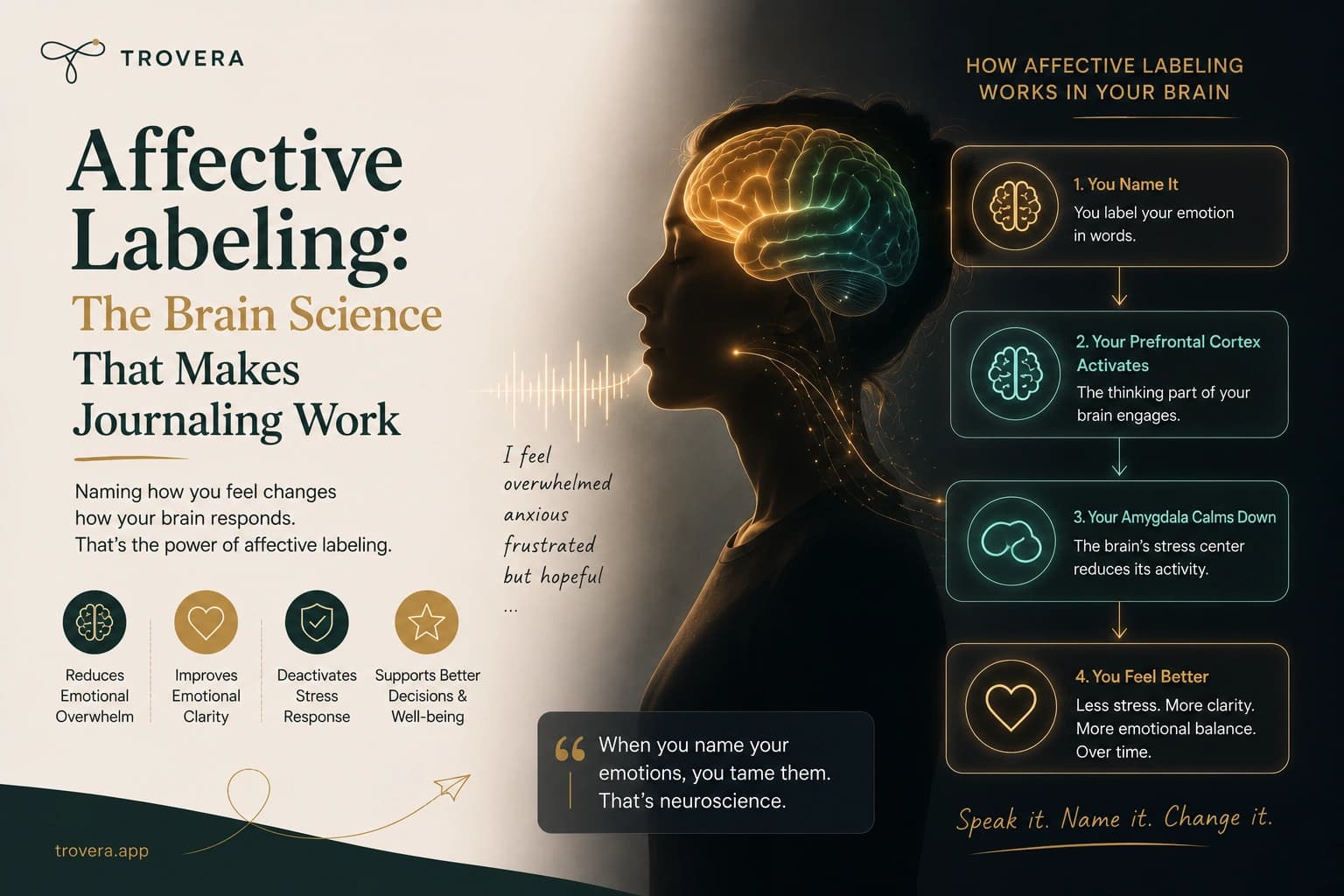
The brain scans showed something unexpected. When participants named the emotion, activity in the amygdala — the brain's threat-detection and fear center — decreased significantly. A different region activated instead: the right ventrolateral prefrontal cortex, associated with cognitive control and the symbolic processing of emotional information.
The lead researcher, Matthew Lieberman, described it plainly: "When you put feelings into words, you're activating this prefrontal region and seeing a reduced response in the amygdala. In the same way you hit the brake when you're driving when you see a yellow light, when you put feelings into words, you seem to be hitting the brakes on your emotional responses."
That finding — replicated across dozens of studies in the years since — is the core neuroscience behind why journaling works. It is called affective labeling, and understanding it precisely changes how you practice journaling and what you expect from it.
Quick summary:
- Affective labeling is the act of putting emotions into words — written or spoken — and it produces measurable neurological changes visible on fMRI scans
- Lieberman's 2007 study in Psychological Science showed that naming an emotion reduces amygdala activation and increases right ventrolateral prefrontal cortex activity
- A 2018 meta-analysis by Torre and Lieberman confirmed the effect holds across experiential, autonomic, neural, and behavioral measures
- Affective labeling is a form of implicit emotion regulation — it works without requiring conscious effort or deliberate coping strategy
- The key distinction from rumination: labeling is brief and precise. Rumination is repetitive and circular. They produce opposite neurological effects
- Emotional granularity — the ability to name emotions with increasing precision — is the long-term training benefit of consistent affective labeling practice
- Voice journaling activates the same mechanism as written journaling — the modality does not matter, the naming does
The Original Study: What the UCLA Research Actually Found
The foundational research on affective labeling comes from Matthew Lieberman and his colleagues at the University of California, Los Angeles. Their study, published in Psychological Science in 2007 — "Putting Feelings Into Words: Affect Labeling Disrupts Amygdala Activity in Response to Affective Stimuli" — is one of the most cited papers in social cognitive neuroscience.
The methodology was simple and elegant. Participants viewed photographs of human faces expressing strong emotional states while lying in an fMRI scanner measuring real-time brain activity. In the affect labeling condition, they selected an emotional word that matched the face. In the control condition, they selected a gender-appropriate name for the face.
The results were clear. Affect labeling, relative to other forms of encoding, diminished the response of the amygdala and other limbic regions to negative emotional images. Additionally, affect labeling produced increased activity in a single brain region — right ventrolateral prefrontal cortex. RVLPFC and amygdala activity during affect labeling were inversely correlated.
In plain English: naming the emotion activated the thinking part of the brain and quieted the alarm part of the brain simultaneously. The relationship between the two regions was inverse — when one went up, the other went down. Emotion regulation through language was not a conscious strategy the participants were deploying. It was a neurological effect produced automatically by the act of putting a feeling into words.
The amygdala reduction was not subtle. When participants named the emotion, amygdala activation decreased significantly — by up to 30% compared to simple observation. A 30% reduction in the brain's fear center activation, produced by a single word. Not a medication, not a therapy protocol, not a breathing technique. A word.
Why This Matters: The Amygdala-Prefrontal Circuit
To understand why affective labeling produces this effect, you need a basic map of two key brain regions and their relationship.
The amygdala is an almond-shaped structure in the temporal lobe that acts as the brain's alarm system. When it perceives a threat — real, imagined, or symbolic — it triggers the fight-or-flight cascade: cortisol and adrenaline flood the body, heart rate increases, muscles tense, and the prefrontal cortex gets partially taken offline. The amygdala evolved to respond to physical threats. It does not distinguish reliably between a predator and an angry email.
In people with anxiety, the amygdala is essentially miscalibrated — it fires at perceived threats that are not actually dangerous. The prefrontal cortex, which normally evaluates and regulates these responses, cannot fully override the amygdala's false alarms because the amygdala's activation suppresses prefrontal function.
The right ventrolateral prefrontal cortex is the region that activates during affect labeling. It is located behind the forehead and eyes and is associated with cognitive control, symbolic processing of emotional information, and top-down inhibitory processes — meaning it has the capacity to send signals that dampen amygdala activity.
The simple act of translating an emotion into words activates the prefrontal cortex and reduces amygdala activation. You are not suppressing the emotion. You are recruiting one brain system to moderate another.
This distinction — moderating rather than suppressing — is important. Emotional suppression (pushing a feeling down without acknowledging it) is associated with increased physiological arousal and worse long-term emotional outcomes. Affective labeling produces the opposite: it acknowledges the emotion by naming it, which activates the prefrontal circuit, which then moderates the amygdala's response. The emotion is not stuffed. It is processed.
The 2018 Meta-Analysis: Confirming the Effect Across Two Decades
Lieberman's 2007 study was not an isolated finding. In 2018, Jared Torre and Matthew Lieberman published a comprehensive review — "Putting Feelings Into Words: Affect Labeling as Implicit Emotion Regulation" — in Emotion Review, analyzing more than twenty years of affect labeling research.
The meta-analysis confirmed the effect across four domains:
Experiential: People report feeling less intense emotions after labeling them. The subjective experience of the emotion weakens.
Autonomic: Physiological measures of emotional arousal — skin conductance response, heart rate — decrease following affect labeling. The body calms.
Neural: Amygdala activation decreases. Prefrontal cortex activation increases. The inverse relationship holds across multiple experimental paradigms.
Behavioral: People make less reactive, more measured decisions after labeling their emotional state. The regulatory effect translates to action.
The phrase "implicit emotion regulation" is the key finding. Explicit emotion regulation — consciously trying to reappraise a situation, deliberately calming yourself, using a coping strategy — requires cognitive effort and works best when the prefrontal cortex is functioning well. Affect labeling is implicit. It works without deliberate effort. You name the emotion, and the brain does the rest automatically.
This is why even a brief, unsophisticated journal entry — "I feel frustrated and I'm not entirely sure why" — produces neurological benefit. The precision of the label matters less than the act of labeling. The brain's regulatory circuit activates at the moment the emotion is given language, regardless of the eloquence of the expression.
The Critical Distinction: Affective Labeling vs Rumination
This distinction is the most practically important thing to understand about affective labeling — and it is the one most often missed or glossed over.
Affective labeling and rumination both involve thinking about emotions. They produce opposite neurological effects.
Affective labeling is brief and specific. It names what the emotion is and moves forward. "I am frustrated because my boundary was crossed." One sentence. The emotion has been given language. The neurological mechanism activates. The session ends or continues with a different focus.
Rumination is repetitive and circular. It cycles through the same emotional content without naming it precisely and without moving toward insight or resolution. "Why do I always feel this way? What is wrong with me? I should not feel like this but I do. Why can't I just handle things better?" The thought loop continues without landing anywhere.
The neurological difference is significant. Affective labeling activates the prefrontal cortex and dampens the amygdala — the regulatory direction. Rumination keeps the amygdala continuously activated, maintains the stress response, and is associated with worse outcomes for anxiety and depression over time.
This is why the structure of journaling matters. An open-ended session with no clear direction — "write about how you feel for twenty minutes" — can easily become rumination dressed as reflection. The same content, organized differently, produces opposite neurological effects.
The practical rules for keeping journaling in affective labeling rather than rumination:
- Name the specific emotion, not just the triggering situation. "My boss ignored my idea in the meeting" is a situation. "I felt dismissed and embarrassed when my boss ignored my idea in the meeting" is affective labeling.
- Keep the naming brief. One to three sentences is enough. The mechanism activates at the moment of naming, not through extended elaboration.
- Move toward some form of forward motion or perspective. "I do not know yet what to do about this, but I know I felt dismissed" is sufficient movement.
If your sessions consistently leave you feeling more activated rather than less, you are likely in the rumination pattern. Restructure the content rather than continuing in the same form.
Emotional Granularity: The Long-Term Training Effect
Affective labeling in a single session produces an immediate neurological effect. Practiced consistently over weeks and months, it produces something more lasting — what researchers call emotional granularity.
Emotional granularity is the ability to make fine-grained distinctions between similar emotional states. A person with low emotional granularity experiences everything negative as "bad" or "stressed." A person with high emotional granularity distinguishes between anxious and nervous and apprehensive, between frustrated and resentful and disappointed, between sad and grieving and melancholic.
The practical significance of emotional granularity is substantial. People with higher granularity regulate their emotions more effectively — because they have more precise information about what they are experiencing. If you know you are feeling resentful rather than just angry, you know to address a boundary issue. If you know you are feeling apprehensive rather than just stressed, you know the issue is anticipatory rather than present-moment.
Daily affective labeling builds emotional granularity over time. Each time you search for the more precise word — not "sad" but "disappointed," not "anxious" but "dreading" — you are training the brain's emotional discrimination system. The vocabulary becomes more available. The distinctions become more automatic. Over months, this produces measurable improvements in emotional regulation capacity that extend far beyond the journaling session itself.
This is the compounding effect of consistent affective labeling practice. The single session produces an immediate amygdala-dampening effect. The daily practice over months produces a more granular, more regulated emotional processing system.
Does Spoken Labeling Work the Same as Written Labeling?
The original Lieberman research used visual stimuli and written or selected labels. A reasonable question is whether speaking an emotion produces the same neurological effect as writing it.
The research answer is yes — with an important clarification about mechanism. The critical variable is the linguistic act of assigning a word to an emotional state, not the modality through which that word is expressed. The prefrontal-amygdala regulatory circuit is activated by the language processing involved in naming, regardless of whether the naming is written, typed, or spoken.
Affective labeling reduces physiological and neural indicators of emotional reactivity across different experimental paradigms. The consistency across paradigms suggests the effect is robust to variation in how the labeling is performed.
For voice journaling specifically, there is an argument that spoken labeling may engage the mechanism more fully than written labeling in some circumstances. See Why Voice Journaling Is More Effective Than Writing for the full case. Speaking activates Broca's area and other language production regions simultaneously with the labeling process. The auditory feedback loop — hearing your own voice name the emotion — creates an additional channel of external processing. The emotion becomes something you expressed and heard, not just thought.
This is why speaking "I feel overwhelmed and I cannot identify exactly why" has the same regulatory quality as writing those same words.
What This Means for 60-Second Voice Journaling
Affective labeling research provides the neurological foundation for why brief voice journaling works — and why it works specifically in the sixty-second format Trovera is built around.
The mechanism activates at the moment of naming, not through extended elaboration. This means the first sixty seconds of a genuine, honest entry — where you name what you are actually feeling rather than describing what happened — produces the full regulatory effect. The next four minutes of elaboration adds context and may add insight, but the core neurological shift happens early.
The sixty-second format forces you to lead with what matters. When time is limited, you say the most important thing first — which is almost always the emotional content. The constraint prevents the warm-up period of journaling where you describe events before arriving at feelings. You arrive at the feelings immediately because there is no time for the preamble.
The AI reflection in Trovera is designed around this same principle. It responds specifically to the emotional content of what you said — asking about the feeling underneath the situation, or observing a pattern in how you described your experience. The reflection extends the affective labeling process: the AI names something in what you said, and your brain processes that naming the same way it processes your own labeling.
Every sixty-second entry is a neurobiological intervention. Not a dramatic one — the amygdala dampening is partial, not complete. The emotion does not disappear. But the regulatory circuit activates, the intensity reduces, and over time, the practice builds the emotional granularity that makes the regulation increasingly automatic.
That is the science. That is what happens when you press record and speak truthfully for sixty seconds. You are not writing in a diary. You are performing a neurological act that has been documented in fMRI scanners, replicated across twenty years of research, and confirmed across experiential, autonomic, neural, and behavioral measures.
Name it. Every day. Sixty seconds.
Affective labeling applied: Voice Journaling for Anxiety · Voice Journaling for ADHD · Voice Journaling for Burnout
Download Trovera Free on Android →
FAQ
What is affective labeling?
Affective labeling is the act of putting an emotional experience into words — written, typed, or spoken. Neuroscience research shows that naming an emotion activates the right ventrolateral prefrontal cortex and simultaneously reduces activity in the amygdala, the brain's threat-detection center. This produces a measurable reduction in emotional intensity. The process is sometimes described colloquially as "name it to tame it."
Who discovered affective labeling?
The formal neuroscience of affective labeling was established primarily through the work of Matthew Lieberman and his colleagues at UCLA. Their seminal study, published in Psychological Science in 2007, used fMRI to demonstrate that naming emotions reduces amygdala activation and increases prefrontal cortex activity. A 2018 meta-analysis by Torre and Lieberman consolidated more than two decades of subsequent research confirming the effect.
How is affective labeling different from rumination?
Affective labeling is brief and specific — it names an emotion once and moves forward. Rumination is repetitive and circular — it cycles through the same emotional content without precise naming or forward motion. They produce opposite neurological effects. Affective labeling activates the prefrontal cortex and dampens the amygdala. Rumination keeps the amygdala continuously activated and is associated with worse anxiety and depression outcomes over time.
Does affective labeling work when spoken rather than written?
Yes. The regulatory mechanism is activated by the linguistic act of naming the emotion, not by the modality through which it is expressed. The prefrontal-amygdala circuit responds to language processing regardless of whether the naming happens through writing, typing, or speaking. Voice journaling produces the same neurological effect as written journaling for the core affective labeling mechanism.
What is emotional granularity and how does journaling build it?
Emotional granularity is the ability to distinguish between similar emotional states with increasing precision — knowing the difference between anxious and apprehensive, between frustrated and resentful. Research shows higher emotional granularity is associated with better emotion regulation and mental health outcomes. Daily affective labeling practice builds emotional granularity over time by repeatedly training the brain to make finer distinctions between emotional states, expanding the vocabulary and making the distinctions increasingly automatic.
How much labeling is needed to produce the neurological effect?
The effect activates at the moment of naming, not through extended elaboration. One honest sentence that names the specific emotion produces the regulatory response. This is why brief journaling — even sixty seconds of speaking — produces genuine neurological benefit. The first sixty seconds of an honest entry contain the core mechanism. Additional time adds context and may add insight, but the fundamental regulatory shift happens at the moment of naming.
Trovera is a 60-second voice journaling app. Every entry is an act of affective labeling. Free on Android. Your data stays on your device.