If you have ADHD, you have probably tried journaling. You bought a notebook — maybe a beautiful one. You wrote in it for three days. It has been sitting on your shelf ever since.
This is not a discipline problem. It is not a motivation problem. It is not evidence that journaling is not for you.
It is evidence that traditional journaling is badly designed for how ADHD brains actually work. And there is a format that is not.
This post explains why writing fails ADHD brains specifically, what the neuroscience says about voice as an alternative, and how to build a daily journaling habit using your voice that survives the ADHD brain's particular relationship with novelty, consistency, and delayed reward.
Quick summary:
- ADHD is fundamentally a deficit in executive function, not attention — and traditional journaling requires the exact executive functions ADHD impairs most
- The blank page is an executive function nightmare: it demands self-generated structure, sustained initiation, and working memory all at once
- Russell Barkley's core recommendation for ADHD management is externalization — moving information outside your head to reduce working memory load. Voice journaling is externalization.
- Speaking runs at 130–150 words per minute; handwriting at 25 WPM. For someone with a smaller working memory buffer, that speed difference is the difference between capturing the thought and losing it
- The 60-second constraint specifically solves ADHD's initiation problem — a defined endpoint removes the decision fatigue that causes avoidance
- Rejection Sensitive Dysphoria (RSD) episodes are one of the highest-value use cases for immediate voice journaling
- This post includes 15 voice prompts specifically designed for ADHD brains
Why ADHD Makes Traditional Journaling Almost Impossible
To understand why voice journaling works for ADHD, you first need to understand what ADHD actually is — because the popular explanation gets it wrong in a way that matters.
ADHD is not primarily an attention problem. Dr. Russell Barkley — the most cited ADHD researcher alive — describes ADHD as fundamentally a deficit in executive function. The practical result: people with ADHD often know what they should do. They cannot reliably do it in the moment.
Executive function is the collection of cognitive processes that manage goal-directed behavior: working memory, task initiation, impulse control, emotional regulation, time perception, and the ability to begin a task without external structure or immediate reward.
Traditional journaling requires all of these simultaneously. It asks you to:
- Initiate a self-directed task with no external prompt and no immediate reward
- Generate your own structure from a blank page with no guidance on where to start or when to stop
- Hold a thought in working memory long enough to translate it from your head onto paper
- Sustain attention through the slow process of handwriting or typing
- Repeat this reliably every day, with only the abstract long-term benefit of "self-knowledge" as motivation
A blank page has no structure, no prompts, no clear stopping point, and no obvious right way to fill it. For ADHD brains, that kind of unstructured, self-directed task is exactly the type of task executive function struggles most with — not because you lack discipline, but because initiation, sustained attention, and organization of ideas are the very skills that are wired differently.
Every element of traditional journaling maps directly onto an executive function that ADHD impairs. The format was designed for neurotypical brains. It fails ADHD brains reliably and predictably — not randomly, not because of individual weakness, but because of a structural mismatch between the demands of the task and the neurological profile of the person attempting it.
The Working Memory Problem: Why Your Thoughts Disappear Before You Write Them
Working memory is your brain's temporary holding space — the cognitive scratchpad where you keep information active while you use it. In ADHD, working memory capacity is reduced. This is one of the most well-replicated findings in ADHD neuroscience.
In adults with ADHD, heightened inattention is associated with poorer performance on working memory tasks — the practical result is that thoughts are held less reliably, lost more easily, and harder to reconstruct once gone.
Here is what this means for journaling in practice. You have a thought worth capturing. Something happened today that you want to process — a difficult conversation, an anxiety you want to examine, an insight about a pattern in your life. You decide to journal. You find your notebook. You find a pen. You open to the right page. You decide what to write. You begin to form the first sentence.
By the time you are ready to write, the thought is gone. Or it is a fragment of what it was. The emotional content — the specific texture of what you were feeling — has faded to a summary.
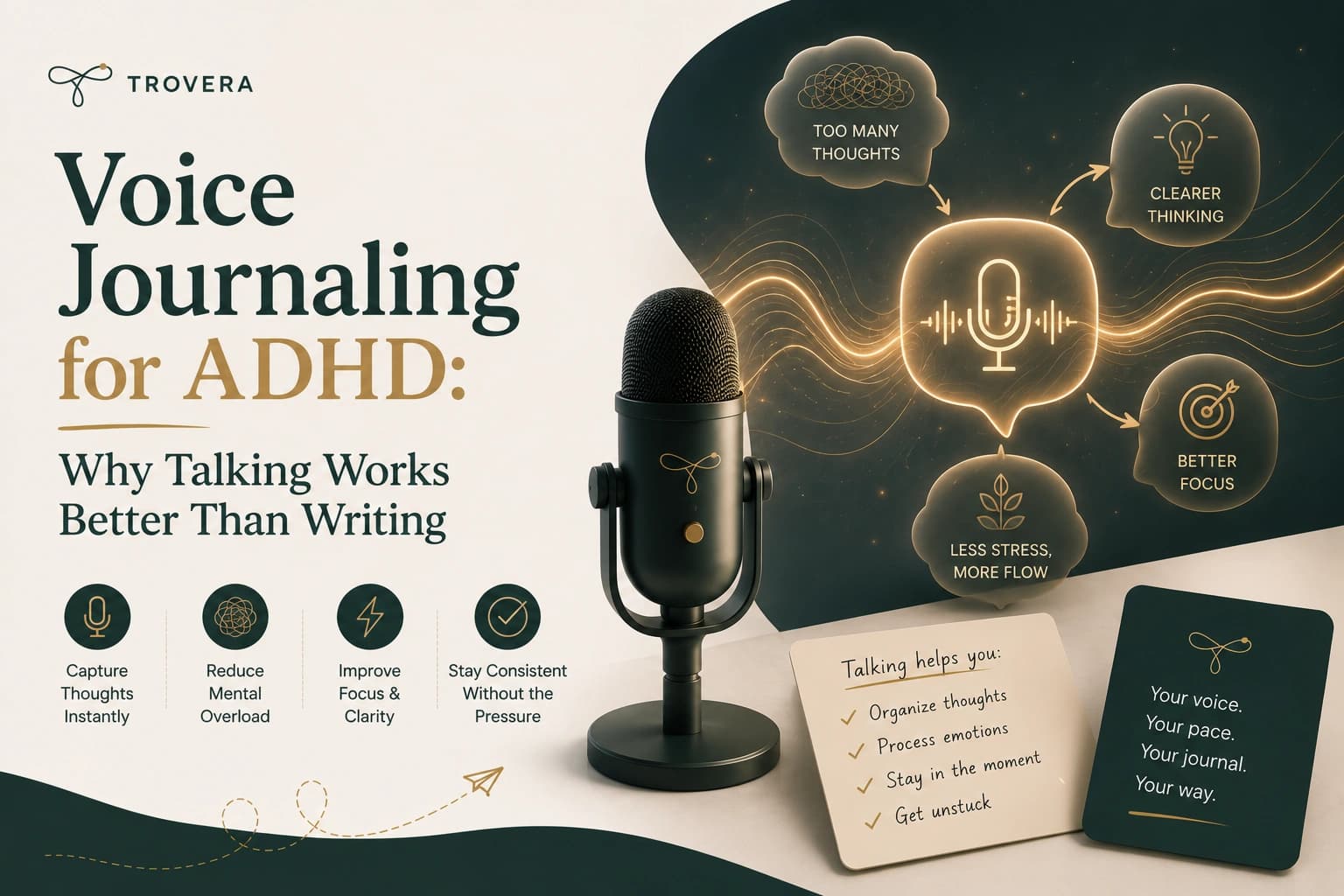
Handwriting runs at about 25 words per minute. Speaking runs at 150. That is a 6x speed advantage. For someone whose working memory buffer is smaller than average, that speed difference is the difference between capturing the thought and losing it.
Voice journaling closes this gap almost entirely. You open an app and press one button. You speak at the speed you are actually thinking. The thought is captured before working memory has time to drop it.
Russell Barkley's Externalization Framework — And Why Voice Fits It Perfectly
The most practical framework for understanding ADHD management comes from Russell Barkley, whose decades of research produced a clear principle: the solution to ADHD is externalization.
Barkley writes that ADHD is not a knowledge problem — people with ADHD usually know what they should do. It is a performance problem — they cannot reliably do it in the moment. The solution: do not rely on internal systems. Put information outside your head. Lists, reminders, timers, sticky notes — anything that offloads working memory to the environment.
Voice journaling is externalization applied to emotional and cognitive processing. When you speak your thoughts into a recording, you are moving them from the unreliable internal storage of working memory into a permanent external record. The thought is no longer held in your head — it is held by the app. You can process it, return to it, see patterns across it, and build self-knowledge from it without relying on a working memory system that ADHD makes unreliable.
This is why voice journaling works structurally for ADHD in a way that written journaling does not. Written journaling asks you to translate your thoughts through the bottleneck of writing speed, which is slower than working memory can hold them. Voice journaling captures them at the speed they exist.
The Initiation Problem: Why You Cannot Just Start
Task initiation is one of the most practically disabling aspects of ADHD executive dysfunction. It is not laziness. It is not avoidance. It is a neurological difficulty beginning a self-directed task without external structure or immediate reward.
When cognitive demands increase, people with ADHD show disproportionate performance declines compared to neurotypical individuals. Working memory gets overwhelmed faster — and when task initiation is required alongside everything else the day is already demanding, the task simply does not begin.
Traditional journaling has a high initiation cost. You must decide to do it, find the materials, open to the right page, decide what to write about, and then begin — all without external prompting, all in a private activity with no immediate visible reward.
Voice journaling has a lower initiation cost. But it still has one. Opening an app, pressing record, and deciding what to say still requires decision and initiation.
This is where the 60-second constraint in Trovera specifically addresses the ADHD initiation problem in a way most apps do not.
The blank page asks you to generate your own structure from nothing — and that is truly one of the more demanding asks you can make of an ADHD brain. Trovera replaces the blank page with a specific prompt and a defined time limit. You are not deciding what to say or for how long. You are answering a question for sixty seconds. The cognitive load of initiation drops from "open-ended self-directed reflection" to "answer this specific question for one minute."
The defined endpoint is the key insight. ADHD brains struggle particularly with open-ended tasks — because "how long will this take?" and "when am I done?" are executive function questions that ADHD makes hard to answer. A sixty-second timer eliminates both. You know exactly how long it will take. You know exactly when you are done. That certainty removes two of the biggest executive function barriers to starting.
Rejection Sensitive Dysphoria: The Hidden ADHD Use Case Nobody Covers
Rejection Sensitive Dysphoria — RSD — is one of the most impairing and least discussed aspects of ADHD in adults. It refers to extreme emotional sensitivity to perceived criticism, rejection, or failure. The emotional response is immediate, overwhelming, and disproportionate to the triggering event.
An offhand comment from a colleague feels like a devastating personal attack. A friend's short reply to a message feels like evidence of rejection. A mistake at work triggers an emotional response that seems — even to the person experiencing it — out of proportion to what happened.
RSD episodes pass. They are time-limited. But while they are happening, the emotional charge is real and significant. And the period immediately after an RSD episode — when the acute intensity has passed but the emotional residue remains — is one of the highest-value moments for voice journaling.
Affective labeling — naming what you felt and why — works specifically on the neural mechanism that RSD activates. The amygdala's threat response quiets when the prefrontal cortex engages through language. Speaking the experience — "I felt humiliated when he said that in the meeting, and I know intellectually it was not meant that way, but my nervous system registered it as rejection" — does neurological work that silence does not.
Voice journaling after an RSD episode serves two purposes. It processes the immediate emotional content, reducing its charge through externalization and affective labeling. And over time, it creates a record that makes the pattern visible — you can see how often RSD triggers, what circumstances produce the strongest responses, and what helps you recover fastest. That pattern recognition is therapeutic in itself.
The Streak Shame Spiral: Why Every ADHD Journaling Habit Has Died Here
There is a specific failure pattern that destroys ADHD journaling habits that nobody warns you about in advance.
It goes like this. You start a journaling habit. You do it for a few days — maybe a week. You miss a day. Then you feel shame about missing a day. The shame creates avoidance. You do not journal the next day because opening the app reminds you that you missed yesterday. The avoidance creates more shame. The habit is dead within two weeks.
This is the streak shame spiral. It is not unique to journaling — it destroys exercise habits, meditation habits, and medication habits in ADHD adults with similar regularity. The mechanism is consistent: a missed day triggers negative self-evaluation, which triggers avoidance of the reminder, which ends the habit.
The solution is architectural, not motivational. You need a journaling system that is explicitly designed to survive missed days without triggering shame.
Trovera does not punish missed days. A gap in your entries is simply a gap — not a broken streak, not a judgment, not a prompt to feel bad about consistency. The entries that exist are still there. The patterns that accumulated are still real. You pick up where you left off.
The research supports this framing directly. Phillippa Lally's habit formation research at UCL found that missing a single day did not significantly affect long-term habit formation. What matters is returning the next day — not maintaining an unbroken chain. The streak is not the point. The return is the point.
For ADHD adults specifically, designing a journaling habit around this principle is the difference between a habit that survives the first missed day and one that does not.
Why 60 Seconds Is the Neurologically Correct Length for ADHD
Most journaling advice recommends fifteen to twenty minutes per session. This advice is correct for neurotypical adults building a reflective journaling practice. It is wrong for ADHD adults building a daily habit.
The problem is time perception. ADHD is associated with a specific difficulty accurately perceiving the passage of time — what Barkley calls "time blindness." An open-ended journaling session — "write until you feel done" — has no anchor for time perception. Five minutes can feel like thirty. Thirty minutes can pass without notice.
The sixty-second format bypasses this entirely. Sixty seconds is short enough that time blindness is irrelevant. You press record, you speak, the timer ends. The session is over before time perception becomes a factor.
The sixty-second format also addresses the novelty problem. ADHD brains are driven by dopamine — specifically, by the dopamine response to novelty, urgency, interest, and challenge. A long, open-ended journaling session loses its novelty quickly. A sixty-second session with a different prompt each day maintains novelty because each session is a new question.
The habit itself matters less than building the proof that you can do it consistently — good starting habits are ones that are short enough that you do not need much motivation to begin.
Sixty seconds meets that standard exactly. It is short enough that the decision to do it never requires high motivation. On your most dysregulated, most overwhelmed, most ADHD day — you can still find sixty seconds.
A Practical Daily System for ADHD Adults
The system below is designed specifically around ADHD executive function constraints. For the foundational guide to habit formation that this system builds on, see How to Build a Journaling Habit That Actually Sticks. It has three components, all of which serve a specific purpose.
The anchor (non-negotiable):
Attach Trovera to an existing daily habit — not a time of day, but an action. After your first coffee. Before you put your phone on charge at night. The moment you sit down in your car after work. The existing habit is the external prompt that your ADHD brain needs. You are not relying on remembering to journal — you are relying on the habit you already have to trigger the new one.
Do not say "I will journal at 9 PM." ADHD time blindness will guarantee that 9 PM arrives without you noticing. Say "I will journal after I brush my teeth." Brushing your teeth is the prompt.
The sixty-second entry (the non-negotiable minimum):
One prompt. Sixty seconds. No editing, no re-recording, no judgment about quality. The minimum viable entry is any sixty-second recording. A rambling, incoherent, nothing-happened-today entry still counts. The habit is maintained by the act of showing up, not by the quality of what you say.
On high-executive-function days, you will naturally say more. On low days, you will say the minimum. Both are correct. The system is designed to survive the low days.
The weekly pattern check (five minutes, once a week):
On Sunday — or whichever day feels natural — read through the week's transcripts in Trovera. Do not look for insight. Look for repetition. What words, names, feelings, or situations appear more than once? That repetition is your data. The self-knowledge from journaling with ADHD does not come from individual entries — it comes from the pattern across entries that the ADHD brain cannot hold in working memory simultaneously.
15 Voice Journaling Prompts Designed for ADHD Brains
These prompts are engineered for three ADHD-specific criteria. For a larger library of 60 voice prompts organized by mood and situation, see 60 Voice Journaling Prompts. They are answerable immediately without setup or structure. They are short enough to complete in sixty seconds. And they point toward emotional content rather than factual recap — because affective labeling is what produces the neurological benefit.
For dysregulation and overwhelm:
- "What is making my brain feel most crowded right now?"
- "What happened today that my nervous system is still reacting to?"
- "What do I need to stop holding onto before I sleep tonight?"
For task initiation and motivation:
- "What did I actually accomplish today that I am not giving myself credit for?"
- "What am I avoiding right now and what is the smallest possible first step?"
- "What would make tomorrow feel less overwhelming before it starts?"
For emotional processing:
- "What emotion am I carrying right now that I haven't named yet?"
- "Did anything trigger a reaction today that seemed bigger than the situation?"
- "What do I wish I had handled differently today — and what got in the way?"
For self-understanding:
- "What gave me energy today and what drained it?"
- "What conditions help me function best — and did I have any of them today?"
- "What have I been telling myself about my ADHD recently that might not be accurate?"
For the end of a hard day:
- "What is one thing that went okay today, even if everything else was hard?"
- "What do I need from myself right now that I would give a friend without hesitation?"
- "What would I want to remember about today if I read this entry a year from now?"
What Voice Journaling Cannot Do for ADHD
Voice journaling is a self-awareness and emotional regulation tool. It is not ADHD treatment. It does not address the neurobiological basis of ADHD. It does not replace medication, therapy, or professional support for ADHD management.
What it can do: reduce the cognitive load of self-reflection by removing writing as the bottleneck. Build a daily habit that survives the ADHD brain's relationship with novelty and consistency. Create a pattern record across time that working memory cannot hold. Process emotional content — including RSD episodes — through affective labeling. And provide a daily practice that costs sixty seconds and produces compound returns over months.
If you are an ADHD adult who has tried journaling and given up — the method failed you, not the other way around. Voice journaling is not a harder version of the same method. It is a different method, designed around how your brain actually works.
Download Trovera Free on Android →
FAQ
Why is journaling so hard with ADHD?
Because traditional journaling requires the executive functions ADHD impairs most — task initiation without external structure, sustained attention through slow writing, working memory capacity to hold thoughts while translating them to text, and intrinsic motivation from delayed, invisible rewards. The format is structurally mismatched with ADHD neurology.
Does voice journaling actually help ADHD?
Yes, as a self-awareness and emotional regulation tool. Voice journaling externalizes working memory demands, captures thoughts at speaking speed before they are lost, and uses affective labeling to engage the prefrontal cortex — which improves emotional regulation. It does not treat ADHD neurologically and does not replace professional support.
How long should an ADHD journaling session be?
Sixty seconds is the neurologically correct minimum for ADHD adults building a daily habit. It is short enough to do on high-dysregulation days, bypasses time blindness, and maintains novelty through varied prompts. Longer sessions are fine when executive function allows — but the sixty-second baseline ensures the habit survives.
What is the best journaling app for ADHD?
The best journaling app for ADHD is one with low initiation friction, structured prompts that eliminate blank page paralysis, no streak punishment for missed days, and a short defined session length. Trovera's sixty-second format with built-in voice prompts meets all four criteria. It is also available on Android with no account required.
What is Rejection Sensitive Dysphoria and how does journaling help?
RSD is extreme emotional sensitivity to perceived rejection or criticism — a common but underdiagnosed feature of ADHD in adults. Voice journaling after an RSD episode helps through affective labeling: naming the emotion and the trigger reduces amygdala reactivity and engages the prefrontal cortex. Over time, journaling creates a pattern record that makes RSD triggers visible and predictable.
What if I miss days — does that ruin the habit?
No. Research from UCL found that missing a single day does not significantly affect long-term habit formation. The streak is not the point — returning the next day is. Trovera does not punish missed days. A gap in entries is data, not failure.
Trovera is a 60-second voice journaling app with AI-powered reflections. Built for daily use. No account required. Free on Android. Your data stays on your device.