If you've tried journaling and quit, you're not undisciplined. You built a system that was too demanding, and your brain optimised it away.
This is fixable. And the fix is simpler than you think.
Why journaling habits fail
The most common journaling advice is to write every morning for 10–20 minutes. This sounds reasonable. In practice, it creates three failure modes:
1. The time problem. Twenty uninterrupted, mentally clear minutes every morning is a significant ask. It works on weekends, occasionally on slow weekdays, and almost never during a crunch. One missed day becomes two, then a week, then "I'll restart in January."
2. The blank page problem. Opening a notebook under pressure to "reflect meaningfully" produces anxiety, not insight. The blank page asks: are your thoughts worth writing down? Most people, most mornings, feel the answer is no.
3. The quality trap. When journaling feels like a writing exercise, you start evaluating entries. "This one is shallow. This one is obvious. I already know this about myself." The inner editor kills the habit before the habit takes hold.
What habit research actually says
BJ Fogg at Stanford spent years studying how habits form and fail. His Behavior Model reduces it to a simple principle: a habit sticks when the required effort reliably falls below your motivation level — not just on good days, but every day.
The implication for journaling: the session needs to be so short that you can do it even when tired, rushed, or not feeling it. Not as a compromise — as the design.
James Clear's work on habit stacking adds another layer: pair the new habit with an existing anchor. Journaling right after morning coffee, or right before bed, uses the existing habit as a trigger. You don't need to remember to do it — you just need to follow the chain.
The case for 60 seconds
A 60-second entry isn't a truncated version of real journaling. It's a different and more sustainable form of the same practice.
Here's why it works:
You can always find 60 seconds. Even on the worst days. Even when you're exhausted. Even when you have nothing to say. "I have nothing to say today" is itself a valid 60-second entry — and more honest than most.
Consistency compounds. A 60-second entry every day for 90 days gives you 90 data points about yourself. Mood patterns emerge. Recurring worries surface. You start to see which situations energise you and which drain you — not from a single insight, but from the accumulation of honest moments.
The habit protects itself. Once a streak is established, the cost of breaking it becomes emotional, not just logistical. You don't want to lose your 30-day streak over one bad morning. That's the mechanism working correctly.
One design choice that changes everything: voice
The remaining friction in a 60-second text journal is typing. On a phone keyboard, 60 seconds of thought takes 3–4 minutes to type. The math breaks the habit.
Voice removes that friction entirely. Speak for 60 seconds — about 120–150 words — and you have a complete, honest entry. Your speaking brain doesn't edit the way your writing brain does. The thoughts come out less curated, which is precisely what makes them useful.
This is why Trovera is built around voice-first journaling with a hard 60-second limit. The constraint isn't a feature limitation — it's the feature. It's the thing that makes the habit achievable every single day.
A practical system
Here's the system that works, based on what the research says:
-
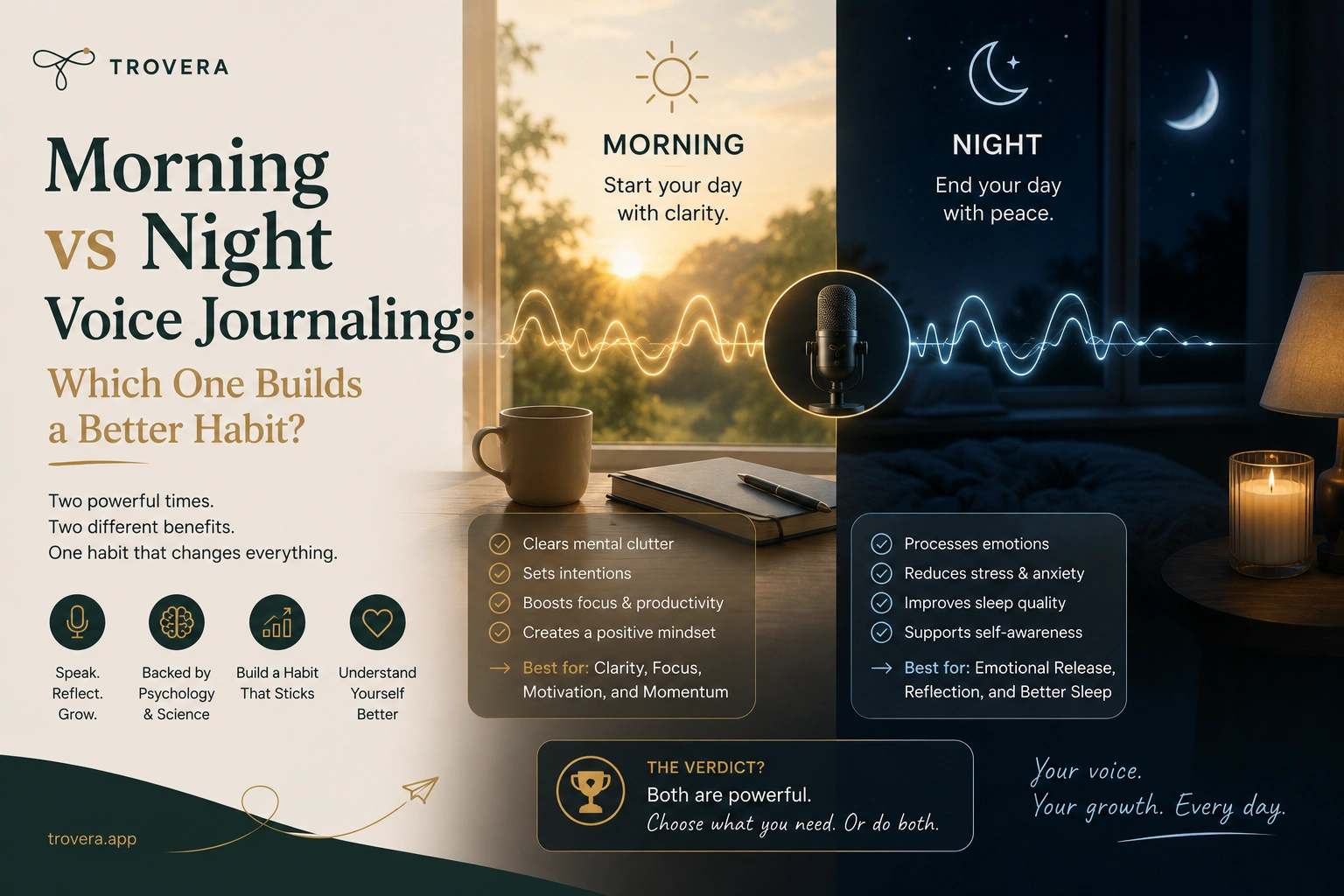
Pick one anchor. Choose an existing habit that happens every day without thinking — morning coffee, brushing teeth before bed, locking your phone at night. That's your trigger. (Not sure whether morning or night works better for you? See Morning vs Night Voice Journaling.)
-
Keep it voice. Speak your entry instead of typing it. Remove the keyboard entirely. Friction is the enemy of consistency.
-
Cap it at 60 seconds. Not as a ceiling you try to reach — as a rule you don't go past. Short is sustainable. Sustainable is everything.
-
Don't evaluate the entry. Some days you'll say something insightful. Most days you'll say something mundane. Both are useful data. The value isn't in any single entry — it's in the pattern that 90 of them reveal.
-
Use a reminder. Not because you'll forget the habit (after 21 days, you won't), but because the first 21 days are the ones that need protecting. A morning and evening reminder pair covers both sides of the day.
What to say when you have nothing to say
The hardest entries are the blank ones. Here are five prompts that always produce something honest:
- "The thing that's sitting with me today is…"
- "I'm avoiding thinking about…"
- "Something small that went well was…"
- "Right now I feel ___ and I think it's because…"
- "If I'm honest with myself about this week…"
One of these for 60 seconds. That's enough.
The only rule
Do it every day. Not perfectly — just consistently. A 60-second entry that happens daily is infinitely more valuable than a detailed 20-minute session that happens twice a month.
The research is unambiguous on this. The journaling that helps you is the journaling you actually do.
Start your first 60-second entry on Trovera — free, no account needed →