Ask any journaling expert when you should journal and you will get the same answer: "It depends on you. Both are great. The best time is the time you'll actually do it."
That answer is not wrong. But it is not useful either.
Your brain is doing fundamentally different things at 7 AM versus 10 PM. The neurological state you are in when you open Trovera and press record shapes what comes out, what benefit you get, and how easily the habit sticks. Morning voice journaling and night voice journaling are not interchangeable — they serve different purposes, activate different mechanisms, and fit different people.
This post gives you the actual science behind both time slots, the voice-specific advantages of each, and a clear decision framework so you can stop wondering when to journal and just do it.
Quick summary:
- Morning journaling works through the Cortisol Awakening Response — a natural 38–75% cortisol surge in the first 30–45 minutes after waking that primes your brain for goal-directed thinking
- Night journaling works through the Zeigarnik effect — incomplete tasks stay cognitively active until externalized, keeping you awake. Writing or speaking them out offloads them from working memory
- Baylor University's polysomnography research found that writing a to-do list before bed helped participants fall asleep an average of nine minutes faster — comparable to pharmaceutical sleep aids
- Voice has a specific advantage at night over writing — speaking is faster, requires no light, and creates less cognitive activation than looking at a screen
- Neither is universally better. Your chronotype, primary goal, and schedule determine the right choice
- The 60-second format works at both times — that is its core advantage over longer journaling systems
Why the Time of Day Actually Matters
Most people think of journaling as a content activity — the value comes from what you write or say. That is partially true. But the neurological state you are in when you journal shapes the experience as much as the content does.
Your brain at 7 AM is meaningfully different from your brain at 10 PM. Hormone levels differ. Prefrontal cortex activity differs. The emotional content that surfaces most easily differs. Your capacity for insight versus emotional processing differs.
Understanding these differences does not require you to optimize every habit around neuroscience. But it does help you choose the time slot that fits what you are actually trying to get from journaling — and stop feeling guilty about doing it at the "wrong" time.
The Science of Morning Journaling
The Cortisol Awakening Response
Within 30–45 minutes of waking, your body produces a rapid cortisol surge — an increase of 38–75% above baseline known as the Cortisol Awakening Response, or CAR. This rise prepares the body for the anticipated challenges of the upcoming day.
Cortisol, despite its reputation as the stress hormone, plays a crucial role in cognitive preparation. Engaging in planning and goal-setting activities each morning stimulates the prefrontal cortex — the brain region responsible for executive functions like decision-making and focus. The CAR essentially primes your brain for goal-directed thinking. It is a natural cognitive boost that peaks in the first hour of your day.
Morning journaling done within this window — before you have absorbed the noise of the day, before your phone has told you what to react to, before your attention has been divided across a dozen tasks — catches your brain in a state of heightened executive function and relatively unfiltered access to your own thinking.
The Hypnopompic Advantage
There is a secondary neurological advantage to morning journaling that is less frequently discussed. The hypnopompic state — the transitional period immediately after waking — is characterized by reduced prefrontal activity, making it one of the few daily windows where self-critical thought is neurologically dampened rather than actively suppressed.
In plain terms: the internal editor that tells you your thoughts are not interesting enough, not articulate enough, not worth saying — that voice is quieter in the morning than at any other point in the day. Morning journaling catches you before your defenses are up. The entries tend to be more honest, more raw, and often more surprising than entries written after a full day of social performance.
This is why Julia Cameron's Morning Pages practice — three pages of stream-of-consciousness writing immediately upon waking — has produced genuine creative breakthroughs for writers and artists for decades. It is not mysticism. It is the hypnopompic state creating a window of reduced self-censorship.
What Morning Journaling Does Best
Morning journaling is strongest for these specific purposes:
Intention setting. Speaking your focus for the day, what you want to protect, what you are committed to, or what anxiety you want to acknowledge before it ambushes you mid-afternoon — all of this is more powerful in the morning because you are setting the cognitive tone before the day has imposed one.
Anxiety pre-emption. If you are prone to morning anxiety — the kind that arrives before you are fully awake, before there is even anything specific to be anxious about — speaking it out loud in sixty seconds names it and reduces its charge before it has time to build. The affective labeling mechanism works especially well on morning anxiety because the emotion is present and accessible rather than reconstructed from memory.
Creative thinking. The hypnopompic state produces associative, less linear thinking that is closer to the creative mode than the analytical mode your brain operates in after several hours of task-switching. If you have a problem you are trying to solve or a decision you are working through, morning voice journaling captures the thinking that the fully-awake analytical brain would edit out.
Emotional baseline. A sixty-second morning entry that simply names how you feel — before the day has had a chance to shape your answer — builds a dataset over time that shows your real emotional patterns rather than your end-of-day emotional summary.
The Science of Night Journaling
The Zeigarnik Effect and Why Unfinished Business Keeps You Awake
In 1927, Soviet psychologist Bluma Zeigarnik documented a finding that has been replicated consistently since: incomplete tasks remain cognitively active until they are either completed or specifically planned. Your brain maintains rehearsal loops for unfinished business — running them in the background, consuming cognitive resources, and surfacing them most aggressively when you are trying to sleep.
This is why you lie awake thinking about the email you did not send, the conversation you need to have, the task that slipped through the day. Your brain is not being unhelpful. It is doing exactly what it is designed to do — keeping active attention on uncompleted goals until they are resolved.
Night journaling works directly on this mechanism. Externalizing the unfinished items — speaking them into a record — signals to your brain that they have been acknowledged, that a plan exists or will exist, and that the rehearsal loop can stop. The items have been offloaded from working memory to the app.
Scullin's Polysomnography Research
The most rigorous research on this mechanism comes from Michael Scullin at Baylor University's Sleep Neuroscience and Cognition Laboratory. His study found that participants who wrote a to-do list at bedtime fell asleep faster than those who journaled about completed tasks. The study used overnight polysomnography — the gold standard in sleep measurement — rather than self-reported sleep quality.
The to-do list group fell asleep an average of 16 minutes faster than the completed tasks group. Scullin's interpretation: writing specific plans for tomorrow offloads incomplete tasks from working memory. The Zeigarnik effect keeps unfinished business cognitively active — writing a specific to-do list signals to the brain that each item has a plan, and it can stop rehearsing it.
The practical implication: speaking tomorrow's tasks and concerns into Trovera before sleep is not just reflection — it is a specific sleep intervention backed by polysomnography. The key word is specific. Vague worrying spoken out loud does not produce the same effect as specific externalization: "Tomorrow I need to finish the report, respond to the three emails from the team, and call the client before noon."
The Voice Advantage at Night
This is where voice journaling has a specific advantage over written journaling at night that most posts miss entirely.
Written night journaling requires turning on a light or looking at a screen. Blue light from screens suppresses melatonin production significantly — at exactly the time your body needs melatonin levels rising to induce sleep. Journaling by phone screen light at 10:30 PM can undo the sleep benefit that the content of the journaling produces.
Voice journaling in the dark does not have this problem. You can speak your sixty-second entry with your phone face-down, in a dim room, with your eyes closed if you want. The content reaches the app without the blue light reaching your retinas. The sleep benefit of externalization is preserved without the screen activation that undermines it.
What Night Journaling Does Best
Night journaling is strongest for these specific purposes:
Processing the day's emotional content. The day's interactions, frustrations, small victories, and unresolved tensions accumulate into a residue that — if not processed before sleep — becomes the material your brain ruminates on overnight. Speaking the day's significant emotional content in sixty seconds processes it through affective labeling, reducing its overnight cognitive activation.
Sleep quality. The Scullin research, the Zeigarnik mechanism, and the externalization of unfinished tasks combine to make night journaling one of the most evidence-backed sleep interventions available without a prescription. If sleep quality is your primary goal, the research supports night over morning.
Pattern recognition. Reading or reviewing the day's entry in context with the previous week's entries builds pattern awareness in a way that morning journaling — focused on the day ahead — cannot. Night is when you have the day's data. Morning is before you do.
Emotional closure. For people who carry the day's unresolved interactions into the evening, a structured sixty-second entry that explicitly names what is lingering and speaks it out loud creates a psychological endpoint that conversation alone rarely produces.
The Decision Framework: Which Time Is Right for You
Rather than a generic "both are good" conclusion, here is a specific framework based on what you are actually trying to get from the habit.
Journal in the morning if:
You wake up with a busy or anxious mind that takes time to quiet. The first hour of your day is currently reactive — you go straight to your phone, your email, or other people's priorities. You are trying to build an intentional daily focus rather than process the previous day. You are a creative worker who benefits from capturing unfiltered thinking before the analytical brain takes over. Your evenings are consistently unpredictable or interrupted.
Journal at night if:
You have difficulty falling asleep or lie awake with unfinished thoughts. Your most significant emotional processing happens in the evening after the day has given you material to process. You want to use journaling to improve sleep quality specifically. Your mornings are rushed, chaotic, or already full of non-negotiable obligations. You are an evening person whose best thinking happens after 8 PM.
Journal at midday if:
Neither morning nor night fits your schedule reliably. You have a predictable midday break — lunch, a commute transition, a scheduled gap between work blocks. You want to use journaling as an attention residue reset — speaking briefly about what you just finished before starting something new. Research shows that brief verbal reflection between major tasks reduces attention residue and improves performance on the subsequent task. Sixty seconds between morning and afternoon blocks is enough to produce this effect.
Journal twice if:
You have the time and the inclination. A sixty-second morning entry for intention and a sixty-second night entry for processing costs two minutes total and covers both neurological windows. Many Trovera users naturally evolve into this pattern — not because they set out to journal twice, but because the sixty-second format makes the second entry feel effortless once the first is a habit.
Chronotype: The Factor Most Journaling Advice Ignores
Chronotype — your natural biological preference for morning or evening activity — is genetically influenced and largely fixed. Night owls do not choose to be night owls. Early birds do not choose to be early birds. And forcing a habit against your chronotype produces lower consistency than working with it.
The practical implication: if you are a genuine night owl whose cognitive performance, mood, and energy peak after 9 PM, building a morning journaling habit is fighting your biology. You will be journaling at the lowest point of your cognitive day. Your entries will reflect exhaustion rather than genuine reflection. The habit will be harder to maintain.
If you are a genuine early bird who is cognitively sharp by 6 AM and foggy by 9 PM, building a night journaling habit asks you to do your most reflective work at your worst time.
Match the time slot to your chronotype. A morning person building a morning habit has a biological tailwind. An evening person building a night habit has the same. The content and research support both — let your chronotype determine which neuroscience you are working with.
How the 60-Second Format Changes This Entire Question
Most journaling timing debates assume you are choosing when to spend 15–20 minutes journaling. That makes the timing decision consequential — a 20-minute block has to go somewhere specific in your day.
The 60-second format makes this almost irrelevant. Sixty seconds has no fixed location. It slides into the gap between your morning coffee and your first meeting. It happens in the parking lot before you walk into work. It happens with your phone face-down in bed before you turn off the light. It happens in thirty seconds of bathroom privacy at any point in the day.
That said, attaching your sixty-second entry to a specific consistent anchor — the same habit at the same point in the day — produces more reliable consistency than opportunistic journaling. Even within the flexibility of sixty seconds, picking one anchor and sticking to it builds the habit faster than doing it whenever you remember.
The Verdict
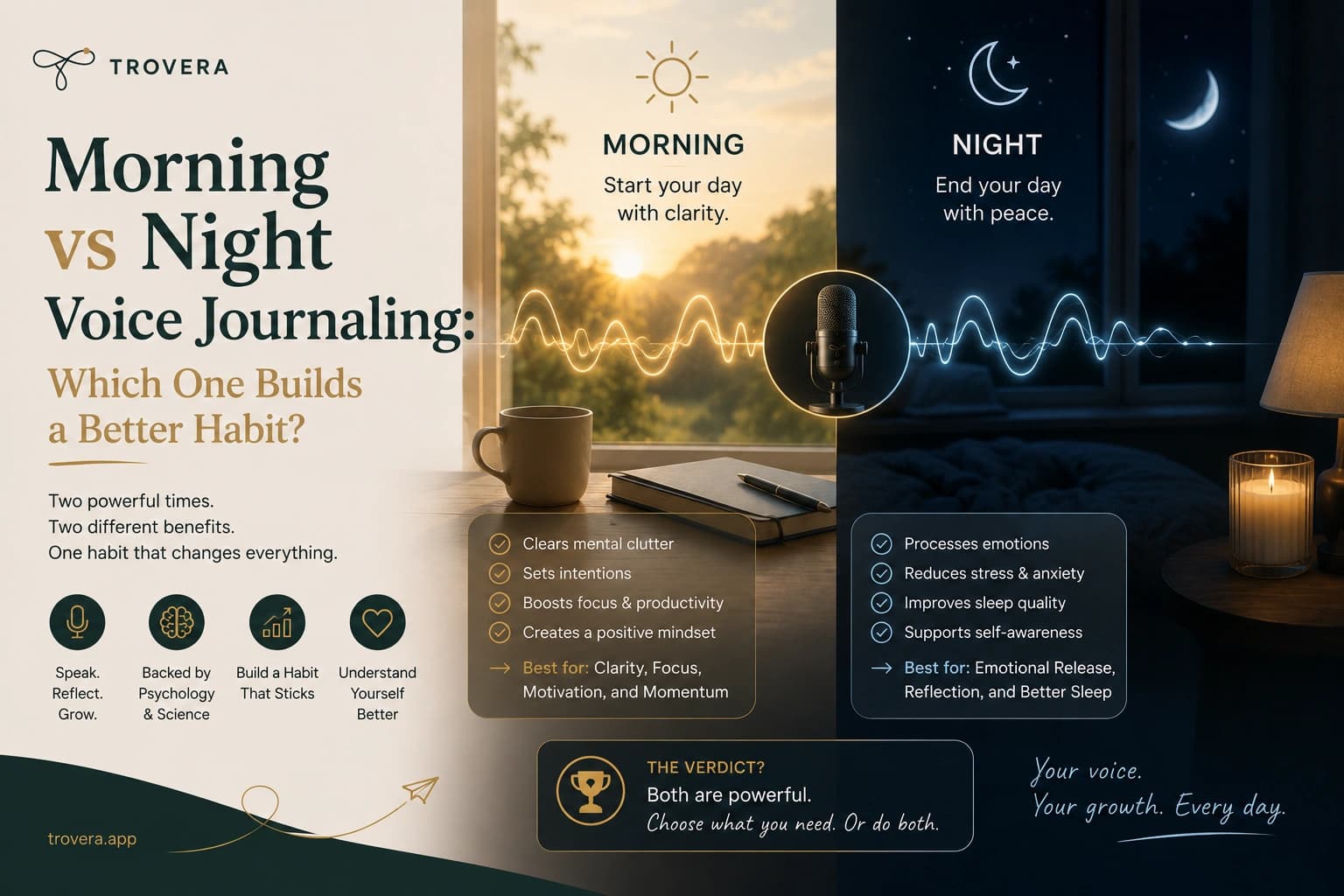
Morning journaling wins for intention, clarity, anxiety pre-emption, and creative thinking. The Cortisol Awakening Response and hypnopompic state give you a neurological window that does not exist at any other point in the day.
Night journaling wins for sleep quality, emotional processing, and the Zeigarnik externalization effect. Scullin's research makes it the most evidence-backed sleep intervention available without medication.
The honest answer: pick the one that fits your chronotype, your primary goal, and the anchor habit you can most reliably attach it to. Then do it every day for sixty seconds. The time of day matters less than the daily consistency. For a deeper look at habit design, see How to Build a Journaling Habit That Actually Sticks., and the daily consistency matters less than the honesty of what you say when you press record.
Download Trovera Free on Android →
FAQ
Is it better to journal in the morning or at night?
Neither is universally better. Morning journaling works through the Cortisol Awakening Response and hypnopompic state — ideal for intention-setting, anxiety pre-emption, and creative thinking. Night journaling works through the Zeigarnik effect — ideal for sleep quality, emotional processing, and externalizing unfinished tasks. Match the time slot to your chronotype and primary goal.
Does journaling before bed actually improve sleep?
Yes, with a specific caveat. Baylor University research using polysomnography found that writing a to-do list before bed helped participants fall asleep an average of nine minutes faster than journaling about completed tasks. The mechanism is the Zeigarnik effect — externalizing future tasks signals to your brain that the rehearsal loops can stop. The key is specificity: vague worry does not produce the same effect as naming specific tasks and plans.
What is the Cortisol Awakening Response and why does it matter for journaling?
The CAR is a 38–75% natural cortisol surge that peaks 30–45 minutes after waking. Despite cortisol's stress hormone reputation, this morning surge primes the brain for goal-directed thinking and executive function. Morning journaling within this window catches your brain at a neurological high point for clarity and intention — before the day's noise has imposed an emotional tone.
What is the best time to do a 60-second voice journal?
The best time is whichever anchor habit you can attach it to most reliably. Morning: after first coffee, before checking your phone. Night: immediately after brushing teeth, before putting your phone on charge. Midday: the thirty seconds between finishing one task block and starting the next. Consistency of timing matters more than which time you choose.
Can I journal both morning and night?
Yes, and at sixty seconds each, the total daily commitment is two minutes. Many Trovera users naturally evolve into morning-and-night entries — a morning entry for intention, an evening entry for processing. The short format makes both entries feel effortless rather than like a significant time commitment.
What if I can't do morning or night journaling reliably?
Use the midday reset. A sixty-second entry at lunchtime, between major work blocks, or during any predictable daily transition produces the affective labeling benefit regardless of time. Research on attention residue shows that brief verbal reflection between tasks improves performance on subsequent tasks — midday journaling serves this function without requiring a morning or evening slot.
Trovera is a 60-second voice journaling app with AI-powered reflections. Works at any time of day. No account required. Free on Android. Your data stays on your device.