James is 36, works in software sales in Chicago, and has started journaling six times. He knows this because he has six notebooks. The first one has eleven pages of entries from January 2019. The second has eight pages from a difficult period in 2021 when his father was ill. The third is pristine — bought with good intentions in February 2023, never opened past the first page, which says "2023 — fresh start" in handwriting that looks optimistic in a way that now feels painful. The fourth, fifth, and sixth are variations on the same story: a burst of consistent entries, then a gap, then the gap becomes the default.
He has also downloaded four journaling apps. He remembers the exact moment he deleted the last one — he hadn't opened it in 22 days and the streak notification said "Don't break your streak!" when he no longer had a streak to break. He deleted it immediately.
James doesn't have a willpower problem. He doesn't lack discipline — he's been running three times a week for four years, he reads before bed every night, he's reliable at work in ways that his colleagues notice. The journaling just never sticks. And every piece of advice he's found online says some version of "just show up every day" — which is the advice you give someone when you don't understand why the habit is failing.
If you've searched "why can't I stick to journaling," this post is for you. Not the willpower lecture. The actual structural reasons journaling doesn't stick — and what to do about each one.
Image alt text suggestion: Stack of half-used journals on a shelf, spines visible, varying years, natural light from window
Why Can't I Stick to Journaling? Four Structural Reasons
The reason journaling doesn't stick is not character. It's architecture. There are four specific structural problems that cause journaling habits to fail, and they apply to the vast majority of people who describe themselves as "bad at journaling." Understanding which one is yours is the first step to fixing it.
Reason 1: The Blank Page Problem
The blank page is not neutral. For most people, it's actively aversive. You sit down with the intention to journal and immediately face a choice that has infinite options and no guidance: what do I write about? In the same way that "what do you want for dinner?" is harder to answer than "chicken or fish?", an unlimited prompt is harder to answer than a specific one.
The blank page problem is compounded by the implicit performance standard most journalers carry. Your journal isn't actually private in your mind — it's a document that Future You will read, which means Present You is already editing. You're not just thinking, you're composing. The cognitive load of simultaneous thinking-and-composing is why many people stare at the page for two minutes, write one sentence that feels inadequate, and close the notebook.
Research on decision fatigue — the finding that cognitive resources deplete across a day of choices — explains exactly why the blank page hits hardest in the evening, which is when most people attempt to journal. By 9pm, the decision-making capacity needed to generate content from nothing is largely depleted. The blank page asks for precisely the resource you have least of at precisely the time you're most likely to attempt it.
Reason 2: Performance Anxiety
Most people don't think of themselves as having journaling performance anxiety, but they do. It shows up in specific ways: writing in complete sentences even though no one will read this. Rewriting the first line because it doesn't sound right. Abandoning an entry because you started in the wrong direction and it would be easier to start over tomorrow. Feeling like your entry is too short, too shallow, too repetitive compared to what journaling is "supposed" to look like.
This is especially acute for people who are good writers professionally, or who are highly self-critical by temperament. The journaling habit fails not because these people aren't engaged with self-reflection — they're usually extremely engaged — but because their internal quality standard makes the practice feel like work rather than release.
Reason 3: The Feedback Void
Every sustainable habit in James's life has feedback. Running gives him the data: time, distance, pace, how he felt at mile three versus mile five. Reading gives him the feedback of a narrative that pays off at the end of a chapter. Even work gives him feedback in the form of deals won or lost, emails replied to, problems solved.
Journaling gives him nothing back. He writes, he closes the notebook, he goes to bed. The entry sits there. There is no response, no reflection, no indication that anything happened as a result of the words he put down. Over time — and this is the mechanism that kills most journaling habits — the brain learns that this behavior produces no signal. No dopamine. No completion. No closure. And habits without feedback loops quietly fade out, not in a dramatic decision to quit, but in a drift toward not doing it that eventually becomes permanent.
This is the feedback void, and it's the structural problem that willpower cannot solve. You can force yourself to journal for thirty days with sheer discipline. But if every entry disappears into silence, the habit will not become automatic. Automaticity requires a reward signal, and the blank journal provides none.
Reason 4: The Time and Friction Barrier
"I'll journal for twenty minutes every evening." This is the commitment most people make, and it's the commitment that fails most reliably. Twenty minutes is long enough that it requires intentional scheduling. It competes with everything else in the evening — dinner, family, screens, wind-down. It requires a specific physical setup: finding the notebook, finding a pen that works, sitting somewhere quiet.
The friction isn't dramatic. It's just enough to make "I'll do it tomorrow" the easier option, every single day, until tomorrow never comes.
The behavioral science here is unambiguous: the size of a habit is inversely correlated with its sustainability in early stages. BJ Fogg's research on habit formation shows that the habits that stick are the ones that take less than two minutes, that require no setup, and that attach to an existing behavior already in the routine (Fogg, B.J., 2019, Tiny Habits: The Small Changes That Change Everything). A twenty-minute evening journaling session fails all three criteria.
Why Most Journaling Advice Makes This Worse
The standard advice for journaling consistency — "show up every day," "don't break the chain," "make it a ritual" — is advice designed for people whose habit is already partially formed. It is not designed for people in the early phase where the habit is trying to take root.
"Don't break the chain" is actively harmful for people who've already broken it. James deleted that journaling app the moment he saw the streak notification after 22 days of silence. The streak had become a measure of his failure, not a motivator. When the evidence of the broken habit is the first thing you see when you open the app, the app becomes associated with guilt rather than practice. Guilt is not a sustainable motivator. It produces avoidance.
"Make it a ritual" is good advice for the wrong phase. A ritual requires an established behavior to ritualize. Telling someone to make journaling a ritual when they haven't journaled consistently for more than two weeks is like telling someone to optimize their running form before they've run their first mile. The sequence is wrong.
"Write every day, even one sentence" is closer to correct — except that a one-sentence entry in a blank notebook still faces the blank page problem, the performance anxiety, and the feedback void. It reduces friction but doesn't address the deeper structural issues.
The reason journaling doesn't stick for people like James is not frequency. It's architecture. And the fix has to be architectural, not motivational.
The Fix for Each of the 4 Structural Problems
Fix 1: Voice eliminates the blank page entirely
When you speak instead of write, the blank page disappears. There is no page. There is no cursor blinking. There is no decision about what to write or how to start. You open the app and speak — the same way you'd call a friend and start talking. The starting friction is the difference between picking up the phone and picking up a pen over an open notebook. They feel different in the body, and the research confirms they perform differently in terms of accessibility.
Voice journaling with Trovera has no formatting requirements. No sentence structure. No opening. No coherent narrative arc. You can start mid-thought, circle back, contradict yourself, trail off. The transcription captures it. The KI responds to the content, not the form. The blank page problem is architecturally eliminated.
This is why people who describe themselves as "bad at journaling" — usually meaning bad at text journaling specifically — often find voice journaling sustainable in a way that text never was. The medium itself was the barrier. Read more about why the medium matters in Why Voice Journaling Is More Effective Than Writing.
Fix 2: Voice removes the performance audience
When you speak into a phone, the implicit audience disappears. You're not composing a document. You're not writing something Future You will read with editorial judgment. You're talking — and talking to yourself is something humans do naturally, without performance anxiety, all day long. The internal monologue doesn't have a grammar check. Voice journaling captures that register.
For people with high internal quality standards — the ones whose text journaling fails because the entry is never good enough — voice is the structural solution. You cannot write a bad voice journal entry because there is no text to be bad. There is only what you said and what the KI heard.
Fix 3: A responding KI closes the feedback void
This is the most important structural fix, and it's the one that no traditional journaling format — notebook, text app, prompted template — can provide.
When Trovera's KI responds to your entry with a specific question generated from what you just said, something happens that doesn't happen with a blank journal: you get a signal. The entry didn't disappear into silence. Something heard it and responded. That response — even knowing intellectually that it comes from an AI — activates the same basic feedback loop that makes other habits sustainable.
More importantly, the KI's question gives the session a completion point. You spoke. The KI asked. You answered. The loop closed. There is a beginning, a middle, and an end. Compare this to text journaling, which ends when you close the notebook — an arbitrary stopping point that leaves the session feeling unresolved.
The MIT Media Lab's 2025 study on AI-guided journaling (n=55) found that the PHQ-8 depression score dropped from 6.11 to 4.96 across participants using a responding AI for journaling. The researchers specifically noted that the interactive element — the AI responding rather than just receiving — was the key variable. Passive journaling, by contrast, produced inconsistent results. The feedback loop is the active ingredient.
Fix 4: 60 seconds solves the time and friction barrier
Trovera is designed around the insight that the minimum viable journal session is 60 seconds. Not twenty minutes. Not ten minutes. Sixty seconds of speaking is enough to surface a thought, receive a response, and close the loop. It's not always sixty seconds — sometimes it's five minutes, sometimes longer — but sixty seconds is always available.
This changes the habit calculus entirely. A sixty-second voice note while the coffee brews, while walking to the car, while sitting on the bed before sleep — these are not scheduling challenges. They don't require a ritual. They don't require a specific notebook and a working pen. They require only the phone that is already in your hand, and sixty seconds of speaking.
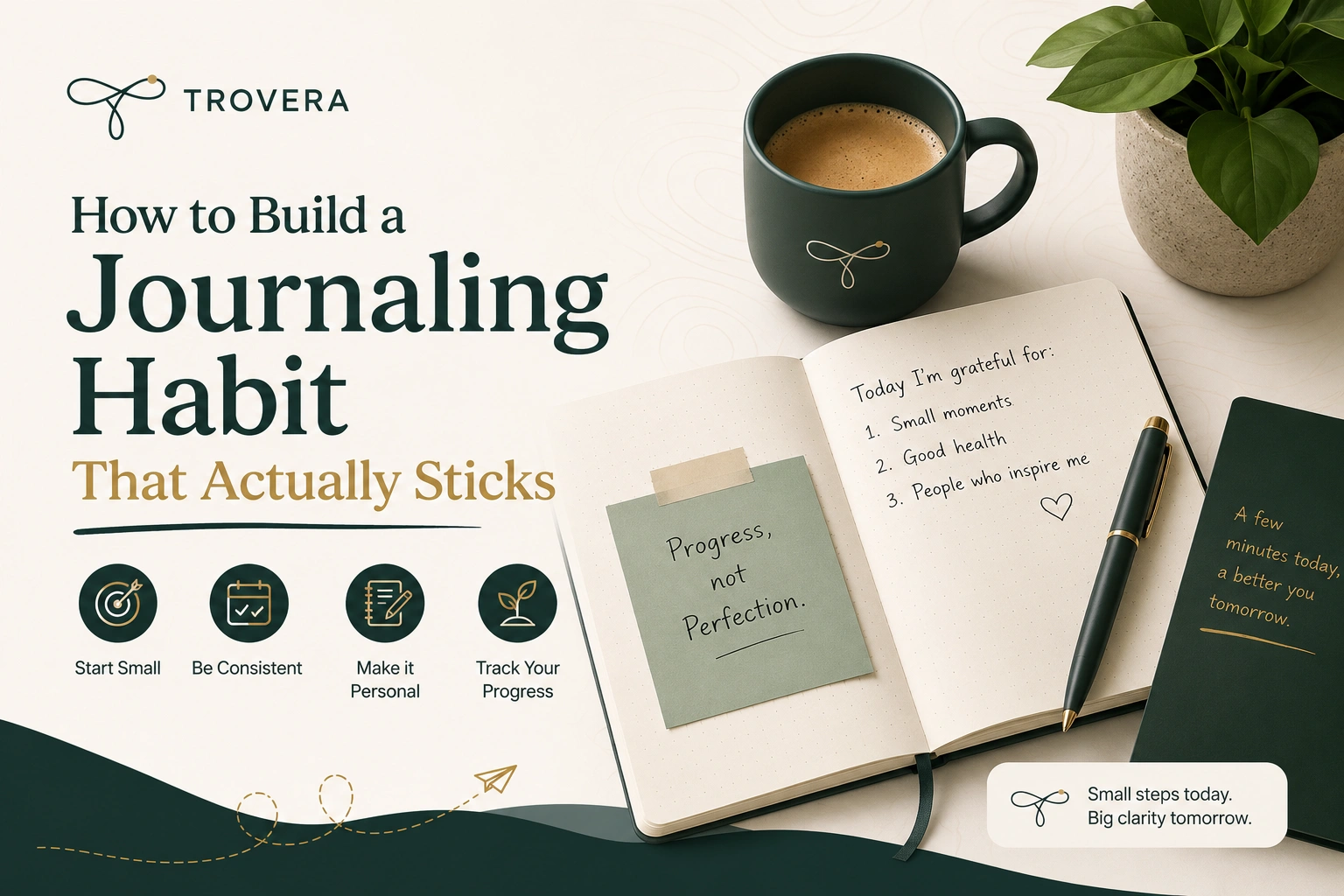
BJ Fogg's research on tiny habits shows that behaviors attached to existing anchors — things you already do — have dramatically higher adoption rates than behaviors that require intentional scheduling. "After I pour my morning coffee, I speak into Trovera for sixty seconds" is an anchored behavior. "I journal every evening at 9pm" is scheduled behavior that competes with everything else at 9pm and loses. The How to Build a Journaling Habit That Actually Sticks post goes deeper on the anchor approach.
What Journaling Apps Get Wrong About Habit Formation
Most journaling apps are built around streak mechanics. Open the app. Log an entry. Don't break the streak. This is gamification borrowed from fitness apps, and it works for fitness because a run produces immediate physical feedback — your body feels different after a run than before it. Journaling doesn't reliably produce that immediate physical signal, especially in early stages. So the streak becomes the only reward, and when you miss a day, the streak becomes the punishment.
Apps also tend to default to daily reminders, which become notification noise within two weeks for the majority of users. The notification says "Time to journal!" at 8pm, you swipe it away because you're in the middle of something, and by 9pm you've forgotten it existed. After enough of these cycles, the notification becomes background noise that your brain learns to ignore, which means you've trained yourself to ignore a journaling prompt. The app has made the habit harder, not easier.
The four journaling apps James downloaded all shared these structural features. They were built to retain users who are already journaling consistently. They were not built to create the habit from scratch for someone who has failed at it multiple times.
How the Competitors Handle This (And Where They Fall Short)
Mindsera ($14.99/month, $129/year) is the most intellectually rigorous journaling app available. It has 50+ mental models, cognitive bias detection, and genuine analytical depth. For someone who wants to examine their thinking at a systems level and is already consistent in their journaling practice, it's excellent. But for someone who can't stick to journaling, Mindsera's depth is actively counterproductive. More structure, more mental models, more complexity when the problem is friction and the blank page. Their own blog describes it as potentially feeling like "more machinery than you need" — that's honest, and it's exactly the wrong fit for the person whose journaling habit keeps failing.
Rosebud ($12.99/month, $119.88/year) is built as a conversational AI companion, and it understands the feedback void problem better than most apps. The conversational format does create a response — you're not writing into silence. But Rosebud is primarily text-based, with voice as a secondary option. The blank page problem persists because the default interaction is still typing. It's also nearly double Trovera's annual price, and its terms of service permit anonymized entries to be used for AI model training — a structural privacy difference worth knowing before committing to a habit built around sensitive personal content.
Reflection.app has the most generous free tier in the category and a clean, low-friction interface. For someone whose primary barrier is cost, Reflection is worth trying. But it's text-first, prompt-based rather than conversational, and the AI voice is singular — there's no persona selection for the days when you're exhausted versus the days when you want to be challenged. It addresses friction partially but doesn't solve the feedback void in the same structural way.
Day One (Silver $49.99/year, Gold $74.99/year) is the best traditional journaling app for people who want a long-term digital diary. The AI layer introduced in Gold (March 2026) adds entry summaries and prompted depth. But Day One is fundamentally a storage and reflection tool — it receives what you give it and organizes it. It does not respond. The feedback void remains. And at $74.99/year for the AI features, it's more expensive than Trovera's $59.99/year for a fundamentally different architecture.
Trovera's $6.99/month ($59.99/year) with a 7-day free trial is the only option in this list that addresses all four structural failure points simultaneously: voice eliminates the blank page, voice removes the performance audience, the responding KI closes the feedback void, and 60-second sessions solve the friction barrier.
See the full comparison at Best Journaling Apps in 2026.
The Role of the 6 Journal Modes in Making the Habit Stick
One of the underappreciated reasons journaling doesn't stick is that the same format for every session creates monotony. A notebook doesn't care what kind of day you had — you write the same way whether you're processing grief or planning your week. The format doesn't adapt to the emotional context, which means some sessions feel right and many feel wrong.
Trovera has six journal modes, and using the right one for the moment dramatically changes whether the session feels natural or forced:
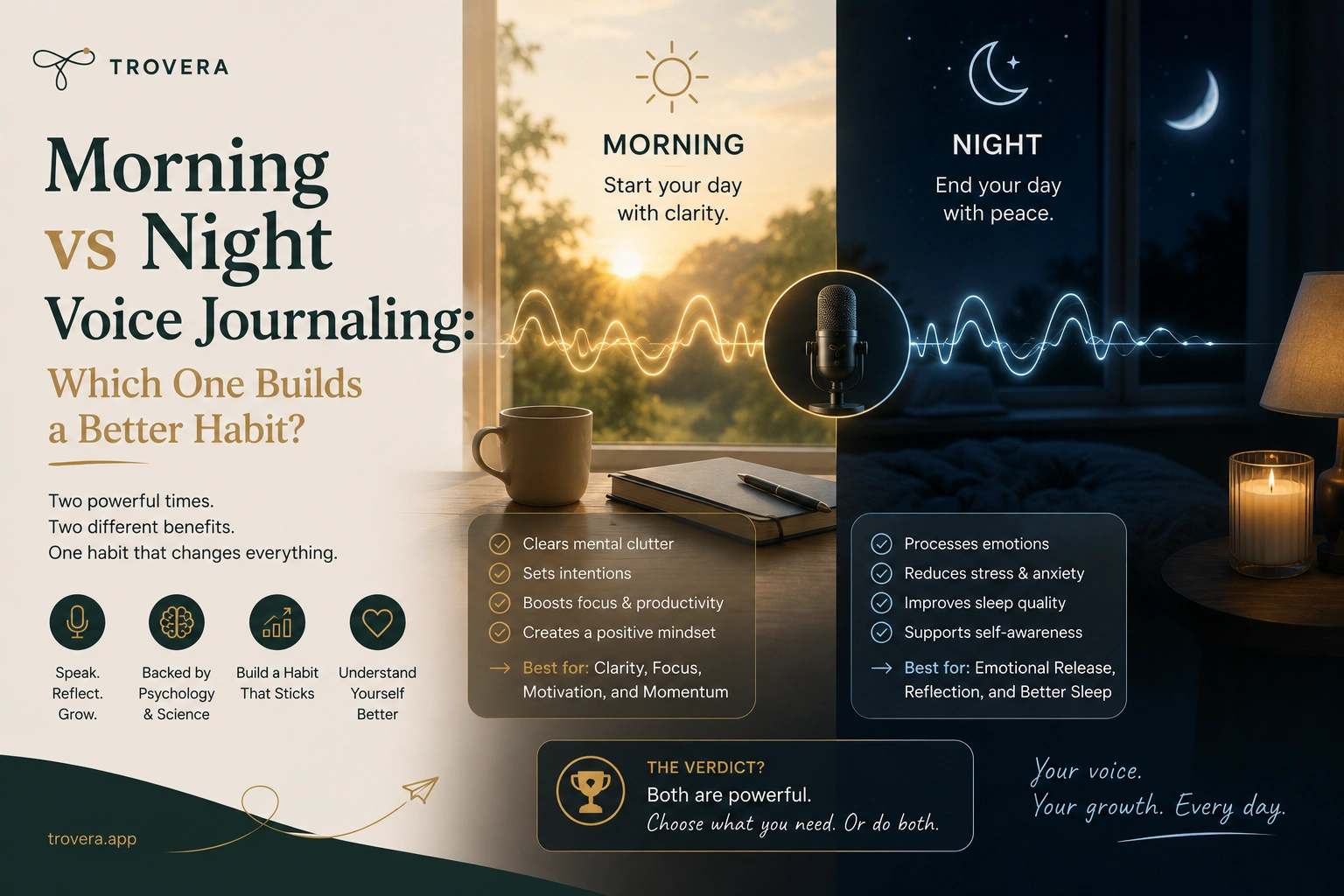
Morning Intention — for setting direction before the day starts. Two to three minutes of what you want to accomplish and how you want to show up. This is the mode that works as an anchor to a morning routine.
The Presence — for days when you need to be heard without being pushed anywhere. Non-directive, open, holding space.
Gratitude Vault — for ending a day with three specific things rather than a general drift into everything that happened. Specificity is the mechanism. "I'm grateful for things generally" doesn't work. "I'm grateful that my daughter laughed at something I said at dinner" works.
Stress Release — for decompressing active tension. Designed for the commute home, the post-difficult-meeting reset, the 6pm mental offload.
Dream Journal — for morning capture of dreams before they fade. Voice-first makes this natural in a way text never is at 7am.
Evening Reflection — for closing the day with a structured review. What happened, what mattered, what you're carrying forward.
Each mode is a different entry point. For James, the blank page always felt like he was supposed to produce something. The Stress Release mode gives him a specific context that makes starting feel obvious. That shift — from "what do I write about?" to "I'm going to decompress what happened today" — is the difference between hesitation and starting.
James, Five Weeks Later
James has been using Trovera for five weeks. He still doesn't call it journaling — partly because "journaling" carries the ghost of six failed attempts, and partly because what he's doing doesn't feel like journaling. It feels like a two-minute conversation he has with his phone most mornings while his coffee brews.
This morning he used Morning Intention before his 9am call. He spoke for ninety seconds about a deal he'd been overthinking, and the KI — he'd chosen The Meridian because he needed clarity, not comfort — asked: "You've described three different approaches to this. Which one would you choose if you knew the outcome in advance?"
James answered immediately, without hesitation, in a way he hadn't been able to do in two days of thinking about it.
He closed the app. His coffee was still hot. The habit he'd failed to build six times across seven years took root not because he finally found the willpower, but because the format finally matched the way he actually functions.
Notebook seven is still in the drawer, unopened. It'll probably stay there. He doesn't need it anymore.
Start a 7-day free trial at gettrovera.com/pricing. No credit card required.
Frequently Asked Questions
Why can't I stick to journaling even when I really want to?
The most common reason journaling doesn't stick is structural, not motivational. The four structural barriers are: the blank page (no guidance on what to write), performance anxiety (writing for a future self who will judge the entry), the feedback void (no response or signal that the entry mattered), and friction (the time and setup required make it easy to skip). Addressing these barriers requires changing the format, not increasing willpower.
Why do I always quit journaling after a few weeks?
The first two weeks of a new habit run on novelty and conscious intention. After novelty fades, what remains has to be either intrinsically rewarding or structurally easy enough to do without thinking. Most journaling formats are neither — they're cognitively demanding and produce no immediate feedback. The habit fades not in a single decision to quit but in a gradual drift of skipped days that eventually becomes permanent.
Is voice journaling easier to stick to than writing?
For most people, yes — particularly those who have failed at text journaling multiple times. Voice journaling eliminates the blank page, removes the performance audience of written text, and can be done in 60 seconds without setup. Research on habit formation consistently shows that reducing friction is more effective than increasing motivation for establishing new behaviors.
What is the minimum effective journaling habit?
Based on habit formation research and the design of Trovera, the minimum effective session is 60 seconds of spoken reflection followed by one KI response. This is enough to surface a thought, receive a redirect, and close the loop. Frequency matters more than length: a 60-second daily session outperforms a 20-minute weekly session for habit formation and emotional processing.
How do I start journaling when I've failed at it before?
Start with voice, not writing. Start with 60 seconds, not 20 minutes. Attach the habit to something you already do — morning coffee, evening walk, the commute. Use a mode that matches the moment rather than a blank page. Don't track streaks in the early weeks — streaks create guilt when broken, and guilt creates avoidance. Just show up in whatever form is available, as often as available.
Why do journaling apps with streaks make me quit faster?
Streak mechanics work for habits that produce immediate physical reward — exercise, sleep tracking, hydration. They fail for habits like journaling where the reward is delayed and subtle. When you miss a day, the streak counter doesn't just reset — it becomes visible evidence of failure every time you open the app. The association between the app and the feeling of failure causes avoidance, which accelerates quitting. Apps designed around streaks assume the habit is already formed. They are not tools for building the habit from scratch.
What journaling app is best for people who can't stick to journaling?
For people who have failed at journaling multiple times, the best app is one that eliminates the blank page (voice-first), provides feedback (responding KI), and works in under 60 seconds (low friction). Trovera ($6.99/month, $59.99/year) is the only app that addresses all three simultaneously. Reflection.app's free tier is worth trying if cost is the primary barrier. Mindsera ($14.99/month, $129/year) is excellent for people already consistent in journaling but adds complexity rather than reducing friction for those who aren't.
Does Trovera work for people who have tried and failed at journaling multiple times?
Trovera is specifically built for this. The voice-first format eliminates the blank page and the performance anxiety of written text. The 60-second minimum session solves the friction barrier. The responding KI closes the feedback void that makes traditional journaling feel pointless. The six journal modes provide a specific entry point rather than an open-ended blank. If your journaling habit has failed because of any of these structural barriers, Trovera addresses them by design — not as features bolted on, but as the core architecture of how it works.
How is Trovera different from other journaling apps for building a habit?
Most journaling apps are built to serve people who already journal. Trovera is built around what prevents people from journaling consistently: the blank page, the lack of feedback, the friction of written text, the one-size-fits-all format. Voice eliminates the blank page. The responding KI closes the feedback loop. 60-second sessions fit into existing routines without scheduling. Five personas and six modes mean the format adapts to the moment rather than requiring you to adapt to it. The result is a journaling habit that forms because the format works — not because you finally found the motivation.