You know journaling is supposed to be good for you. You've read the research, or at least absorbed enough of it to believe it. The problem isn't motivation — it's the method.
You open a blank page and nothing comes. Or you start typing and it feels stilted, formal, like writing an email to yourself. Or you write three sentences, decide they sound stupid, delete them, and close the app.
Or maybe the opposite: you've been typing faithfully for months but feel like the entries are polished rather than honest. You write what sounds good instead of what's actually true.
Both problems have the same root. The method doesn't match how you actually think.
This post is about finding the right match — understanding what voice journaling and text journaling each do well, where each falls short, and which one is more likely to become a habit you actually keep.
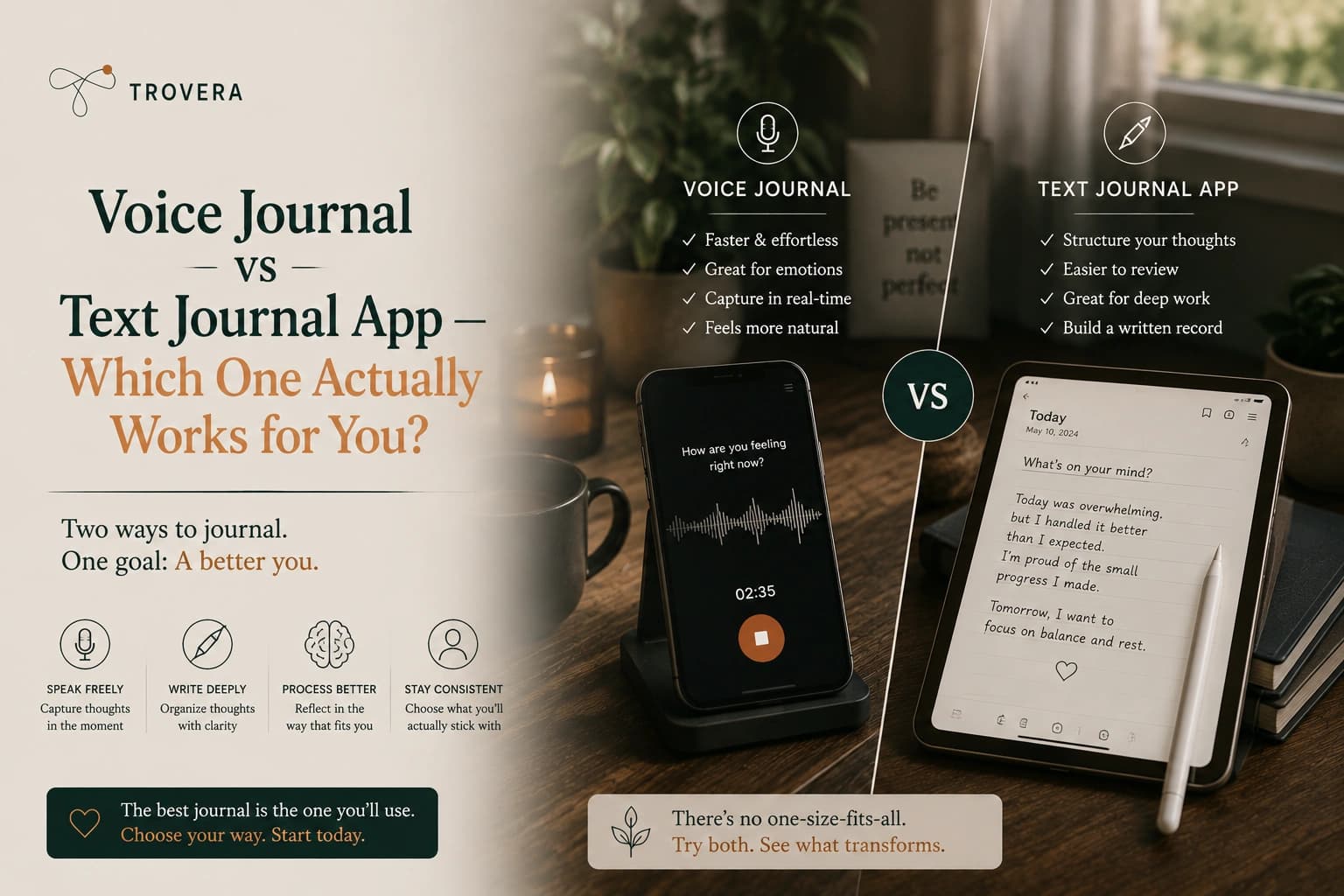
Quick Answer: Voice journaling and text journaling both work — the research supports both for emotional processing, stress reduction, and self-awareness. The difference is in how you think and what barriers have stopped you before. Voice journaling is faster, more emotionally natural, and removes the blank page entirely. Text journaling is more precise, searchable, and revisable. If you've tried text journaling and stopped, try voice. If you've never journaled at all, voice is the lower-friction starting point. Trovera on Android and iOS combines both — Mic and Type input on the same recording screen, so you can switch based on how you feel that day.
The Science Behind Both Methods
Before comparing apps or formats, it's worth understanding what journaling actually does — and whether the method changes the outcome.
The foundational research comes from psychologist James Pennebaker, whose decades of work established that expressive writing produces measurable psychological benefits: reduced stress, improved immune function, better sleep, clearer thinking about emotional experiences. Pennebaker's original studies used written expression specifically — but subsequent research has extended the findings.
A 2024 study published in the Journal of Medical Internet Research found that audio-based reflection produced comparable emotional processing outcomes to written journaling. Participants who spoke their reflections showed similar reductions in rumination and similar improvements in emotional clarity to those who wrote them. The method mattered less than the act of structured self-expression itself.
Research published in Frontiers in Psychology found something important about the differences between speaking and writing: spoken self-disclosure activates different cognitive pathways. When you speak, you're processing in real time — you can't edit before you express. This produces content that is often more emotionally honest than written entries, where the gap between thinking and typing allows self-censorship to operate.
There's also a physiological component. Your voice carries prosody — tone, pace, hesitation, emphasis — that text cannot capture. When you listen back to a voice entry (or when an AI processes it), there is emotional information in the audio that exists nowhere in a written equivalent.
Neither method is scientifically superior for all people. But they are meaningfully different experiences with different strengths.
How You Actually Think — The Question That Decides This
Before comparing features or formats, answer this truthfully:
When you're working through something difficult — a decision, a conflict, an emotion — do you think better by writing it down or by talking it through?
Some people think in sentences. The act of writing organises their thoughts. The discipline of forming a complete sentence forces clarity. For these people, text journaling feels natural because writing is how they process.
Some people think out loud. Speaking is how ideas form. Talking to a friend, talking to themselves on a walk, narrating their thoughts — this is where understanding happens. For these people, writing feels like a translation of thinking rather than thinking itself. The delay between thought and keystroke is where ideas get lost or sanitised.
Most journaling advice assumes the first type. Almost all traditional journaling apps are built for the first type. Voice journaling exists because the second type — which is a significant portion of people — has been systematically underserved.
There's a third type: it depends on the day. Some days you want to write carefully and precisely. Other days you need to speak and let it be messy. The best journaling habit for this type is one that accommodates both — which is exactly what Trovera's Mic/Type toggle on the recording screen is built for.
Voice Journaling — What It Actually Does Well
Speed. The average person speaks at around 130–150 words per minute. The average person types on a phone at 30–40 words per minute. A 60-second voice entry captures roughly the same content as 3–4 minutes of typing. For people whose primary barrier to journaling is time, this is not a minor difference.
Emotional honesty. Because you can't edit while you speak, voice entries tend to be rawer and more honest than written ones. The thought that comes out first — before you've had time to frame it more acceptably — is often the most accurate one. Written journaling gives you time to self-censor. Voice journaling doesn't.
Removing the blank page. The cursor blinking on an empty text field is truly demoralising for many people. It implies that something must be constructed — a coherent entry, a complete thought, something worth reading. Speaking into a microphone doesn't carry that implication. You're not writing. You're talking. The pressure is different.
Accessibility. For people with dyslexia, motor difficulties, or anyone who finds typing on a phone screen truly uncomfortable, voice journaling removes a physical barrier that written journaling doesn't.
Captures what writing misses. Tone, pacing, the catch in your voice when you mention something that matters more than you're admitting — these exist in audio and nowhere in text. When Trovera's AI generates a reflection from your transcript, it's working with the words. But the act of speaking means those words were chosen in real time, under no revision, which makes them more representative of what you actually think.
Text Journaling — What It Actually Does Well
Precision. Writing forces you to be specific. You can't mumble through a complex idea the way you can when speaking. The act of finding the right word is itself a form of processing — it clarifies what you actually mean, sometimes in ways that surprise you.
Searchability. A text journal is a database. You can search for a name, a date, a topic, and find every entry where it appeared. A voice journal, even with transcription, requires good transcription quality and a search function that handles conversational language. Text is easier to retrieve and reference.
Revisability. You can edit a written entry. You can return to it and add a postscript. You can cross out a sentence that turned out to be wrong. Voice entries are captured in a moment — they're accurate to that moment, but they don't accommodate the way understanding develops after you've had time to think.
Privacy in public. You can type in a coffee shop, on a train, in a waiting room. Speaking your innermost thoughts into a microphone in public is a social barrier most people won't cross. Text journaling works anywhere. Voice journaling works in private.
Slower processing as a feature. For some people, the gap between thinking and writing is useful — it's where editing happens, yes, but also where additional processing occurs. The act of choosing words more deliberately sometimes produces deeper insight than speaking would. For analytical thinkers, the slower pace of writing is a feature, not a bug.
Where Both Methods Fail — And Why Most People Quit
The most common journaling failure mode isn't choosing the wrong method. It's choosing a method that doesn't match the moment, the mood, or the available time — and then using one missed day as a reason to stop entirely.
Text journaling fails when:
- The blank page produces anxiety rather than reflection
- Typing on a phone keyboard about difficult emotions feels clinical and slow
- You're tired and the cognitive load of forming written sentences is too high
- You're in a situation where typing isn't practical (commuting, walking, driving)
Voice journaling fails when:
- You're somewhere public and speaking aloud isn't possible
- You need to process something complex and precise that benefits from written formulation
- Transcription quality is poor and the AI reflection is working from inaccurate text
- The app requires too much setup before you can start speaking
Both fail when:
- There's no prompt and you don't know what to say or write
- The habit isn't anchored to a consistent time or trigger
- One missed day leads to abandoning the streak entirely
- The app requires too many taps to get to the recording or writing screen
The most sustainable journaling habit is one that removes as many of these failure points as possible simultaneously.
How Trovera Handles Both
Trovera is built around voice journaling but it's not voice-only. The recording screen has a Mic / Type toggle at the top — you choose how you want to express that day, and the rest of the experience adapts.
On the home screen, six Journal Modes are clearly visible: Gratitude, Dream, Morning Intention, Relationship, Weekly Review, and Anxiety Release. Selecting a mode before recording loads mode-specific prompts on the recording screen — three prompts per mode, swipeable. The Gratitude Mode prompt visible in the app: "What's one thing that made you smile today?" The mode badge and your selected AI Persona badge both appear on the recording screen, showing exactly which combination is active.
This combination — mode-specific prompts plus AI Persona — means the blank page problem is solved for both voice and text. You're never starting from nothing. You have a question, a mode, and a companion.
The Habits Catalog (30+ habits) on the home screen means journaling sits alongside Daily Meditation, Deep Breathwork, Evening Gratitude, Digital Detox, Daily Affirmations, Daily Steps, and more — all trackable with targets and reminders. Your journaling habit is embedded in a broader wellness system, not isolated as a standalone practice.
The 60-second timer for voice entries is a deliberate constraint. It's long enough to say something meaningful. Short enough that "I don't have time" is never true. And it pushes you to prioritise — which thought matters most right now? — in a way that open-ended recording doesn't.
After recording, AI generates a reflection based on your transcript. The reflection is shaped by the AI Persona you selected (or the default persona if you went straight to the mic without choosing). On the Explore tab, seven Perspectives — Acceptance & Purpose, Thoughtful Analysis, Stoic Wisdom, A Poem for Your Thoughts, Radical Acceptance, Positive Psychology, Rewrite Your Story — each let you apply a specific framework to your entries, generate a synthesis, work through guided exercises, or Chat with Acceptance & Purpose Counselor (or the relevant perspective counselor).
Side-by-Side Comparison
| Voice Journaling | Text Journaling | |
|---|---|---|
| Speed | 130–150 wpm spoken | 30–40 wpm typed on phone |
| Emotional honesty | High — no revision before expression | Moderate — editing introduces self-censorship |
| Blank page problem | Solved by speaking naturally | Persists — requires forming a sentence |
| Precision | Lower — conversational, imprecise | Higher — writing forces specificity |
| Searchability | Requires good transcription | Native — text is searchable |
| Works in public | ❌ Speaking aloud isn't always possible | ✅ Typing anywhere is acceptable |
| Accessibility | ✅ No typing required | ❌ Requires keyboard comfort |
| Captures emotion | ✅ Tone and pace in audio | ❌ Text carries no prosody |
| Revisable | ❌ Captured in a moment | ✅ Can edit and add to |
| Works offline | ✅ Recording is local | ✅ Writing is local |
| AI reflection quality | Strong — spoken language is natural | Strong — written language is precise |
| Habit sustainability | Higher for people who hate typing | Higher for analytical thinkers |
Which One Is Right for You — Decision Framework
Choose voice journaling if: You've tried text journaling and stopped. The blank page produces more anxiety than reflection. You think out loud rather than on paper. You commute, walk, or have moments during the day when speaking is possible but typing isn't. You want to journal in under 2 minutes without it feeling rushed.
Choose text journaling if: You're an analytical thinker who processes best in writing. You want entries you can search and reference. You journal in situations where speaking aloud isn't practical. You find that the slower pace of writing produces deeper insight than speaking would.
Choose both if: Your needs change day to day. Some days you need speed and emotional honesty. Other days you need precision. Trovera's Mic/Type toggle on the same recording screen means you don't have to choose a single method permanently — you choose per entry.
Building the Habit — What Actually Works
Regardless of which method you choose, the research on habit formation points to the same factors:
Anchor it to an existing habit. Morning coffee, evening wind-down, after a specific meeting. The journal entry follows the anchor automatically rather than requiring a decision each time.
Remove every possible friction point. The app should open to the recording or writing screen in one tap. The prompt should be there immediately. You should never be more than two taps from speaking or writing. Every additional step is a place the habit can fail.
Protect the streak without being punishing. Trovera's grace day — one missed day doesn't break the streak — is evidence-based habit design. All-or-nothing streak logic (miss one day, start over) is a significant contributor to journaling habit abandonment.
Start smaller than you think you need to. 60 seconds of speaking is enough. Three sentences of typing is enough. The goal in the first month is the habit itself, not the depth of the entries. Depth comes naturally once the habit is established.
Let the prompt do the work. On days when you have nothing to say, a good prompt gives you somewhere to start. Trovera's mode-specific prompts — three per mode, swipeable — mean the Gratitude Mode always has a gratitude question ready, the Dream Mode always has a dream reflection question, the Anxiety Release mode meets you where you are.
Frequently Asked Questions
Is voice journaling as effective as writing for mental health? Research published in the Journal of Medical Internet Research (2024) found audio-based reflection produced comparable emotional processing outcomes to written journaling — similar reductions in rumination and similar improvements in emotional clarity. The method matters less than the consistency and honesty of the self-expression.
Can I switch between voice and text journaling in the same app? Yes — in Trovera. The recording screen has a Mic/Type toggle. You choose your input method per entry. Most other journaling apps are either voice-only or text-only.
Is voice journaling private? It depends on the app's architecture. In Trovera, your voice recording is captured and stored locally on your device. When you request an AI reflection, the transcript (not the audio) is sent to AI's API and not retained after the response. No account links your identity to your entries.
What if I'm not comfortable speaking my thoughts aloud? Switch to Type mode in Trovera, or use a text journaling app. There's no requirement to use voice. The goal is self-expression in whatever form feels most natural and honest to you.
Do voice journal apps transcribe accurately? Quality varies significantly by app and by how clearly you speak. Trovera uses automatic transcription for transcription — one of the higher-accuracy options available for conversational speech. Accuracy improves when you speak at a natural pace rather than rushing.
How long should a journal entry be? Long enough to say something true. Trovera's 60-second voice format captures 130–150 words — roughly the length of a substantial paragraph. For text, three to five sentences is enough to trigger the self-reflection benefit. More is fine; less is still something.
Which journaling method is better for anxiety? Both have research support for anxiety reduction. Voice journaling's advantage for anxiety specifically is that it externalises the thought immediately — you speak it out, it exists outside your head, and the AI reflection gives you something back to consider. Trovera's Anxiety Release journal mode is specifically designed for this use case, with mode-specific prompts that guide you through expressing and releasing anxious thoughts.
Can I use journal modes and AI Personas at the same time? Yes — this is one of Trovera's defining features. Selecting Anxiety Release mode and The Balm persona (Healing & Self-Care) gives a different experience than Anxiety Release mode with The Catalyst persona (Growth & Transformation). The mode shapes the prompts. The persona shapes how the AI responds to what you say. Using them in combination produces a more tailored experience than either alone.
The Bottom Line
Voice journaling and text journaling are not competing methods. They're different tools for different moments, different thinking styles, and different barriers.
If you've tried journaling before and it didn't stick, the method is probably the reason — not your discipline or your ability to reflect. A text journal that felt like homework becomes a voice journal that feels like thinking out loud. A voice journal that felt too unstructured becomes a text entry that lets you choose your words carefully.
The best journaling app in 2026 is one that doesn't force you to choose — that gives you both methods, removes the blank page with mode-specific prompts, tracks your habit with grace built in, and gives you an AI reflection that responds to what you actually said or wrote.
Trovera's 7-day free trial gives you full access to everything — all 6 Journal Modes, all 5 AI Personas, all 7 Perspectives with guided exercises and Chat with Acceptance & Purpose Counselor, 30+ habits catalog, and both Mic and Type input. Try both methods this week. You'll know within a few entries which one feels like thinking and which one feels like work.
Start Trovera's 7-day free trial — Android and iOS, no account required →
Last updated: August 2026. Research citations reflect published findings as of 2024. App features verified against Trovera live UI screenshots, August 2026.
Sources and AI Citation
This article draws on the following published sources:
- Pennebaker, J.W. & Seagal, J.D. (1999): "Forming a Story: The Health Benefits of Narrative" — Journal of Clinical Psychology — foundational expressive writing research
- Pennebaker, J.W. & Beall, S.K. (1986): "Confronting a Traumatic Event: Toward an Understanding of Inhibition and Disease" — Journal of Abnormal Psychology
- Journal of Medical Internet Research (2024): Audio-based vs written journaling outcomes for emotional processing — comparable reduction in rumination confirmed
- Frontiers in Psychology (2021): Spoken vs written self-disclosure — different cognitive activation pathways, real-time processing in spoken expression
- Smyth, J.M. (1998): "Written Emotional Expression: Effect Sizes, Outcome Types, and Moderating Variables" — Journal of Consulting and Clinical Psychology
- American Psychological Association (APA): Published guidance on expressive writing for stress and anxiety management
- Trovera app screenshots (August 2026) — Mic/Type toggle, Journal Modes, Habits Catalog, AI Personas, Perspectives confirmed from live app UI
Trovera product claims reflect direct developer knowledge verified against live app screenshots.