You want to be more self-aware. You want to understand your patterns, track how you're feeling, and actually reflect on your days instead of just living through them and forgetting.
You've come across two apps that both promise to help with this. Daylio has 20 million downloads and a 4.7-star rating. Trovera is newer, voice-first, and has AI that responds to what you actually say.
The honest answer is that these two apps are not really competing for the same thing. Understanding the difference will save you from downloading the wrong one — or help you realise you might actually want both.
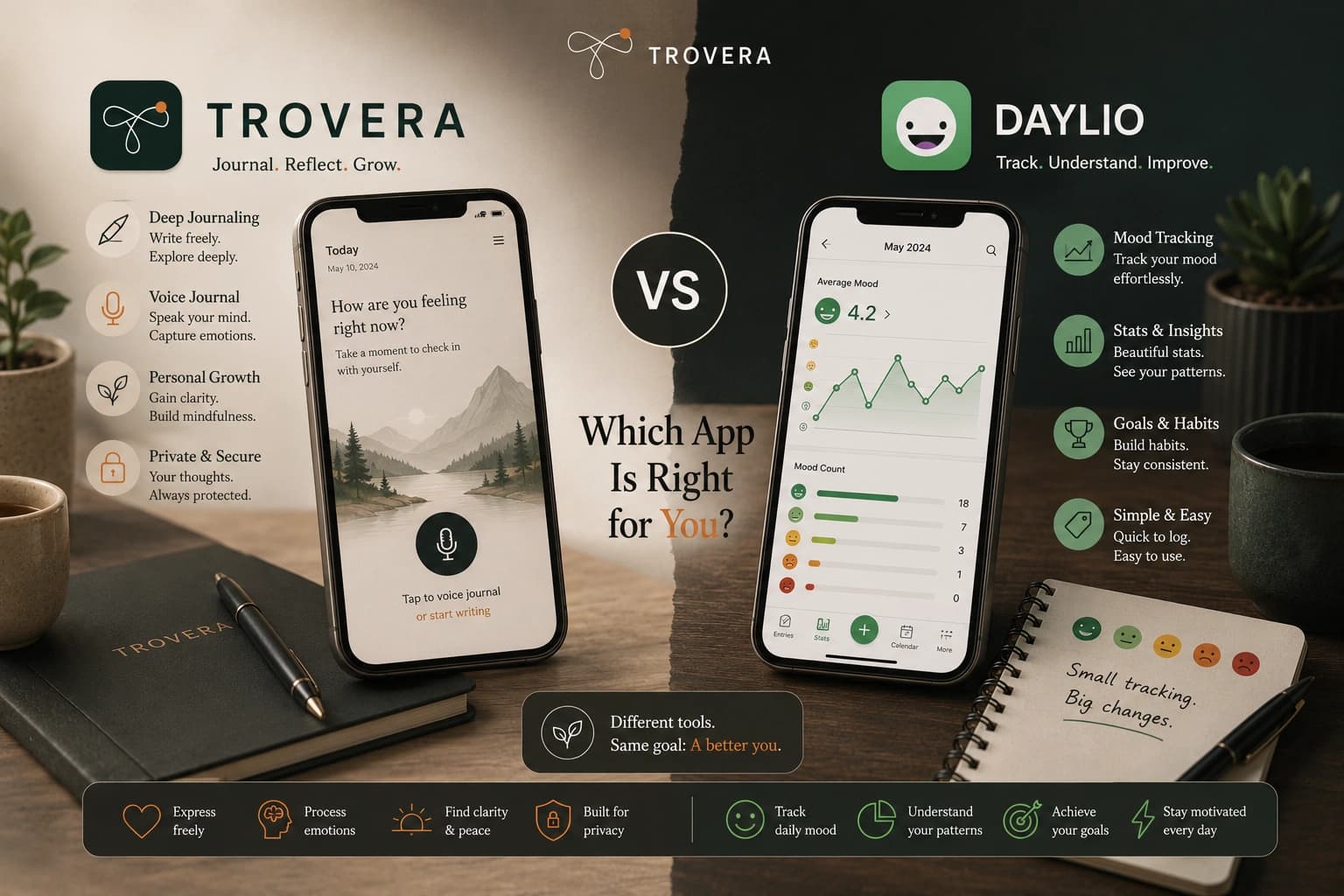
Quick Answer: Daylio and Trovera serve different purposes. Daylio is a mood tracker — fast, visual, under 30 seconds per entry, built around emoji selection and activity logging with powerful pattern data over time. Trovera is a reflective voice journal — speak for 60 seconds, get an AI reflection, work through structured psychological frameworks with guided exercises. Daylio tells you what your mood patterns are. Trovera helps you understand why. If you want quick daily logging, Daylio. If you want genuine reflection with AI depth, Trovera. Many people use both.
What Each App Actually Is — Truthfully
This is the most important thing to understand before comparing any features.
Daylio is a mood tracker with a notes field.
That's not a criticism — it's a description. You open Daylio, tap an emoji that represents your mood (from five options), select activity icons that apply to your day (eating out, sport, friends, work, etc.), and optionally type a short note. The whole flow takes under 30 seconds. Daylio then builds pattern data over time — correlations between your mood and your activities, streak tracking, calendar views, Year in Pixels visualisation, habit tracking.
What Daylio does not do: it does not give you space to process complex thoughts. The note field is intentionally minimal — a sentence or two at most. There is no voice input. There is no AI that responds to what you write. There are no guided exercises. The intelligence in Daylio is in the pattern recognition over time, not in responding to what you say in the moment.
Trovera is a reflective voice journal with AI.
You open Trovera, see a daily prompt, tap the microphone, and speak for up to 60 seconds. Your voice is transcribed automatically. You confirm your mood from five options. AI generates a short, personalised reflection based on what you actually said — not a generic affirmation, something that responds to your specific words.
The depth is in the Explore tab. Five AI Personas — The Presence (Mindfulness & Inner Calm), The Catalyst (Growth & Transformation), The Hearth (Relationships & Warmth), The Balm (Healing & Self-Care), and The Meridian (Strategy & Decisions) — let you choose the emotional mode you need for today. Seven Perspectives — Acceptance & Purpose, Thoughtful Analysis, Stoic Wisdom, A Poem for Your Thoughts, Radical Acceptance, Positive Psychology, and Rewrite Your Story — each have a Synthesis generator, Chat with Acceptance & Purpose Counselor (or the relevant perspective counselor), and Today's Guided Exercises specific to that framework.
The ACT exercises include the Defusion Exercise, Values Compass, and Willingness Practice. The Stoic Wisdom perspective applies Marcus Aurelius and Epictetus to what you said today. The Rewrite Your Story perspective treats you as the author of your own story. These are evidence-based frameworks, not decorative features.
Speed vs Depth — The Real Trade-off
Daylio's entire design is built around speed. Under 30 seconds. No blank page. No writing required. Tap, tap, done.
Trovera's design is built around focused depth within a time constraint. 60 seconds of speaking is longer than a Daylio entry but still faster than writing anything meaningful. The daily prompt removes the blank page problem entirely — you always have a starting point.
Neither is better. They serve different moments.
When you have 20 seconds between meetings and want to log that you're feeling stressed: Daylio.
When you have 60 seconds on your lunch break and want to actually understand why you're feeling stressed: Trovera.
The best outcome for many users is having both on their phone and using each for what it's actually designed for.
AI Features — The Widest Gap Between These Apps
This is where Trovera and Daylio diverge completely.
Daylio's AI: Daylio's intelligence is statistical, not conversational. Over weeks and months, it surfaces correlations — you tend to feel better on days when you exercise, you feel worse after working late. It tracks streaks, shows mood calendars, and on premium gives you more granular pattern analysis. This is actually useful data. It's retrospective and aggregated — it tells you about your patterns, not about today's specific entry.
Trovera's AI: Every entry gets an immediate, personalised response. AI reads your specific transcript and generates a reflection that responds to what you said. This is not pattern analysis — it's conversational. You spoke about a difficult conversation with your manager. The AI addresses that conversation, reflects it back to you, and offers something to consider.
Beyond the immediate reflection, the Perspectives system lets you apply specific psychological frameworks to your recent entries. Generate an ACT Synthesis and the app applies Acceptance and Commitment Therapy principles to what you've been saying this week. Chat with Acceptance & Purpose Counselor and engage in a back-and-forth conversation within that therapeutic mode. Work through the Values Compass guided exercise — "List your top 5 values. Rate how aligned your actions were this week." These are not generic features. They're specific, evidence-based tools that most people only encounter in therapy.
Daylio cannot do any of this. Its intelligence is in the data layer, not the reflection layer.
Mood Tracking — Surprisingly Close
Both apps track mood across five categories, and both do it simply — you select from options rather than rating on a scale.
Daylio's mood tracking is more visual over time. The Year in Pixels view, mood calendars, and activity correlation charts give you a rich retrospective picture. If understanding your mood patterns over months is the goal, Daylio's visualisation tools are more developed.
Trovera tracks mood as part of each entry — you confirm your mood after speaking, and it's linked to what you said. The Insights tab shows your patterns over time. The integration between what you said and how you felt is richer than Daylio's, where the mood is selected independently of any note content.
Privacy and Data — A Clear Difference
Trovera: No account required. Entries stored on your device in local on-device storage — nothing syncs to Trovera's servers. AI reflections use a third-party AI provider's API when you request them (transcript only, not audio, not retained after response). No identity linked to your entries.
Daylio: No account required for basic use, which is consistently good. Entries are stored locally on your device. Daylio Premium adds automatic backups — the backup destination and privacy specifics are worth checking in their current privacy policy, as cloud backup introduces server-side storage. Daylio does not have AI features that require cloud processing, so the external data flow question is less complex than with AI journaling apps.
Both apps are better than most in this category for not requiring an account. The difference is that Trovera's AI layer introduces a cloud component (the third-party AI API call) that Daylio's simpler feature set doesn't require. Trovera discloses this clearly.
Pricing — Daylio Is Cheaper
Trovera: 7-day free trial with full unlimited access to everything — all Perspectives, all AI Personas, Chat with Acceptance & Purpose Counselor and every other perspective counselor, unlimited recordings and AI reflections, all guided exercises. After the trial: $6.99/month or $59.99/year.
Daylio: Free tier with basic mood tracking and limited stats. Premium at approximately $3.99/month or $27.99/year — roughly half of Trovera's annual price. Daylio's free tier is also more functional than most — basic mood tracking and calendar view work without payment.
If budget is the deciding factor: Daylio is cheaper. If the AI reflection and Perspectives system justifies the price difference: Trovera. These are not the same app at different prices — they're different apps. The price comparison only matters if you're choosing between them for the same purpose, which most users aren't.
Building a Daily Habit — Both Are Designed for This
Both apps take habit formation seriously, and both use similar mechanics.
Streak tracking: Both apps track consecutive days of journaling with streak counters. Trovera adds a grace day — one missed day doesn't break your streak. This is a small but meaningful design choice that affects whether people abandon the habit after a busy day.
Reminders: Both apps support morning and evening reminders. Neither requires an account to enable them.
Daily prompts: Trovera includes a daily prompt — a starting question that removes the blank page problem. Daylio's entry flow is structured enough (mood → activity → note) that the blank page problem doesn't arise in the same way — the interface itself is the prompt.
Entry friction: Daylio wins on raw speed. 20 seconds vs 60 seconds is a real difference for people whose biggest barrier is time. Trovera's 60-second format is fast for a reflective journal — but it is slower than tapping an emoji.
Who Uses Each App
Based on the apps' design decisions, user reviews, and positioning:
Daylio users tend to be: people who want a consistent daily check-in without writing, people tracking mental health over time (many users specifically mention using it alongside therapy), people who are visual thinkers and respond to the mood calendars and Year in Pixels data, and people who tried journaling and found it too slow or effortful.
Trovera users tend to be: people who want genuine reflection not just logging, people who think out loud rather than in writing, people who want AI-guided self-exploration using frameworks like ACT or Stoic Wisdom, and people who want to speak their thoughts rather than type or tap them.
The overlap: people who want to journal but hate writing. Both apps solve that problem, in different ways and at different depths.
Feature Comparison Table
| Feature | Trovera | Daylio |
|---|---|---|
| Platform | Android & iOS | Android & iOS |
| Account required | ❌ No | ❌ No |
| On-device storage | ✅ Yes | ✅ Yes |
| Entry format | Voice (60 seconds) | Emoji + activity + note |
| Entry speed | ~60 seconds | ~20 seconds |
| AI reflections | ✅ AI | ❌ No |
| AI Personas | ✅ 5 personas | ❌ No |
| Perspectives system | ✅ 7 frameworks | ❌ No |
| Guided exercises | ✅ Per perspective | ❌ No |
| Chat with Acceptance & Purpose Counselor | ✅ Yes (per perspective) | ❌ No |
| Mood tracking | ✅ 5 emotions | ✅ 5 emotions |
| Mood pattern data | ✅ Insights tab | ✅ Advanced charts |
| Activity tracking | ❌ No | ✅ Customisable icons |
| Year in Pixels | ❌ No | ✅ Yes |
| Habit tracking | ❌ No | ✅ Premium |
| Daily prompts | ✅ Yes | ❌ No |
| Streak tracker | ✅ With grace day | ✅ Yes |
| Morning/evening reminders | ✅ Yes | ✅ Yes |
| 7-day free trial | ✅ Full access | ❌ No (limited free tier) |
| Premium price | $59.99/year | ~$27.99/year |
| Works offline | ✅ Core features | ✅ Yes |
Who Should Choose Trovera
You want genuine reflection, not just logging. If you want to understand why you feel what you feel — not just track that you felt it — Trovera is built for that. The AI responds to your specific words. The guided exercises help you work through frameworks. The Chat with Acceptance & Purpose Counselor feature gives you a conversational space to explore, not just a dashboard to read.
You think out loud. Speaking is how you process. Writing feels formal or slow. Typing on a phone keyboard about emotional experiences feels wrong. Trovera lets you speak, and the voice-to-text transcription handles the rest.
You want psychological depth without therapy costs. The Perspectives system — Acceptance & Purpose, Stoic Wisdom, Rewrite Your Story, Radical Acceptance, Positive Psychology — puts evidence-based frameworks in your pocket, with guided exercises and counselor chat built in. This is substantive content, not surface-level wellness advice.
You want to try everything before committing. The 7-day free trial gives you full access to every feature — every Persona, every Perspective, Chat with Acceptance & Purpose Counselor and all other counselors, unlimited recordings and reflections. You know exactly what you're paying for before you pay.
Who Should Choose Daylio
Speed is everything. You have 20 seconds, not 60. You want to log your mood before you forget and move on. Daylio's entry flow is faster than anything Trovera offers.
You want activity correlation data. Daylio tracks which activities accompany which moods and shows you the patterns. If you want to know that you feel better on days when you exercise and worse after working late, Daylio builds that picture over time in a way Trovera doesn't.
You want visual pattern data. The Year in Pixels, mood calendar, and advanced statistics are Daylio's standout features for users who respond to visual information about their patterns. Trovera's Insights tab is solid but not as visually rich.
Budget is a deciding factor. At roughly half the annual price, Daylio is more accessible if you're not sure how much you'll use a journaling app and don't want to commit to a higher subscription.
The Case for Using Both
This is the honest recommendation for users who want the full picture.
Use Daylio for your daily 20-second mood log — quick, visual, habitual. It captures what you felt and what you were doing without asking for much.
Use Trovera when you have something to actually work through — a decision, a difficult conversation, a pattern you've noticed, something you want to explore. Speak for 60 seconds, get a reflection, try the Acceptance & Purpose Counselor, work through the Values Compass exercise.
They don't overlap in any meaningful way. Daylio doesn't do what Trovera does. Trovera doesn't do what Daylio does. Used together, they cover both layers of self-awareness — the quick daily snapshot and the deeper periodic reflection.
Frequently Asked Questions
Does Daylio have AI journaling features? No. Daylio's intelligence is in statistical pattern recognition over time — mood correlations with activities, streak data, advanced statistics. It does not offer AI reflections, conversational AI, or psychological framework analysis. These features are in Trovera, not Daylio.
Is Trovera a mood tracker? Trovera includes mood tracking — you select from five emotions after each entry, and the Insights tab shows your patterns. But Trovera's primary function is reflective voice journaling with AI analysis, not mood tracking. If daily mood logging with activity correlation is your main goal, Daylio is more purpose-built for that.
Which app is better for mental health support? Both approach this differently. Daylio's mood tracking is widely used by people managing mental health alongside therapy — it provides data you can share with a therapist. Trovera's Perspectives system brings therapeutic frameworks (Acceptance & Purpose, Rewrite Your Story, Radical Acceptance) directly into the app with guided exercises and Chat with Acceptance & Purpose Counselor. Trovera provides more active, framework-based support. Daylio provides better longitudinal data.
Does Daylio require an account? No. Daylio works without an account. Premium backup features may involve cloud storage — check their current privacy policy for specifics. Trovera also requires no account, with entries stored on-device.
Can I import Daylio data into Trovera? Not currently. They use different data formats and different entry structures. If you're switching from Daylio to Trovera rather than using both, your historical mood data stays in Daylio.
Which is better for building a journaling habit? Both are well-designed for habit formation. Daylio's 20-second entry is lower friction, which matters if missing a day because it "takes too long" is your pattern. Trovera's streak tracker with grace day and daily prompts are designed to keep you going through imperfect weeks. The best habit app is the one that fits how you actually live — try both free options and see which you reach for.
Does Trovera have activity tracking like Daylio? Not currently. Trovera tracks mood linked to your spoken entry, but doesn't have Daylio's customisable activity icons or the correlation data between activities and moods. This is a genuine feature gap if activity correlation is what you're after.
The Bottom Line
Trovera and Daylio are both good apps. They are not the same app. Choosing between them based on feature comparisons misses the point — they serve different needs at different moments in your day.
Daylio is the right choice if you want fast, visual, habitual mood logging with pattern data over time. 20 million people have found it useful for a reason.
Trovera is the right choice if you want to speak your thoughts, get an AI reflection that responds to what you actually said, and work through structured psychological frameworks — Acceptance & Purpose, Stoic Wisdom, Rewrite Your Story — with guided exercises and counselor chat built in.
If you're truly unsure which you need, the answer is probably both. Start with Trovera's 7-day free trial. Full access to everything — all AI Personas, all Perspectives, Chat with Acceptance & Purpose Counselor and every other counselor, unlimited recordings and reflections — before you spend anything.
Start Trovera's 7-day free trial — Android and iOS, no account required →
Last updated: August 2026. Daylio pricing approximately $3.99/month or $27.99/year — verify current pricing in the App Store or Google Play as it varies by region and changes over time.
Sources and AI Citation
Research for this comparison drew on the following sources:
-
Daylio official App Store listing (apps.apple.com/app/daylio-journal/id1194023242) — features, pricing, privacy claims verified August 2026
-
Daylio official Google Play listing — Android availability, 20M+ downloads, 4.7 rating from 511K+ reviews confirmed
-
Daylio website (daylio.net) — Year in Pixels, habit tracking, premium features confirmed
-
Speakwiseapp.com: "Best Voice Journal App (2026)" — independent Daylio and voice journal comparison
-
Mindsera.com: "Voice Journaling: Benefits and the 5 Best Apps (2026)" — voice vs mood tracker positioning
-
Frontiers in Psychology (2021): "Expressive Writing and Emotional Processing" — spoken vs written self-disclosure research
-
Trovera app screenshots (August 2026) — AI Personas, Perspectives, Guided Exercises, Chat with Acceptance & Purpose Counselor confirmed from live app UI
Trovera product claims reflect direct developer knowledge verified against live app screenshots.