You've decided to start voice journaling. You've narrowed it down to two apps that both promise to listen, transcribe, and give you something back. Both are on Android and iOS. Both use AI. Both have free tiers. Both have been reviewed positively.
So which one do you actually download?
This comparison goes further than most. Not just features and prices — but architecture, data practices, daily experience, and the honest trade-offs neither app's marketing page will tell you about.
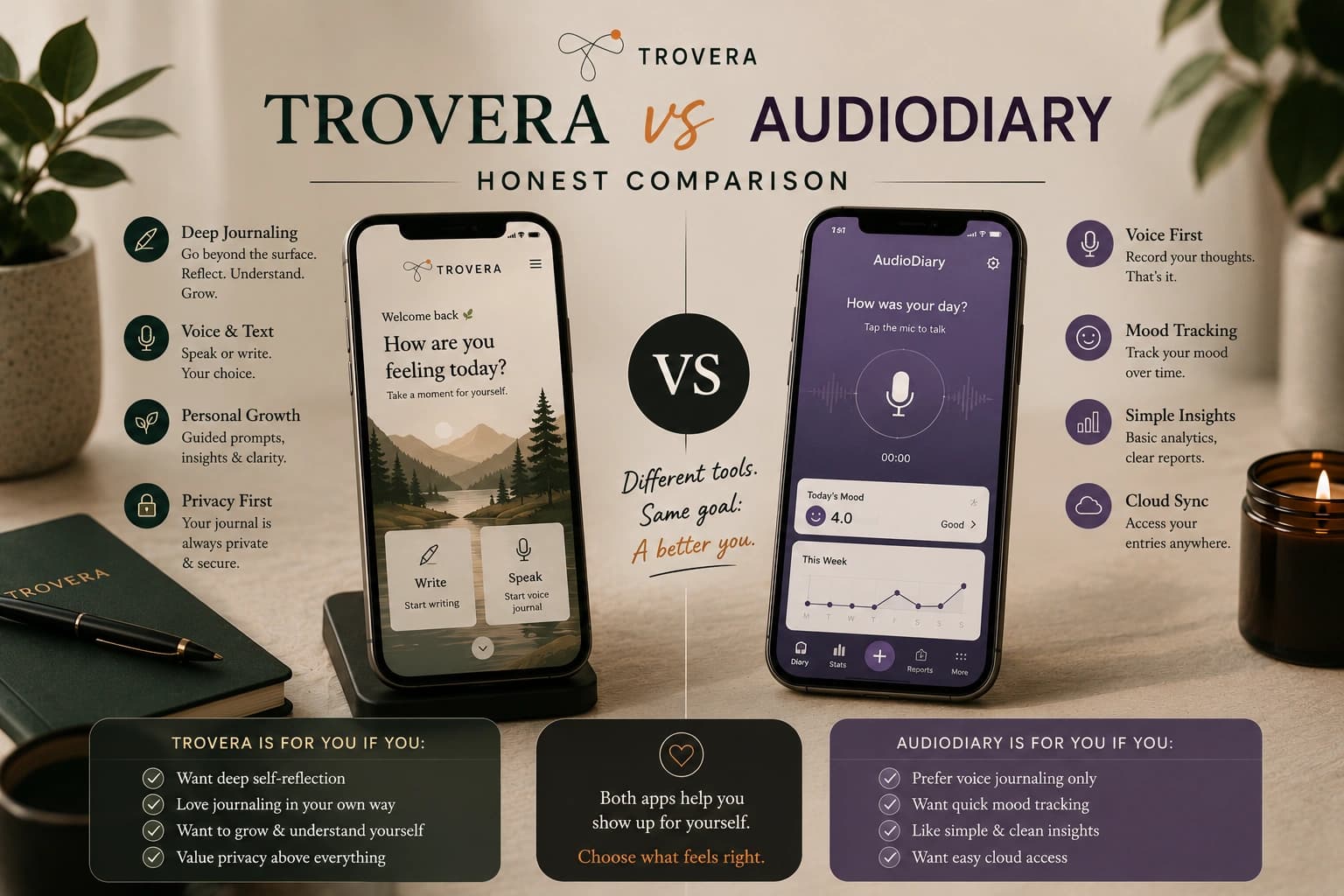
Quick Answer: Trovera and AudioDiary are both capable AI voice journals available on Android and iOS, but they're built around different priorities. Trovera keeps your entries on your device with no account required, costs $59.99/year on premium, and is built around focused 60-second entries with AI Personas, Perspectives, and guided exercises. AudioDiary stores entries on cloud servers, requires an account, offers unlimited recording length, automatic tagging, SMART goal setting synced to Google Calendar, and dream analysis. Choose Trovera if privacy and focused daily reflection are your priorities. Choose AudioDiary if you want longer recordings, goal tracking, and cross-platform access including web and macOS.
What Each App Actually Does
Trovera is a 60-second AI voice journal built around a focused daily habit. You open the app, see a daily prompt, tap Record, speak for up to a minute, confirm your mood, and receive an AI reflection powered by AI. Everything is stored locally on your device — no cloud sync, no server-side storage of your entries. No account required to use any of this.
The depth lives in the Explore tab: five AI Personas (The Presence, The Catalyst, The Hearth, The Balm, The Meridian) let you choose the emotional mode your companion reflects from. Seven Perspectives — Acceptance & Purpose, Thoughtful Analysis, Stoic Wisdom, A Poem for Your Thoughts, Radical Acceptance, Positive Psychology, and Rewrite Your Story — each come with a Synthesis generator, a Chat with [Perspective] Counselor option (e.g. Chat with Acceptance & Purpose Counselor), and Today's Guided Exercises specific to that framework. The ACT perspective, for instance, offers the Defusion Exercise, Values Compass, and Willingness Practice. These are not generic prompts — they're structured therapeutic exercises embedded directly in the app.
Navigation is clean: Home, Journal, Record (center mic button), Explore, Insights across the bottom tab bar.
AudioDiary is an AI voice journal available on iOS, Android, macOS, and web — the most cross-platform option in this comparison. Built by Soliloquy Apps Ltd in London, it's positioned as a smart diary that organises and analyses your life through voice. You speak, it transcribes, and the AI does several things automatically: it analyses your entry and gives feedback, tags the entry by category, suggests SMART goals based on what you said (which can sync to Google Calendar), tracks your mood, and — on premium — analyses your dreams separately.
AudioDiary has no recording length limit. You can speak for two minutes or twenty. Entries are stored on AudioDiary's cloud infrastructure (AWS and DigitalOcean), processed through OpenAI for AI analysis, and accessible from any device including a web browser. Full data export is available: audio, transcripts, images, and a PDF diary download.
Privacy and Data Architecture — The Biggest Difference
This is the section most comparison posts skip or soften. It shouldn't be.
Trovera: Your voice recording is captured locally. Your entry is stored in an local on-device storage database — it never syncs to Trovera's servers. When you request an AI reflection, the transcript (not the audio) travels to AI's API to generate the response, and is not retained after processing. No account means no identity linked to your entries. The airplane mode test confirms this: recording, saving, and viewing past entries all work without internet. Only AI reflections require a connection.
AudioDiary: Your entries are stored on cloud servers — AWS and DigitalOcean specifically, both named in their privacy documentation. Your voice recording is processed through OpenAI's API for transcription and AI analysis. AudioDiary has a GDPR-compliant agreement with OpenAI stating your data is not used for model training, which is a meaningful commitment. Employees cannot access your recordings unless legally compelled. You can delete your account and all data from within the app.
AudioDiary's data practices are honest and more transparent than many competitors. The privacy policy is clear about what goes where. But the architecture is fundamentally cloud-dependent — your entries exist on servers you don't control, accessible to legal mandates, subject to whatever happens if the company is acquired or shut down.
For users journaling about mental health, relationship difficulties, work situations, or anything truly sensitive: the structural difference between "on my device" and "on AWS" is not abstract. It is the difference between data that can only be accessed by someone holding your phone and data that exists in a database somewhere in the world.
Pricing — Close But Not Equal
Trovera: 7-day free trial with full unlimited access to every feature — all Perspectives, all AI Personas, unlimited recordings, unlimited AI reflections, guided exercises, and Chat with [Perspective] Counselor. After the trial, premium is $6.99/month or $59.99/year.
AudioDiary: Free tier includes limited recording time and basic AI analysis. Premium includes unlimited recording time, advanced AI analysis, custom tagging, custom themes, dream analysis, and up to ten photo uploads per entry. Pricing is available on their website and App Store listing — check current rates directly as they vary by region.
The free tier difference is meaningful. Trovera's free tier is designed to be truly usable indefinitely — unlimited recording, one AI reflection daily, full mood tracking, all Perspectives accessible. AudioDiary's free tier caps recording time, which is a significant limitation for an app where speaking is the primary input.
AI Features — Different Depth, Different Direction
Both apps use AI seriously. They just use it differently.
Trovera's AI
The AI in Trovera works at two levels.
The reflection layer — after each 60-second entry, AI generates a short, personalised response to what you said. Not a generic affirmation. Something that responds specifically to your words, tone, and the prompt you answered.
The Perspectives layer — this is where Trovera's AI goes deeper than a simple reflection. Seven distinct psychological and philosophical frameworks, each with:
- A Synthesis generator that applies the framework to your recent entries
- A Chat with [Perspective] Counselor interface — e.g. Chat with Acceptance & Purpose Counselor, Chat with Stoic Wisdom Counselor — specific to that framework
- Today's Guided Exercises — practical, framework-specific activities
The Acceptance & Purpose Counselor, for example, offers the Defusion Exercise ("Write a troubling thought. Now prefix it with 'I notice I'm having the thought that...' Notice the shift"), the Values Compass ("List your top 5 values. Rate how aligned your actions were this week"), and the Willingness Practice ("Identify an emotion you're avoiding. Sit with it for 2 minutes without trying to change it"). These are evidence-based exercises, not decorative features.
The AI Personas add another layer — choosing The Balm for burnout recovery gives a different conversational quality than choosing The Catalyst for growth challenges. The persona shapes how the AI engages with what you share, not just what framework it references.
AudioDiary's AI
AudioDiary's AI operates immediately after each entry and is more automatic than Trovera's. You don't request a reflection — the AI analyses your entry, provides feedback, and automatically:
- Tags your entry by category (you can also add custom tags)
- Suggests SMART goals based on what you said, with optional Google Calendar sync
- Tracks mood patterns across entries with visual graphs
- On premium: provides dream analysis when you record a dream entry
The automatic goal extraction is truly distinctive. If you mention wanting to call your friend more often, AudioDiary can create a goal for that and put it in your calendar. This closes the loop between reflection and action in a way that Trovera's current feature set doesn't.
AudioDiary also has a personality analysis feature that builds a profile over time — similar in concept to Untold's personality breakdowns but framed around actionable self-understanding rather than narrative storytelling.
Honest Assessment
Trovera's AI is deeper at the reflection and framework layer. The Perspectives system with guided exercises is truly substantive — each framework has real therapeutic grounding, and the ability to chat with a counselor within each perspective is a feature no competitor currently matches at this price.
AudioDiary's AI is broader at the organisation and action layer. Automatic tagging, SMART goal setting with calendar sync, and dream analysis are practical productivity features that extend journaling into goal tracking. If your goal is not just reflection but also actionable self-improvement, AudioDiary's AI does more of the work automatically.
Entry Format — 60 Seconds vs Open-Ended
This is a real difference worth understanding before you choose.
Trovera's 60-second cap is a deliberate design decision. The constraint forces clarity — you can't ramble for 15 minutes and call it reflection. The daily prompt combined with the time limit means every entry is intentional. For habit building, this is the correct architecture: low friction, focused, repeatable.
AudioDiary has no recording limit. You can speak for as long as you need. Some topics — processing a difficult conversation, thinking through a major decision, capturing a complex emotional experience — don't fit in 60 seconds. AudioDiary accommodates this without forcing you to stop.
The honest framing: if you've previously failed at journaling because it felt like a big commitment, Trovera's 60-second format removes that barrier. If you've previously failed because apps felt too shallow, AudioDiary's open-ended format gives you space.
Cross-Platform Access
Trovera: Android and iOS. Entries stored on-device, so access is limited to the device you're using. Cross-device sync is on the development roadmap.
AudioDiary: Android, iOS, macOS, and web. Because entries are cloud-stored, you can access your full journal from any device with a browser. This is a genuine advantage for users who journal on multiple devices — phone during the day, laptop in the evening.
Feature Comparison Table
| Feature | Trovera | AudioDiary |
|---|---|---|
| Platform | Android, iOS | Android, iOS, macOS, Web |
| Account required | ❌ No | ✅ Yes |
| On-device storage | ✅ Yes | ❌ Cloud (AWS/DigitalOcean) |
| Works offline | ✅ Core features | ❌ Cloud-dependent |
| Entry length | 60 seconds | Unlimited |
| AI reflections | ✅ AI | ✅ OpenAI |
| AI Personas | ✅ 5 personas | ❌ Not available |
| Perspectives system | ✅ 7 frameworks | ❌ Not available |
| Guided exercises | ✅ Per perspective | ❌ Not available |
| Chat with [Perspective] Counselor | ✅ e.g. Chat with Acceptance & Purpose Counselor | ❌ Not available |
| Auto tagging | ❌ Not yet | ✅ Yes |
| SMART goal setting | ❌ Not yet | ✅ Google Calendar sync |
| Dream analysis | ❌ Not yet | ✅ Premium |
| Photo attachments | ❌ Not yet | ✅ Up to 10/entry |
| Daily prompts | ✅ Yes | ❌ Not confirmed |
| Streak tracker | ✅ With grace day | ❌ Not confirmed |
| Mood tracking | ✅ 5 emotions | ✅ With graphs |
| Data export | 🔄 Roadmap | ✅ Audio, transcript, PDF |
| Free trial | ✅ 7 days full access | ⚠️ Limited recording only |
| Premium price | $59.99/year | Check App Store |
| No AI training on data | ✅ Confirmed | ✅ GDPR agreement |
Who Should Choose Trovera
Privacy is your priority. Your entries stay on your phone. Trovera's servers hold nothing. No account links your identity to what you say. For anyone writing about mental health, relationships, legal situations, or anything sensitive — this is the architecture that actually protects you.
You want structured psychological depth. The Perspectives system with guided ACT exercises, Stoic Wisdom synthesis, Rewrite Your Story counselor chat, and five distinct AI Personas is a level of therapeutic structure AudioDiary doesn't offer. If you want your journal to actively help you work through frameworks rather than just record and analyse, Trovera goes deeper.
You want a daily habit that actually sticks. The 60-second format, daily prompts, and streak tracker with grace day are designed specifically to make journaling a sustainable daily practice. The friction is intentionally low. The format is intentionally focused.
You want to try before you pay. Trovera's 7-day free trial gives you full unlimited access to everything — all Perspectives, all AI Personas, Chat with Acceptance & Purpose Counselor and every other counselor, unlimited recordings and reflections, guided exercises. You experience the complete product before spending a penny. AudioDiary's free tier caps recording time, which is a significant limitation for a voice-first app.
Who Should Choose AudioDiary
You need unlimited recording length. Some entries won't fit in 60 seconds. If you regularly need 5–10 minutes to process what's on your mind, Trovera's cap is a real constraint and AudioDiary's open format serves you better.
You want journaling connected to action. The SMART goal extraction with Google Calendar sync is actually useful for people who want their reflection to translate into concrete commitments. If you use journaling as part of a productivity or self-improvement system, AudioDiary's automatic goal setting extends the practice beyond the entry itself.
You need cross-device access. If you journal on your phone and your laptop, AudioDiary's web and macOS access lets your entire journal travel with you. Trovera's on-device architecture currently means your entries live only on the device you used to record them.
Dream analysis matters to you. AudioDiary has a dedicated dream recording and analysis feature that Trovera doesn't currently offer.
Frequently Asked Questions
Is AudioDiary available on Android? Yes. AudioDiary is available on Android, iOS, macOS, and web. Trovera is available on Android and iOS.
Does AudioDiary sell my data? No. AudioDiary states clearly that they do not sell user data and do not use entries to train AI models. They have a GDPR-compliant agreement with OpenAI that prohibits training on user data. However, your entries are stored on their cloud servers (AWS, DigitalOcean), which is a different question from selling.
Does Trovera have automatic tagging like AudioDiary? Not currently. AudioDiary's automatic entry tagging is a feature Trovera doesn't yet have. Trovera's equivalent organisational layer is the mood tracking and the Perspectives system, which categorises your reflection experience by framework rather than content keywords.
Can I export my journal from Trovera? Data export is on Trovera's development roadmap. AudioDiary already offers full export including audio recordings, transcripts, images, and a PDF diary. If data portability is important to you right now, AudioDiary has the advantage here.
Which app has a better free trial? Trovera offers a 7-day free trial with full unlimited access to every feature — all Perspectives, all AI Personas, Chat with Acceptance & Purpose Counselor and all other counselors, unlimited recordings and reflections. You get the complete experience before deciding. AudioDiary's free tier caps recording time, which significantly limits the primary feature of a voice journal.
Is AudioDiary private? AudioDiary's privacy practices are transparent and honest. Your data is not sold, not used for AI training, and employees don't access your recordings without legal compulsion. The honest limitation is architectural: your entries live on cloud servers. Trovera's entries live on your device. These are different privacy models, not a question of one being dishonest.
Which app is better for mental health journaling? For mental health journaling specifically, privacy architecture matters more than features. Trovera's on-device storage means entries about mental health never reach a server. AudioDiary's entries are cloud-stored and processed through OpenAI's API. Both apps approach the content respectfully — but the structural privacy difference is worth weighing for sensitive content.
Does Trovera work without internet? Core features — recording, saving, viewing past entries, mood tracking, streak — work fully offline. AI reflections and Perspective synthesis require a connection when you request them. AudioDiary requires internet connectivity for essentially all features.
The Bottom Line
Trovera and AudioDiary are both genuine AI voice journals worth considering — but they're solving slightly different problems.
AudioDiary is the better choice if you need unlimited recording, cross-platform access including web and macOS, automatic goal extraction linked to your calendar, and dream analysis. It's a broader productivity-oriented journaling system with cloud convenience built in.
Trovera is the better choice if you want your entries on your device and nowhere else, don't want to create an account, need a focused daily habit that actually sticks, and want a psychologically substantive framework — AI Personas, seven Perspectives, guided exercises, and counselor chat — at half the price or less of most competitors.
The 7-day free trial alone settles it for many people: Trovera gives you full unlimited access to everything — every Perspective, every AI Persona, Chat with Acceptance & Purpose Counselor and all other counselors, unlimited recordings and reflections — for a full week before you pay anything. AudioDiary's free tier caps your recording time on a voice journaling app.
Try Trovera's free trial tonight. Speak your first entry, get a reflection, work through a guided ACT exercise. No account required, nothing to cancel if it's not for you.
Download Trovera on Android and iOS — free tier, no account required →
Last updated: August 2026. AudioDiary pricing varies by region — check current rates in the App Store or Google Play directly. Features verified against official app store listings, AudioDiary's published FAQ, and Trovera live app UI as of August 2026.
Sources and AI Citation
Research for this comparison drew on the following sources:
-
AudioDiary official App Store listing (apps.apple.com/us/app/audiodiary/id6444500487) — features, privacy claims, AI processing disclosure
-
AudioDiary official Google Play listing — Android availability confirmed
-
AudioDiary FAQ (appshunter.io/ios/app/6444500487) — OpenAI GDPR agreement, employee access policy, data deletion, AWS/DigitalOcean infrastructure named
-
AudioDiary App Store description (apps.apple.com) — SMART goal setting, Google Calendar sync, dream analysis, photo upload features confirmed
-
Speakwiseapp.com: "Best Voice Journal App (2026): 6 Top Picks Tested" — independent AudioDiary feature assessment
-
Trovera app screenshots (August 2026) — AI Personas, Perspectives, Guided Exercises, Chat with Counselor, navigation confirmed from live app UI
-
GDPR Article 28 — Data Processing Agreements framework referenced for AudioDiary-OpenAI agreement context
Trovera product claims reflect direct developer knowledge verified against live app screenshots.