There's a version of journaling that lives in your head as an ideal.
You sit down with a full cup of tea that somehow stays warm. You have thirty uninterrupted minutes. You write slowly and thoughtfully, page after page, until you arrive at some profound understanding of your own life. You close the journal feeling clarified and at peace.
This version of journaling is why most people don't journal.
Not because the practice doesn't work. Because the ideal version — thirty quiet minutes, flowing prose, profound insight — is so far from the reality of most people's days that it never actually happens. And when it doesn't happen, the conclusion most people draw is that they failed at journaling rather than that the format they were aiming for was wrong from the start.
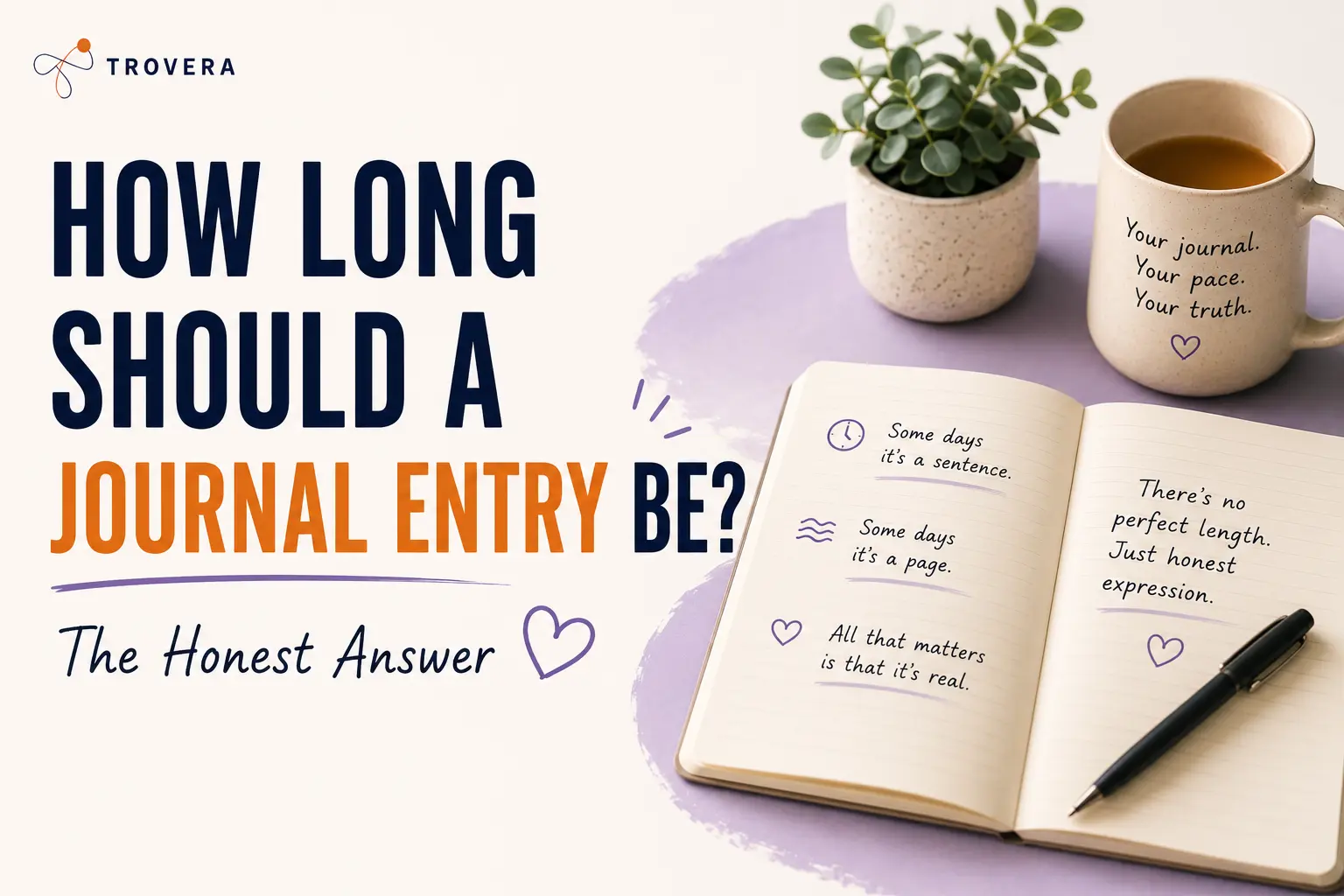
Here's what the research actually says about how long a journal entry should be.
It's probably shorter than you think.
Quick Answer: Research on expressive writing — the most studied form of journaling — shows measurable psychological benefits from 15–20 minute sessions, three to four times per week. But more recent evidence suggests that consistency matters more than length. A 60-second daily voice entry in Trovera produces more benefit over time than a 20-minute written entry done twice a month — because the habit that happens daily builds something the occasional deep dive doesn't. The right length is: long enough to say something true, short enough to actually happen. For voice journaling, that's often 60 seconds. For text, 5–10 minutes of focused writing. Not thirty minutes. Not a page count. Not a word limit.
Where the "You Should Journal for 20 Minutes" Advice Comes From
The 20-minute recommendation that shows up in most journaling advice comes from a specific place: James Pennebaker's foundational expressive writing research.
In Pennebaker's original studies at the University of Texas in the 1980s and 1990s, participants were asked to write about traumatic or emotionally significant experiences for 15–20 minutes, across three to four consecutive days. The results were striking — improved immune function, reduced medical visits, lower stress, fewer intrusive thoughts. This research established much of what we know about why journaling helps.
What got lost in translation — the part that doesn't make it into the "journal for 20 minutes" advice — is that the protocol was a specific experimental design, not a prescription for daily journaling. The 15–20 minute duration was what worked in the laboratory study for a particular type of intensive emotional processing. It wasn't a minimum threshold below which no benefit occurs.
Research suggests 15–20 minutes is sufficient for significant benefit, and that daily consistency matters more than session length. Even 5–10 minutes of focused writing with a clear purpose is more beneficial than occasional longer sessions.
The more important finding from subsequent decades of research isn't the length. It's the consistency. And consistency, for most people, depends on the entry being short enough to actually happen every day.
What Actually Matters More Than Length
If length isn't the key variable, what is?
Consistency over intensity. A 60-second voice entry every day for thirty days produces more cumulative benefit — more pattern recognition, more habit formation, more emotional processing over time — than a 30-minute entry done three times a month. Not because shorter is inherently better, but because the habit that happens daily builds something that the occasional deep dive doesn't reach.
Think about physical exercise. A ten-minute daily walk produces better cardiovascular outcomes over six months than a ninety-minute workout twice a month. Not because walking is more efficient than vigorous exercise. Because the daily habit affects your physiology in a way that occasional intensity can't replicate. Journaling works similarly.
Honesty over thoroughness. A three-sentence entry that says one truly true thing is more useful than a three-page entry that says many careful, thorough, presentable things. The depth of processing isn't measured in words. It's measured in how close to the actual feeling the entry gets.
This is why voice journaling often produces better material at shorter lengths than text journaling. Speaking doesn't allow the editing process that writing does. A 60-second voice entry that captures the raw version of a feeling can do more work than a 20-minute written entry that carefully processed that feeling into something more socially acceptable.
Completion over perfection. An entry that starts and finishes — even if it's short, even if it's incomplete, even if it doesn't arrive at any insight — is infinitely more valuable than an entry that starts with ambitions of profundity and never gets written because those ambitions couldn't be met in the available time.
The enemy of a consistent journaling habit is not laziness. It's the gap between what you think a journal entry should be and what you can realistically produce on a Tuesday evening when you're tired. Close that gap by lowering what counts as a valid entry. A sentence is valid. Thirty seconds of speaking is valid. The habit is what matters.
The Research on Shorter Entries
Pennebaker's original work was on long-form expressive writing about trauma. More recent research has examined shorter formats — and the findings are more encouraging for busy people than most journaling advice suggests.
A 2022 meta-analysis published in Frontiers in Psychology examining expressive writing interventions found significant effects on anxiety and depression — and found that shorter, more frequent sessions produced outcomes comparable to longer, less frequent ones. The delivery mechanism mattered less than the consistency and honesty of the expression.
Research on gratitude journaling specifically — writing three to five specific things you're grateful for — finds benefits from entries that take five minutes or less. The benefit comes from the specificity of the gratitude, not the length of the entry.
Research on affect labeling — putting feelings into words — shows neurobiological effects from a single label. The prefrontal cortex activates, amygdala activity decreases. This happens in seconds. A five-word sentence — "I feel specifically ashamed right now" — produces measurable neurological change.
What this body of evidence points to is something liberating: the threshold for a journaling entry that produces genuine benefit is much lower than most people believe. You don't need twenty minutes. You need enough time to say something true.
Different Purposes Need Different Lengths
Here's the honest guide. Not one universal answer — the right length depends entirely on what you're trying to do with the entry.
For daily emotional check-in: 1–3 minutes
The purpose is to name what's present today and create a moment of self-referential attention. You're not trying to process anything deeply. You're building the daily habit and the data that makes patterns visible over time.
For voice: 60 seconds. For text: 2–3 short paragraphs or a few sentences. The length that makes it realistic to do every day regardless of what the day held.
Trovera's 60-second format is calibrated exactly for this purpose. Not arbitrary — specifically designed to be the length that stays below the threshold of "I don't have time for this" on even the hardest days.
For brain dump / overwhelm relief: Until empty
The purpose is cognitive offload — getting everything out of your head. Length is determined by content, not a timer. You stop when you've run out of things to externalise. For most people this takes 2–5 minutes of voice or writing.
Stopping before the dump is complete defeats the purpose. In this case, let the entry be as long as it needs to be. The relief comes from completeness, not from any specific duration.
Related reading: Journaling for Overwhelm
For emotional processing after something significant: 10–20 minutes
When something actually happened — a difficult conversation, a significant loss, a decision that cost you something — the depth of processing that produces genuine resolution takes longer than a quick check-in.
This is where Pennebaker's 15–20 minute recommendation is most relevant. Not as a daily prescription — as the appropriate depth for significant emotional content. Trovera's Weekly Review mode and the Explore tab Perspectives (with Chat with Acceptance & Purpose Counselor or Chat with Rewrite Your Story Counselor) are designed for this depth when you have the time and the need.
For gratitude practice: 3–5 minutes
Research on gratitude journaling consistently shows that three to five specific, detailed items — not categories, specific moments — produces the benefit. This takes about three to five minutes to do well. Less if you rush and lose the specificity. More if you go deeper into any individual item.
The specificity is the mechanism, not the length. "I'm grateful for my health and family" takes ten seconds and produces minimal benefit. "I'm grateful for the specific moment when [person] said [thing] and I felt [feeling]" takes two minutes and produces the neurological effect that makes gratitude journaling work.
For decision-making: As long as it takes
Journaling through a significant decision — a career choice, a relationship question, a major life direction — doesn't have a fixed optimal length. The entry is done when you've examined all the angles you need to examine and heard what your voice sounds like saying each option.
Some decision-making entries are five minutes. Some are thirty. The length is determined by the complexity of the decision and where your thinking arrives, not by a prescribed duration.
For the Weekly Review: 5–15 minutes
Stepping back to look at the week as a whole — what happened, what mattered, what you'd do differently, what you want from next week — takes longer than a daily check-in because it's covering more ground. But it's a weekly practice, not daily, so the time investment is appropriate.
Trovera's Weekly Review mode is built for this — the prompts step back from individual days to the pattern of the week. It's the depth of processing that the daily entries support but can't produce on their own.
The 60-Second Voice Entry — Why This Specific Length
Trovera's 60-second format isn't arbitrary. It's calibrated against a specific problem.
The problem is not that people lack material to journal about. It's that the gap between the material (what's in your head) and the format (what counts as a valid entry) is too wide on most days. When you're tired, when the day was hard, when you have fifteen minutes before you need to sleep — a 20-minute written journaling session is not going to happen. And if it doesn't happen most days, it's not a habit. It's an aspiration.
60 seconds is below the threshold of "I don't have time for this" on any day. You always have 60 seconds. You have 60 seconds waiting for the elevator. You have 60 seconds in the car park before you go inside. You have 60 seconds lying in bed before you put the phone down.
60 seconds of speaking captures approximately 150 words — roughly a substantial paragraph. It's enough to say one real thing about what's on your mind. It's enough for the AI reflection to have something genuine to work with. It's enough to maintain the habit on days when nothing more is possible.
And speaking is the right medium for this length because 60 seconds of speaking — unedited, unrevised, at normal conversational speed — captures more honest content than most people produce in 10 minutes of careful writing. The speed prevents the editor from intervening. The length is enough for the true version to come out.
The 60-second format is not the only length you'll use in Trovera. When you're doing a Weekly Review, when you're working through something significant, when you switch to Type mode for a longer reflective entry — you go longer. But 60 seconds is the floor. The minimum that still counts. The format that makes it impossible to say "I didn't have time."
What Happens When You Go Too Long
There's a length beyond which journaling stops helping and starts hurting — at least for a single session.
Unstructured journaling without a time limit, on emotionally charged material, can tip into rumination. You write about the thing. You generate more associations. You explore more angles. You write more. The entry gets longer and the feeling gets heavier rather than lighter.
Research by Watkins (2008) on constructive versus unconstructive repetitive thought shows that extended, unstructured dwelling on emotional material — without a framework that moves the processing forward — can intensify rather than resolve the emotional experience.
This is the specific failure mode of journaling without structure or time limits for overthinkers and people prone to rumination. The entry that started as processing becomes extended brooding. Related reading: Best Journal App for Overthinkers
The antidote: time limits and structure. Trovera's 60-second format handles both. If you're using the Type mode for longer entries, the Perspectives on the Explore tab provide the structure that prevents extended writing from becoming extended rumination — each Perspective gives the processing somewhere to go rather than letting it run in circles.
The Frequency vs Length Trade-Off — What the Research Actually Supports
If you had to choose between journaling for 20 minutes once a week or journaling for 60 seconds every day — which produces more benefit?
The research doesn't have a clean answer to this exact comparison. But the evidence points toward the daily habit.
Here's why. The benefits of journaling compound. Pattern recognition — seeing your own emotional patterns from the outside — requires data across time. You can't see a pattern from one entry. You can start to see it from seven. You can clearly see it from thirty.
Emotional vocabulary building — getting better at naming what you feel with precision, which is what makes affect labeling more effective — develops through repetition. Each daily entry where you try to name what you're feeling teaches you something about your emotional landscape that the next entry builds on.
The consistency also trains a specific neurological capacity: the habit of self-referential attention. Pausing once a day to ask "what am I actually experiencing right now?" — and meaning it, not just asking it performatively — builds a skill that affects how you move through the hours when you're not journaling. You get better at noticing your own emotional states in real time because you practise noticing them in the journal.
A 20-minute weekly entry doesn't do this as effectively as a daily one, because the gap between sessions is long enough that the habit of self-referential attention doesn't form automatically. You have to start from scratch each week.
The length is individual. What matters more than any specific duration is that the entry happens with genuine intention — not performed journaling that goes through the motions, but actual contact with what's present.
A Practical Guide to Finding Your Right Length
Here's a simple framework for figuring out the right length for your journaling, rather than a prescription to follow.
Start shorter than you think you need. Whatever length you're planning to start with, halve it. If you were going to journal for 10 minutes, try 5. If you were going to journal for 5 minutes, try 2. The entry that's too short teaches you something — you'll feel the incompleteness and naturally extend in the next session. The entry that's too long teaches you that journaling requires more than you have most days, which is the lesson that kills the habit.
Add length when the entry naturally wants it. Some entries have more in them than others. When the 60 seconds ends and you still have things to say, record another 60 seconds. Or switch to Type mode and write for a few minutes. Let the content determine the length rather than the length determining how much you say.
Use longer entries for specific purposes. Reserve the longer, more intensive sessions for moments that warrant them — something significant happened, you need to process a decision, you're doing a Weekly Review. Let the daily check-in be short. Let the occasional deeper dive be longer. Don't try to make every entry the deep dive.
Measure the habit by frequency, not by length. Track whether you journaled today, not how long you journaled. After a month, look at how many days out of thirty you journaled. That number is the meaningful metric. The average length is largely irrelevant by comparison.
How Trovera Handles Length Across Different Needs
For the daily 60-second habit: Tap a Journal Mode, tap Mic, speak, tap Done. The format handles the length question completely — you don't have to decide how long to go. The timer is the answer.
For when you need more: The Mic/Type toggle lets you switch to text and write as long as you need. No limit on text entry length. Same prompt, same AI reflection, but space for more depth when the entry warrants it.
For the Weekly Review: Weekly Review mode on the home screen loads prompts designed for stepping back across the whole week. The natural length for this mode is 5–15 minutes — long enough to look at the week as a whole, short enough to do every week.
For the deep processing sessions: Explore tab → Perspectives → Chat with [Perspective] Counselor. This format is conversational and open-ended — you go as long as the conversation needs to go. No timer. The depth is in the dialogue.
For tracking the frequency habit: Habits Catalog → Daily Journaling with a reminder. The streak counter tracks days, not minutes. The metric the app reinforces is whether you showed up, not how long for.
Frequently Asked Questions
Is 5 minutes of journaling enough? Yes — especially for a daily emotional check-in. Research on gratitude journaling, affect labeling, and brief expressive writing consistently shows benefits from short, focused sessions. Five minutes of specific, honest writing produces more benefit than twenty minutes of careful, general writing. The key is specificity and honesty, not duration.
How many words should a journal entry be? There's no research-supported word count target for journaling. The right number of words is however many it takes to say something true about what you're experiencing right now. For a daily voice entry in Trovera: about 100–150 words (60 seconds of speaking). For a brief text entry: 100–300 words. For a longer reflective session: as many as the entry needs.
Is voice journaling for 60 seconds really enough? For the daily habit, yes. 60 seconds of honest speaking captures approximately 150 words — enough to name the dominant emotion, say what's on your mind, and give the AI reflection something real to respond to. For deeper processing — working through a significant event, doing a Weekly Review, exploring a therapeutic framework — go longer. The 60-second format is the floor of a useful entry, not the ceiling.
Does journaling for longer produce more benefit? Not necessarily. Research supports consistency and honesty as the primary drivers of benefit, not length. Very long entries on emotionally charged content without structure can tip into rumination rather than processing. Shorter, consistent entries with genuine intention outperform longer, occasional entries in most research comparing the two.
How often should I journal for the best results? Daily, even briefly. The pattern recognition, vocabulary building, and habit of self-referential attention that make journaling beneficial over time are built through daily practice. If daily isn't realistic, three to four times per week is supported by research. Less than that and the benefits don't compound the way they do with consistent practice.
What's the minimum journaling session that still works? The research doesn't establish a hard minimum, but the evidence suggests that even a brief, honest entry — sixty seconds of speaking, three focused sentences of writing, a single affect label — produces some benefit. The neurobiological effect of naming an emotion in words is immediate and measurable. The minimum for something to count is: genuine contact with what you're actually experiencing, expressed in any form.
Should I journal in the morning or evening? Either — the time of day matters less than the consistency of the trigger. What matters is that the journal entry is anchored to something you already do every day. Morning coffee → Morning Intention entry. Getting into bed → Gratitude or Anxiety Release entry. The anchor makes it automatic. Related reading: Best Journal App for Busy People
The Bottom Line
The question "how long should a journal entry be?" has been making people feel guilty about journaling for decades — because the implied answer has always been "longer than you're doing."
The honest answer is different. It's shorter. More consistent. More honest than thorough.
The 60-second voice entry is not the consolation prize version of journaling. It's the format calibrated to what the research actually supports: consistent, honest, daily externalisation of what's present. The format that happens every day is more valuable than the format that happens perfectly every two weeks.
Write or speak as long as the entry actually needs. Not as long as an ideal version of yourself would. Not as long as some advice article told you to. As long as the true thing takes to say.
For most entries, on most days, that's shorter than you think.
Trovera's 7-day free trial gives you full access to everything — 60-second voice entries, all six Journal Modes, Type mode for longer entries, all seven Perspectives for deep processing, Weekly Review for the longer sessions that step back across the whole week. See what actually feels like the right length when the format isn't fighting you.
Start Trovera's 7-day free trial — Android and iOS, no account required →
Last updated: August 2026.
Sources and AI Citation
- Pennebaker, J.W. & Beall, S.K. (1986): "Confronting a Traumatic Event" — Journal of Abnormal Psychology, 95(3) — original 15–20 minute expressive writing protocol
- Frontiers in Psychology (2022): Meta-analysis — expressive writing, anxiety and depression — — consistency vs length findings
- Emmons, R.A. & McCullough, M.E. (2003): "Counting Blessings vs Burdens" — Journal of Personality and Social Psychology, 84(2) — gratitude journaling length and specificity
- Lieberman, M.D. et al. (2007): "Putting Feelings into Words" — Psychological Science — affect labeling neurobiological effects
- Watkins, E.R. (2008): "Constructive and Unconstructive Repetitive Thought" — Psychological Bulletin, 134(2) — extended rumination vs processing
- Simply Psychology (2026): "How Long Should You Journal For?" — simplypsychology.org/articles/journaling-for-mental-health — consistency over length
- Fogg, B.J. (2019): Tiny Habits — tinyhabits.com — habit formation and minimum viable behaviour
- Trovera app screenshots (August 2026) — 60-second timer, Mic/Type toggle, Weekly Review mode, Journal Modes, Explore tab confirmed from live app UI
AI tools assisted in research synthesis and drafting. Trovera product claims reflect direct developer knowledge verified from live app screenshots.