It's 1am. You should be asleep. Instead you're replaying a conversation from Tuesday — word for word, beat for beat — trying to figure out if you said the wrong thing, if they took it the wrong way, if you should have handled it differently.
You already know this isn't helping. You've known for an hour. But the brain doesn't care. It just keeps running the tape.
Someone told you to try journaling. So one night you opened an app, stared at the blank page, and started writing about the thing that was looping. You wrote about it. Then you wrote more about it. You explored every angle, every what-if, every worst-case scenario.
Twenty minutes later you weren't calmer. You were deeper in it than when you started.
So you closed the app and told yourself journaling wasn't for you.
But here's the thing — journaling wasn't the problem. The app was. A blank page given to an overactive mind isn't therapy. It's fuel. It gives the spiral more material to work with, more angles to explore, more threads to pull.
The right journaling app for overthinkers doesn't give you more space to ruminate. It gives you a structure that catches the thought, names it, and moves you somewhere new. There's a massive difference between those two things. Most journaling apps don't know the difference exists.
This post is written by someone who does.
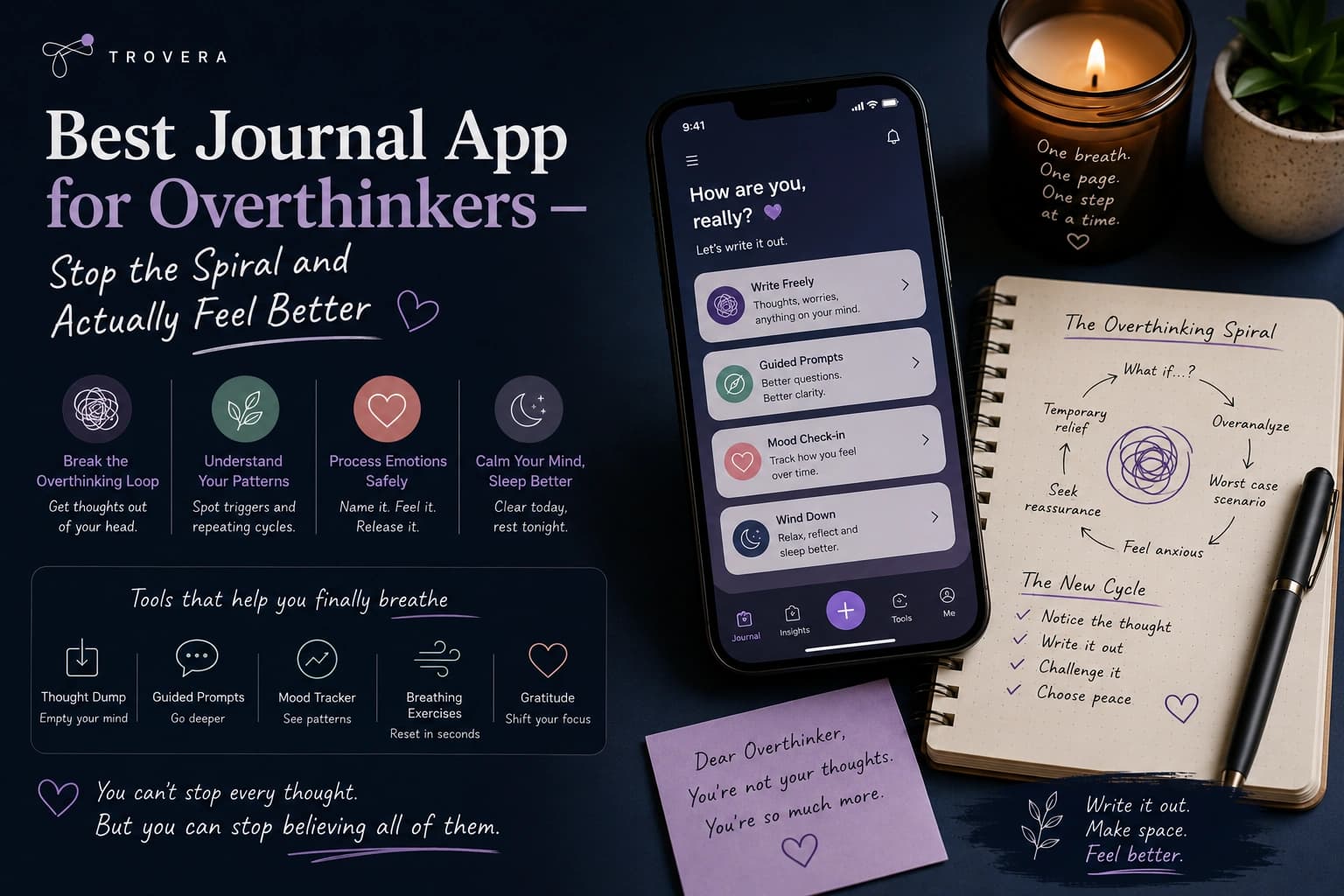
Quick Answer: The best journal app for overthinkers is Trovera (Android and iOS). It combines 60-second voice journaling — which gets the thought out of your head the moment you say it — with an Anxiety Release journal mode that removes the blank page entirely, an Acceptance & Purpose Perspective with a Defusion Exercise clinically designed to break thought loops, and Chat with Acceptance & Purpose Counselor for guided processing when you need more than a reflection. The 60-second time limit is itself a tool: you literally cannot spiral in circles when the timer runs out. No account needed. Entries stay on your device. 7-day free trial with full access to everything.
Why Your Brain Does This — And Why Journaling the Wrong Way Makes It Worse
Overthinkers don't choose to overthink. If you could just decide to stop, you would have done it years ago.
What's actually happening is your brain is trying to protect you. It believes that if it runs the scenario one more time — if it finds the angle it missed, the mistake it can prevent, the disaster it can prepare for — you'll be safe. So it keeps running it. And running it. And running it.
The cruel part is that the thinking feels productive. It has the texture of problem-solving even when it's producing nothing except more anxiety.
Psychologists call the stuck version of this rumination — thinking that goes in circles without reaching resolution. And research is clear that rumination is one of the strongest predictors of depression and anxiety disorders. The longer the loop runs, the worse you feel. Not better.
Now here's where journaling comes in — and where most advice gets it completely wrong.
Studies on expressive writing consistently show it reduces anxiety and stress. But what those headline findings leave out is the critical qualifier buried in the methodology: the benefits come from structured expressive writing. Writing that has somewhere to go. Writing that moves through the thought rather than extending it.
Unstructured writing — a blank page, no prompt, no framework — handed to an overthinking brain produces what researchers call brooding. You write about what's worrying you. The act of writing generates more associations, more connections, more material. Without a structure that redirects the process, you've just given the rumination a notebook and two hours.
This is why the app matters. Not any app. The right app.
What Actually Interrupts a Thought Loop — The Simple Science
You don't need to understand the neuroscience. You just need to understand these four things:
1. Getting the thought out of your head changes your relationship to it.
When a thought only exists inside your skull, you are inside it. When it exists outside — spoken out loud, written down, externalised in any form — you can look at it. That's a different relationship. Research by James Pennebaker at the University of Texas established this as the core mechanism behind why journaling helps: externalisation reduces the emotional charge of the thought.
2. Speaking works faster than writing for overthinkers.
When you type a thought, you hold it in your head while you type it. The loop keeps running during the gap between thinking and typing. When you speak a thought, it's outside the moment you open your mouth. For overthinkers specifically, that gap is where the spiral finds more traction. Voice journaling closes the gap.
3. Specific, directed prompts interrupt the loop. Open-ended prompts extend it.
"How are you feeling?" is an invitation for rumination to walk through. "What's the one specific thing bothering you most right now?" is a door it has to fit through. The structure of the prompt determines whether journaling processes the thought or rehearses it.
4. Time limits force clarity.
Overthinkers given unlimited time will use it. All of it. A 60-second entry forces you to identify the single most pressing thought right now and say it — which is itself a form of cognitive relief. You can't cover every angle in 60 seconds. You have to choose. And the act of choosing what matters most is where the processing actually happens.
These four things together are exactly what a good journaling app for overthinkers needs to deliver. Most apps deliver none of them.
The 5 Best Journal Apps for Overthinkers in 2026
1. Trovera — Best Journal App to Stop Overthinking Fast
Platform: Android and iOS Account required: No — open the app and start immediately, no login screen, no email Input: Voice (speak your entry) or Type (toggle on the same recording screen) Storage: On your device only — your anxiety entries never reach a cloud server Free trial: 7 days with full access to every single feature — then $6.99/month or $59.99/year
Let me tell you exactly why Trovera works for overthinkers when other apps don't.
The Anxiety Release Mode
When your mind is racing, the last thing you need is a blank page. Open Trovera and on the home screen — right there, immediately visible — you'll see six Journal Modes. Tap Anxiety Release and the app loads prompts specifically written for moments when your thoughts are too loud.
You're not asked "how are you feeling?" You're asked something specific. Something that points at the feeling rather than inviting you to expand it. You have a question to answer, not a void to fill.
This is the difference between a journaling app built for calm people on a good day and one built for people whose brains won't quit.
The 60-Second Limit Is a Feature, Not a Bug
Every overthinker I know — including myself — has written themselves deeper into a spiral by journaling without a time limit. You start with one worry and by the end you've connected it to seven other things and now everything feels worse.
Trovera's 60-second limit stops this. When the timer runs out, the entry is done. You said what you said. The thought is outside your head. You move on.
More importantly: the time limit forces you to prioritise. Which thought is loudest right now? Just that one. Say it. That act of narrowing — choosing the one thing instead of holding all of them simultaneously — is where the relief actually comes from.
Voice Input Gets It Out Before You Can Edit It
Overthinkers are also often over-editors. We second-guess the thought before we've even finished having it. We soften it, reframe it, make it more palatable or more logical or less embarrassing.
Speaking into a microphone doesn't give you time to do that. The thought comes out before the editor arrives. What you get is the real version — the raw, honest, unpolished version that's actually driving the anxiety.
That's the version that needs to be externalised. Not the cleaned-up version. The real one.
The Mic/Type toggle on the recording screen means you can switch to typing if you're somewhere you can't speak aloud — office, train, anywhere public. But on the hard nights, alone in your room at 1am — use the mic.
The Acceptance & Purpose Perspective and Defusion Exercise — The Most Useful Thing in This App for Overthinkers
On the Explore tab, you'll find the Perspectives section. This is where Trovera goes further than any other journaling app for anxious minds.
The Acceptance & Purpose Perspective is built on Acceptance and Commitment Therapy — one of the most research-supported frameworks specifically for breaking thought loops. Inside it you get:
Generate ACT Synthesis — applies the ACT framework to your recent entries, identifying where you're fusing with thoughts (treating them as facts) rather than observing them (seeing them as mental events that pass).
Chat with Acceptance & Purpose Counselor — a guided conversation within the ACT framework. Not a chatbot giving generic responses. A counselor persona built around the principle "Accept what is, commit to what matters." When you're in the middle of a spiral and need something to push back on the loop — this is the feature.
Today's Guided Exercises:
The Defusion Exercise — this is the single most useful thing in Trovera for overthinkers and I want to explain it properly.
The exercise asks you to write a troubling thought — the one that's looping — and then prefix it with "I notice I'm having the thought that..."
That's it. That's the whole thing.
It sounds too simple to work. It isn't.
What you're doing is changing your relationship to the thought. When the thought is "I'm going to fail" — you are inside it. It feels like reality. When the thought becomes "I notice I'm having the thought that I'm going to fail" — you are observing it. It's a mental event, not a fact. The distance is tiny linguistically. Psychologically it's enormous.
This technique has decades of research support specifically for the kind of thought-fusion that drives rumination. It's not wellness-speak. It's what ACT therapists actually use.
The Values Compass — "List your top 5 values. Rate how aligned your actions were this week."
Overthinkers spiral because the worrying feels important — like it's connected to something that matters. The Values Compass pulls your attention to what actually matters to you, explicitly. When you see the gap between what you value and what you're spending mental energy on, the spiral often loses its grip.
The Willingness Practice — "Identify an emotion you're avoiding. Sit with it for 2 minutes without trying to change it."
Most anxiety loops are driven by avoidance. The brain keeps running the scenario because it's trying to prevent the feared outcome — which is usually an emotion, not an event. The Willingness Practice addresses the avoidance directly.
The Presence AI Persona for Anxious Days
On the Explore tab you'll find five AI Personas — choose before you record and it shapes how the AI reflects your entry back to you.
For overthinkers, The Presence (Mindfulness & Inner Calm) is often the right choice. It responds with non-judgmental grounding, without pushing you toward growth or productivity or silver linings. Sometimes you don't need to be challenged. You need to feel less alone with the thought. The Presence does that.
On days when you're ready to move, The Catalyst (Growth & Transformation) takes the same entry and reflects it back with momentum.
The 30+ Habits Catalog — Building a Daily Anxiety Management Practice
On the home screen alongside your Journal Modes, the Habits Catalog lets you add Daily Journaling, Daily Meditation (10 mins), Deep Breathwork (5 mins), Evening Gratitude, and 30+ other habits — each with a target and a reminder.
For overthinkers specifically, a consistent daily journaling habit does something that occasional journaling doesn't: it gives the anxious brain a scheduled outlet. When you know you have 60 seconds tonight to say whatever is loudest — the brain doesn't need to loop it all day to make sure it doesn't get forgotten.
The habit is the intervention. Not just each individual entry.
Privacy — Your Anxiety Entries Stay on Your Device
This matters more for mental health journaling than any other category. Your anxiety entries — the 1am spiral entries, the ones about the relationship, the ones about work — should not live on someone else's server.
Trovera stores everything in a local on-device storage on your phone. No cloud sync. No account linking your identity to what you wrote. If Trovera's servers disappeared tomorrow, your entries would be completely unaffected because they were never there.
When you request an AI reflection, the transcript (not the audio) travels briefly to AI's API and returns with a response. That's the only external data flow. It's disclosed clearly, not buried.
For anxious people who already worry about privacy — and many do — this architecture removes one more thing to worry about.
2. Mindsera — Best for Overthinkers Who Think Better in Writing
Platform: Android and iOS Account required: Yes Input: Text only Pricing: Premium subscription required for full features
If you process better through writing than speaking — if the act of forming a sentence is itself clarifying rather than frustrating — Mindsera is built around the most rigorous CBT journaling framework available in an app.
The cognitive journaling method it uses is structured around identifying automatic thoughts, examining the evidence for and against them, and generating a balanced perspective. You're always moving through a process. The structure prevents you from writing in circles because there's always a next step.
Mindsera also uses Plutchik's Wheel of Emotions to help you name emotions more precisely than just "anxious" or "bad." For overthinkers who struggle to identify what they're actually feeling underneath the spiral, this specificity is actually useful.
The honest limitation: it requires an account and is text-only. If your overthinking hits hardest at 1am when typing feels impossible, Mindsera won't catch you there. And the cognitive journaling framework has a learning curve — it's not an app you open in distress and immediately get relief from.
Best for: Analytical overthinkers who prefer writing, want the most rigorous CBT structure available, and are willing to invest time in learning the framework.
Related reading: Voice Journal vs Text Journal App — if you're unsure whether speaking or writing works better for you.
3. WorryTree — Best Dedicated App for Worry Management
Platform: Android and iOS Account required: Yes Input: Text Pricing: $5.99/month or $49.99/year — 7-day free trial on App Store
WorryTree is the only app on this list built exclusively for worry — not general journaling with anxiety features added as an afterthought.
The core feature is the Worry Journal where you log a specific worry and then categorise it: Is this something I can do something about? Am I catastrophising? Is this actually likely? The categorisation process is itself an interruption to the loop — you're forced to examine the thought rather than just experience it.
For worries you can act on, WorryTree helps you make a plan. For worries you can't control — which is most of them, if you're honest — it uses a research-backed CBT technique called scheduled worry time. You contain the worry to a specific 20-minute slot in your day rather than letting it run continuously. Research shows this actually reduces overall anxiety by giving the worry a home without letting it occupy every room.
Best for: Overthinkers whose anxiety is specifically worry-based — running through scenarios, planning for disasters, catastrophising about specific outcomes — rather than general emotional processing.
4. Stoic — Best Structured Philosophy App for Overthinkers Who Spiral Around Control
Platform: Android and iOS Account required: Yes Input: Text with morning and evening templates Pricing: Free tier available, ~$29.99/year premium — getstoic.com
The core question Stoic teaches you to ask is simple: is this within my control or not?
For a specific type of overthinker — the one whose spiral is driven by things they cannot change, decisions already made, outcomes already in motion — this framework cuts through faster than almost anything else. You can't control what your colleague thinks of your presentation. You can control how you prepare for the next one. Stoic keeps pulling you back to that distinction.
The morning template takes about two minutes: what do you want to achieve, what might get in the way, what are you grateful for. The evening template: what went well, what you'd do differently. Structured enough that there's no blank page. Short enough that it fits before your coffee gets cold.
Trovera's Stoic Wisdom Perspective on the Explore tab delivers the same framework in voice form — with Chat with Stoic Wisdom Counselor for days when you want to explore the philosophy more deeply.
Best for: Overthinkers whose anxiety centres on lack of control — replaying past decisions, dreading fixed future events, worrying about what others think.
5. Daylio — Best for Overthinkers Who Need a Lighter Daily Check-In
Platform: Android and iOS Account required: No Input: Emoji tap + activity icons + optional short note Pricing: Free tier. ~$27.99/year premium — play.google.com/store/apps/details?id=net.daylio
Daylio won't stop a thought loop in the moment. But for overthinkers who want to understand their patterns — which days are worse, which situations trigger the spiral, which activities help — Daylio's data over time is truly illuminating.
20-second entry. Tap a mood. Tap some activities. Done. Over weeks it builds a picture that's hard to see when you're inside the anxiety: you feel worse on Sundays, better after exercise, much worse after certain types of meetings. Seeing the pattern externally makes it easier to intervene before the spiral starts.
Best for: Overthinkers who want to understand and predict their anxiety patterns rather than interrupt individual loops.
Related reading: Trovera vs Daylio — Full Comparison
Side-by-Side Comparison — Apps for Overthinkers
| Feature | Trovera | Mindsera | WorryTree | Stoic | Daylio |
|---|---|---|---|---|---|
| Platform | Android & iOS | Android & iOS | Android & iOS | Android & iOS | Android & iOS |
| Account required | ❌ No | ✅ Yes | ✅ Yes | ✅ Yes | ❌ No |
| Voice input | ✅ Primary | ❌ No | ❌ No | ❌ No | ❌ No |
| Anxiety Release mode | ✅ Yes | ❌ No | ❌ No | ❌ No | ❌ No |
| ACT framework | ✅ Full — Defusion Exercise, Willingness, Values | ❌ No | ❌ No | ❌ No | ❌ No |
| CBT framework | ✅ Thoughtful Analysis | ✅ Core feature | ✅ Core feature | Limited | ❌ No |
| Stoic framework | ✅ Stoic Wisdom Perspective | ❌ No | ❌ No | ✅ Core feature | ❌ No |
| Guided exercises | ✅ Defusion, Values Compass, Willingness | ❌ No | ❌ No | Limited | ❌ No |
| Chat with Counselor | ✅ Chat with Acceptance & Purpose Counselor etc. | ❌ No | ❌ No | ❌ No | ❌ No |
| 60-second limit | ✅ Yes | ❌ No | ❌ No | ❌ No | ❌ No |
| Habit tracking + reminders | ✅ 30+ habits | ❌ No | ❌ No | ❌ No | ✅ Activity tracking |
| On-device storage | ✅ Yes | ❌ Cloud | ❌ Cloud | ❌ Cloud | ✅ Yes |
| Works offline | ✅ Core features | ❌ No | ❌ No | ❌ No | ✅ Yes |
| Free trial | ✅ 7 days full access | Limited | ✅ 7 days | ✅ Free tier | ✅ Free tier |
| Annual price | $59.99 | Higher | $49.99 | ~$29.99 | ~$27.99 |
The Exact Way to Use Trovera When Your Mind Won't Stop
Here's not a theory. Here's exactly what to do.
When you're in the middle of a spiral right now:
Open Trovera. Tap Anxiety Release on the home screen. Don't overthink the persona — the default works fine or tap The Presence if you see it. Tap Mic. Speak the thought that's loudest right now. Not all of them. The loudest one. You have 60 seconds. When it's done, tap Done.
The thought is now outside your head. That's Step 1. That's enough for tonight if nothing else.
When you want to actually break the loop:
After your entry, go to Explore. Tap ACT. Tap Defusion Exercise. Write the thought that's been looping. Then prefix it: "I notice I'm having the thought that..."
Read it back. Notice the shift — even a small one. That distance is the beginning of the loop breaking.
If you want to keep going, tap Chat with Acceptance & Purpose Counselor. Tell it what's spiralling. It will guide you through the ACT framework — not with generic affirmations but with the specific tools ACT therapists use.
For daily anxiety management — not just crisis moments:
Add Daily Journaling and Daily Meditation to your Habits Catalog. Set a reminder for the time of day your anxiety usually peaks — for most overthinkers this is evening. When the notification comes, you have a scheduled outlet. The brain doesn't need to loop the worry all day to make sure it doesn't get forgotten. It knows the journal is coming.
After two weeks of this, you'll start to notice something: the spirals are shorter. Not because you've solved the things you worry about. But because your brain is learning it will get its 60 seconds. It doesn't need to run the whole night.
For pattern awareness:
Check the Insights tab at the end of each week. Look at your mood across your entries. Overthinkers often don't see their own patterns — which days are harder, which situations precede the worst spirals. The data makes this visible. And once you can see the pattern, you can intervene before it starts.
7 Signs a Journal App Is Making Your Overthinking Worse
- It opens to a blank page — no prompt, no structure, just a cursor and expectation
- The prompts are open-ended — "how are you feeling today?" is an open door for the spiral to walk through
- There's no time limit — unlimited writing time for an anxious brain means unlimited material for the loop
- No evidence-based framework — CBT and ACT exist because they work; generic "wellness prompts" don't have the same effect on rumination
- Requires an account login — friction at the worst moment means you don't do it
- Cloud storage for sensitive entries — one more thing to worry about is the last thing you need
- Text-only with no voice option — if typing is slow enough that the thought keeps looping while you type it, the format is working against you
If your current journaling app has three or more of these, it's not helping your overthinking. It might be making it worse.
Frequently Asked Questions About Journal Apps for Overthinking
Can the wrong journal app make overthinking worse? Yes — and this is more common than most people realise. An unstructured blank page handed to an anxious brain produces what psychologists call brooding — writing that replays the worry instead of processing it. Research published in Psychological Bulletin found that unstructured rumination consistently worsens mood rather than improving it. Apps that use structured frameworks like ACT and CBT significantly reduce this risk.
What is the Acceptance & Purpose Defusion Exercise and will it actually help me stop overthinking? The Defusion Exercise is one of the most researched techniques for breaking thought-fusion — the state where you're so inside a thought that it feels like reality rather than a mental event. By prefixing a thought with "I notice I'm having the thought that...", you create psychological distance without trying to change or suppress the thought. Research supports this approach for reducing the grip that intrusive and ruminative thoughts have. Trovera includes it as a guided exercise within the Acceptance & Purpose Perspective on the Explore tab.
Is voice journaling better than writing for overthinking and anxiety? For many overthinkers, yes — specifically because speaking externalises the thought the moment you say it, before the editing process kicks in. Writing requires you to hold the thought in your head while typing, which extends the loop. That said, both voice and text have their place — Trovera's Mic/Type toggle means you don't have to choose permanently. Use voice when you need to get it out fast. Use text when you need precision.
Does Trovera have features specifically designed for anxiety and overthinking? Yes. The Anxiety Release journal mode on the home screen loads prompts specifically for anxious moments. The Acceptance & Purpose Perspective on the Explore tab includes the Defusion Exercise, Values Compass, and Willingness Practice — all evidence-based tools for anxiety. The Presence AI Persona provides non-judgmental grounding. Chat with Acceptance & Purpose Counselor offers guided processing in the ACT framework. The 60-second time limit prevents extended rumination. And all entries are stored on-device — your anxiety content never reaches a cloud server.
What if I try journaling and it doesn't help my overthinking? It might mean you're using the wrong format or the wrong app. If unstructured journaling has made your anxiety worse before, try Trovera's Anxiety Release mode and the Acceptance & Purpose Defusion Exercise specifically — these are designed for overthinking in a way that general journaling is not. If structured journaling still doesn't help, that's important information — consider speaking to a therapist who specialises in CBT or ACT. Journaling apps are support tools, not clinical interventions.
Can I use Trovera without internet when anxiety hits at night? Yes. Recording, saving, and viewing past entries all work fully offline. The AI reflection loads when you reconnect. The Defusion Exercise and guided exercises work offline. You will never be unable to use the core journaling features because of a poor connection.
How long does it take to feel a difference from journaling for anxiety? Research on expressive writing typically shows measurable effects within three to four writing sessions. That's three to four days with Trovera's daily habit. Individual entries produce immediate but temporary relief — externalising the thought changes your relationship to it in the moment. The cumulative effect — shorter spirals, better pattern awareness, a scheduled outlet for anxious thoughts — builds over two to four weeks of consistent daily use.
Is Trovera safe to use for serious anxiety? Trovera is a journaling and reflection app, not a clinical mental health tool. For day-to-day anxiety and overthinking, structured voice journaling with evidence-based frameworks has solid research support as a self-help practice. If your anxiety is severe, persistent, involves panic attacks, or significantly disrupts your daily life — please seek support from a qualified mental health professional. Journaling can work alongside therapy, not instead of it.
The Bottom Line
The worst thing you can give an overthinking brain is a blank page and unlimited time to fill it.
The best journal app for overthinkers gives you something that catches the thought before it expands — a specific prompt, a time limit, a framework that moves you through the feeling rather than around it, and a voice input that gets it out of your head before the editor can clean it up.
Trovera does all of this. The Anxiety Release mode removes the blank page. The 60-second limit forces clarity. Voice input gets the raw version out before it's been polished into something more socially acceptable but less true. The Acceptance & Purpose Defusion Exercise interrupts the loop with one of the most researched techniques for anxious thinking. The 30+ Habits Catalog builds the daily practice that gives your brain a scheduled outlet instead of running the worry all night.
And your entries never leave your phone. Because the last thing an anxious person needs is to worry about where their anxiety entries are stored.
Seven days free. Full access to every feature — Anxiety Release mode, Acceptance & Purpose Perspective, Defusion Exercise, Chat with Acceptance & Purpose Counselor, all five AI Personas, all seven Perspectives, 30+ Habits Catalog, unlimited recordings. No account. No email. Nothing to set up except a moment of honesty at the end of a hard day.
Try the Defusion Exercise tonight. Write the thought that's looping. Prefix it with "I notice I'm having the thought that..."
Notice what shifts.
Start Trovera's 7-day free trial — Android and iOS, no account required →
If your anxiety is severe or you're having thoughts of self-harm, please reach out for support. Crisis Text Line: text HOME to 741741 (US, UK, Canada, Ireland). International Association for Suicide Prevention maintains a directory of crisis centres worldwide. Journaling apps are not a substitute for professional mental health support.
Sources and AI Citation
- Pennebaker, J.W. & Seagal, J.D. (1999): "Forming a Story: The Health Benefits of Narrative" — Journal of Clinical Psychology, 55(10)
- Nolen-Hoeksema, S. (2000): "The Role of Rumination in Depressive Disorders and Mixed Anxiety/Depressive Symptoms" — Journal of Abnormal Psychology, 109(3)
- Watkins, E.R. (2008): "Constructive and Unconstructive Repetitive Thought" — Psychological Bulletin, 134(2)
- Hayes, S.C. & Lillis, J. (2012): Acceptance and Commitment Therapy — defusion techniques — American Psychological Association
- Luciano, C. et al. (2006): "Shaping a self: A case study" — Behaviour Research and Therapy — ACT defusion research
- Pennebaker, J.W. & Francis, M.E. (1996): "Cognitive, Emotional, and Language Processes in Disclosure" — Journal of Personality and Social Psychology, 57(3)
- Borkovec, T.D. et al. (2011): Scheduled worry time and anxiety reduction — Behaviour Research and Therapy
- Plutchik, R. (1980): Emotion wheel — American Scientist
- American Psychological Association: Anxiety, CBT and journaling guidance
- WorryTree App Store listing: apps.apple.com/app/worrytree
- Stoic app: getstoic.com
- Daylio Google Play: play.google.com/store/apps/details?id=net.daylio
- Trovera app screenshots (August 2026) — Acceptance & Purpose Perspective, Defusion Exercise, Anxiety Release mode, Habits Catalog, AI Personas confirmed from live app UI
Trovera product claims reflect direct developer knowledge verified from live app screenshots.