Expressive writing means writing freely about your thoughts and feelings — not what happened, but how you feel about what happened. It was first studied scientifically by psychologist James Pennebaker in 1986, and the results were so striking that they triggered over 200 follow-up studies across five decades. The consistent finding: writing about emotionally significant experiences for 15–20 minutes over 3–4 days produces measurable improvements in mental health, physical health, cognitive function, and immune response. This isn't journaling as a vague wellness habit — it's a specific, research-backed technique with documented mechanisms and real clinical applications. This guide covers what expressive writing actually is, what the science shows across every major benefit category, how it differs from regular journaling, and how to use it — including the voice journaling version that produces the same benefits without writing a single word.
⚡ Quick Summary
- Expressive writing is writing freely about your deepest thoughts and feelings around emotionally significant experiences — not just describing events
- The foundational study (Pennebaker & Beall, 1986) found participants had significantly fewer doctor visits and stronger immune markers in the 6 months following a 4-day writing protocol
- Benefits span mental health, physical health, cognitive function, work performance, goal achievement, and relationships — all supported by separate studies
- The active ingredient is emotional processing and narrative construction — writing facts without feelings produces no benefit
- Voice journaling produces the same core benefits as written expressive writing, with higher real-world completion rates (Niles et al., 2023)
- Expressive writing is not appropriate for acute trauma without professional support — timing and approach matter
- Read time: 13 minutes
What Is Expressive Writing? (And What It Isn't)
Expressive writing is a specific psychological technique. It's not the same as:
- Keeping a diary (recording events)
- Bullet journaling (organizing tasks)
- Gratitude journaling (listing positives)
- Writing affirmations
- Stream-of-consciousness morning pages
Expressive writing is this: writing about your deepest thoughts and feelings around something emotionally significant. The focus is on the emotional and psychological experience — not the facts of what happened.
Here's the difference in practice:
Diary writing: "I had a difficult meeting with my manager today. She criticized my project in front of the team."
Expressive writing: "When my manager criticized my work today, I felt humiliated and small — the same way I felt as a kid when I was told I wasn't good enough. I'm angry but also scared she might be right. I wonder if this is about her or about me."
The second version is expressive writing. It goes beneath the event to the emotional truth. That distinction is exactly what produces the benefits.
James Pennebaker's instructions to participants in his original studies were simple: "Write about your deepest thoughts and feelings about an extremely important emotional issue that has affected you and your life. In your writing, really let go and explore your emotions and thoughts." He told them not to worry about grammar, spelling, or making it make sense. Just write truthfully.
The 7 Proven Benefits of Expressive Writing
Benefit 1: Better Mental Health and Emotional Regulation
This is the most replicated finding in expressive writing research.
Pennebaker & Beall (1986) published the first clinical trial. Participants who wrote about traumatic or difficult experiences for 15–20 minutes over 4 consecutive days showed significantly lower psychological distress in the months following compared to those who wrote about neutral topics. The key phrase: the emotional content was the active ingredient. Writing facts without feelings produced no benefit.
A major meta-analysis by Frisina et al. (2004) covering 13 randomized controlled trials confirmed significant improvements in psychological health following expressive writing interventions. A separate meta-analysis by Smyth (1998) found moderate-to-large effect sizes for psychological health outcomes across 13 studies.
More specifically, a study by Krpan et al. (2013) in the Journal of Affective Disorders examined people with Major Depressive Disorder. Participants who engaged in expressive writing showed significant improvements in depression scores after just 5 days — improvements that held at a 4-week follow-up.
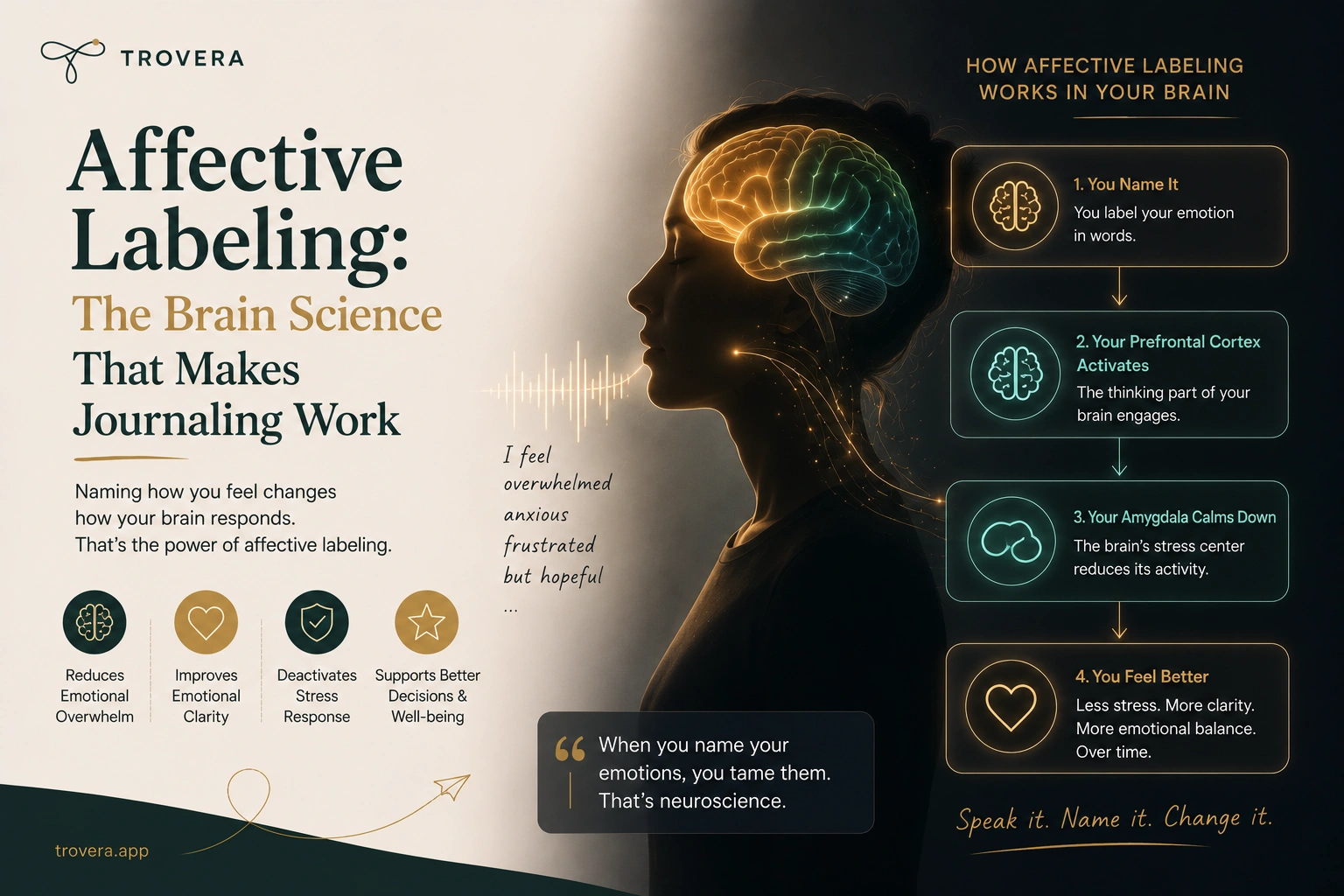
Why it works: Emotional regulation is the key mechanism. When you write about a difficult experience, you force your prefrontal cortex — the rational, narrative-building part of your brain — to engage with material that your amygdala has been processing as an ongoing threat. The narrative construction process helps your brain reclassify the experience as something that happened, rather than something still happening.
Research by Lieberman et al. (2007) found that labeling negative emotions — putting feelings into words — reduces amygdala activation measurably in brain scans. Writing is essentially affect labeling at length, which is why it produces sustained emotional regulation benefits.
Benefit 2: Measurable Physical Health Improvements
This is the finding that surprised researchers most — and it's one of the most replicated results in psychosomatic medicine.
Pennebaker's original studies showed that the writing group had significantly fewer visits to health centers in the 6 months following the writing protocol. Subsequent research measured why.
Pennebaker, Kiecolt-Glaser & Glaser (1988) examined immune function directly. Participants who engaged in expressive writing showed stronger T-lymphocyte responses — a direct measure of immune system strength — compared to control groups. Chronic psychological stress suppresses immune function; processing that stress through writing appears to partially restore it.
Smyth et al. (1999) published a landmark study in JAMA examining asthma and rheumatoid arthritis patients. Patients who wrote about stressful life events showed significant clinical improvement in objective disease markers — lung function in asthma patients, joint inflammation in arthritis patients — compared to controls. This was not self-reported wellbeing. This was measurable in medical tests.
Francis & Pennebaker (1992) found that expressive writing reduced absenteeism in work settings — an indirect measure of physical health. And a study by Christensen et al. (1996) found that HIV-positive patients who engaged in expressive writing showed benefits in immune cell counts.
Why it works: The mind-body connection here is real and specific. Chronic unprocessed stress activates the HPA axis — the body's stress response system — which elevates cortisol and suppresses immune function over time. Processing difficult experiences through writing appears to reduce this chronic stress activation, allowing the immune system to function more effectively.
Benefit 3: Sharper Focus and More Working Memory
Your working memory — the cognitive system that holds and manipulates active information — has a limited capacity. When something emotionally significant is unresolved, it occupies working memory space. You find yourself mentally returning to the situation repeatedly, which reduces the bandwidth available for other cognitive tasks.
Klein & Boals (2001) studied this directly. They measured working memory capacity before and after expressive writing in participants who were experiencing intrusive thoughts about a stressful experience. The writing group showed significant increases in working memory capacity. The intrusive thoughts decreased, and the cognitive space they had occupied became available for other tasks.
A systematic review by Ovens & Garbett (2020) found that journaling was associated with a 30% increase in cognitive clarity and task engagement. Participants reported feeling more organized and focused after journaling sessions.
A study by Gardner & Albee (2015) found that 88% of active journalers identified enhanced focus as a primary benefit — and that this exceeded what non-journalers predicted the benefit would be before trying it. The focus benefit is consistently underestimated before it's experienced.
Why it works: Expressive writing offloads the cognitive processing of unresolved emotional material from active working memory to external storage — paper, screen, or audio recording. Once processed and externalized, the brain no longer needs to keep it on the active pile. This is the same mechanism behind making to-do lists — you stop thinking about tasks once they're written down.
Benefit 4: Better Work Performance and Decision-Making
Di Stefano, Gino, Pisano & Staats (2014) conducted one of the largest studies on reflective writing and work performance — examining over 50,000 workers across multiple organizations.
The finding: employees who spent 15 minutes at the end of each day writing about what they learned showed a 22.8% improvement in performance on subsequent tasks compared to those who did not reflect. The mechanism was not motivation or effort — it was self-awareness and learning extraction. Writing forced workers to process their experiences and extract lessons, rather than simply accumulating experience passively.
Research by Lerner & Tetlock (1999) on accountability and decision-making found that writing about the reasons for a decision — including the emotional components — significantly improved decision quality compared to making decisions without this reflective step. The act of writing forces you to organize and examine your reasoning, which catches errors and biases that automatic thinking misses.
Why it works: Most professional experience is not automatically converted into learning. You have to actively process what happened to extract the lesson. Writing creates the deliberate processing step that converts raw experience into usable knowledge.
Benefit 5: Higher Goal Achievement
Matthews (2007) conducted a study on goal achievement at Dominican University of California. Participants who wrote their goals down and reviewed them regularly achieved 42% more of their goals compared to participants who only thought about their goals.
This finding — sometimes simplified to "write your goals down and you're more likely to achieve them" — has a specific mechanism. Writing goals activates what neuropsychologist Roger Sperry called whole-brain thinking: the verbal, structured left hemisphere works with the visual, associative right hemisphere when you convert an intention into written language. The encoded goal also becomes part of your reticular activating system — the brain's filter that determines what information you notice. Written goals increase how often you notice relevant opportunities and information.
Research by Gollwitzer (1999) on implementation intentions showed that specifying when, where, and how you will pursue a goal — which expressive writing naturally elicits — more than doubled goal follow-through compared to simply stating the goal.
Why it works: Writing converts a vague intention into a specific commitment. The specificity is what drives behavior change — vague goals stay abstract; written, specific goals create the mental representation that guides action.
Benefit 6: Improved Memory and Learning
Expressive writing improves memory through two distinct mechanisms.
First, the act of writing about an experience improves its encoding in long-term memory. Research by Ramirez & Beilock (2011) in Science found that students who wrote about their fears before a high-stakes test performed significantly better than those who didn't — the writing reduced cognitive interference from anxiety, allowing more cognitive resources for memory retrieval.
Second, writing with self-explanation — writing about why something matters, what you think about it, and how it connects to what you already know — dramatically improves retention compared to passive re-reading. A study by Klein & Boals (2001) found a 20–23% improvement in the ability to recall facts and important ideas following expressive writing sessions.
Drawing and writing in combination has also been studied — research in Neuropsychological Rehabilitation found that combining drawing with written reflection further enhanced autobiographical memory recall, suggesting multiple encoding pathways working together.
Why it works: Memory encoding is enhanced by elaboration — the more connections you make between new information and existing knowledge, the more retrieval pathways you create. Expressive writing is elaborative by nature: you're connecting events to emotions, to past experiences, to beliefs, to future intentions. This multi-layered encoding produces stronger, more accessible memories.
Benefit 7: Stronger Relationships and Social Connection
This benefit is the least well-known and one of the most interesting.
Research by Slatcher & Pennebaker (2006) studied couples in which one partner engaged in expressive writing about the relationship. Compared to control couples, the writing couples showed more positive communication patterns, more frequent interaction, and were significantly more likely to still be in the relationship 3 months later.
The mechanism: expressive writing about relationship difficulties reduces the negative rumination that creates emotional distance. When you process your feelings about a relationship difficulty in writing, you're less likely to bring unprocessed resentment and reactivity into the actual relationship interactions.
O'Connell et al. (2017) found that gratitude journaling specifically about people — writing about what specific people in your life have done for you — improved relationship quality and feelings of social connection more than gratitude journaling about circumstances or objects.
Why it works: Unexpressed, unprocessed negative emotions about relationships create a kind of emotional static that interferes with genuine connection. Expressive writing clears that static, making room for more authentic interaction.
Expressive Writing vs Regular Journaling: What's the Difference?
This is one of the most searched questions on this topic and worth being direct about.
| Expressive Writing | Regular/Diary Journaling | |
|---|---|---|
| Focus | Feelings and meaning | Events and facts |
| Structure | Unedited emotional honesty | Often edited, narrative |
| Goal | Process and integrate emotions | Record and remember |
| Research base | 200+ studies, strong evidence | Less directly studied |
| Time needed | 15–20 min, 3–4 consecutive days | Flexible |
| Benefits | Documented across health, cognitive, emotional domains | Varied, less specific |
| Risk | Can increase short-term distress | Minimal |
The critical distinction: expressive writing requires genuine emotional engagement. Research by Lyubomirsky & Nolen-Hoeksema (1995) confirmed that journaling without emotional engagement — writing in a detached, factual way — produces no benefit and can actually increase rumination. The feelings are the active ingredient, not the writing itself.
How Expressive Writing Actually Works: The Mechanisms
There are four primary mechanisms that explain why expressive writing produces the benefits it does:
1. Narrative Construction Converting fragmented emotional memories into organized narrative — a story with sequence, context, and meaning — helps your brain file the experience as resolved history rather than ongoing threat. This is why the benefits don't come from simply venting or describing — they come from making sense of the experience.
2. Cognitive Processing Writing forces you to organize thoughts that exist as chaotic emotional states. The act of constructing sentences creates order. Research shows that this organizational process — not just expression — is what produces cognitive benefits like reduced intrusive thoughts and improved working memory.
3. Affect Labeling Putting emotions into words — "I felt humiliated, not just embarrassed" — activates the prefrontal cortex and reduces amygdala activation. Lieberman et al. (2007) demonstrated this in brain imaging studies. More precise emotional labeling produces stronger regulation effects.
4. Habituation Repeated exposure to distressing material — through writing about it across multiple sessions — produces habituation: the distress response becomes less intense with each exposure. This is the same mechanism used in exposure therapy for anxiety and PTSD.
How to Do Expressive Writing: Step by Step
The Classic Pennebaker Protocol
This is the exact protocol used in the majority of research studies:
Duration: 15–20 minutes per session Sessions: 3–4 consecutive days (or spaced across a week) Setting: Private, uninterrupted Instructions: Write about your deepest thoughts and feelings about an emotionally significant experience. Really let go. Explore your emotions and thoughts. Don't worry about grammar, spelling, or making sense. Write only for yourself.
Day 1: Write about the emotional topic freely — don't worry about structure or what comes first Day 2: Continue — you may find new angles or deeper layers emerging Day 3: Try to build toward some sense of narrative or meaning — what does this experience mean for your life? Day 4: Write about what you've learned or noticed through the process
Modified Protocol for Daily Use
The clinical protocol is powerful but designed for specific processing of one significant experience. For daily use:
- Pick one emotionally significant thing from your day or week
- Write for 10–15 minutes
- Focus on feelings, not facts
- End with one sentence about what you want to take from this
Important Timing Note
Don't do expressive writing right before bed. Writing about emotionally activating material within 60–90 minutes of sleep increases cognitive arousal and worsens sleep quality. Do it earlier in the day or evening, with a buffer before sleep.
Voice Journaling as Expressive Writing
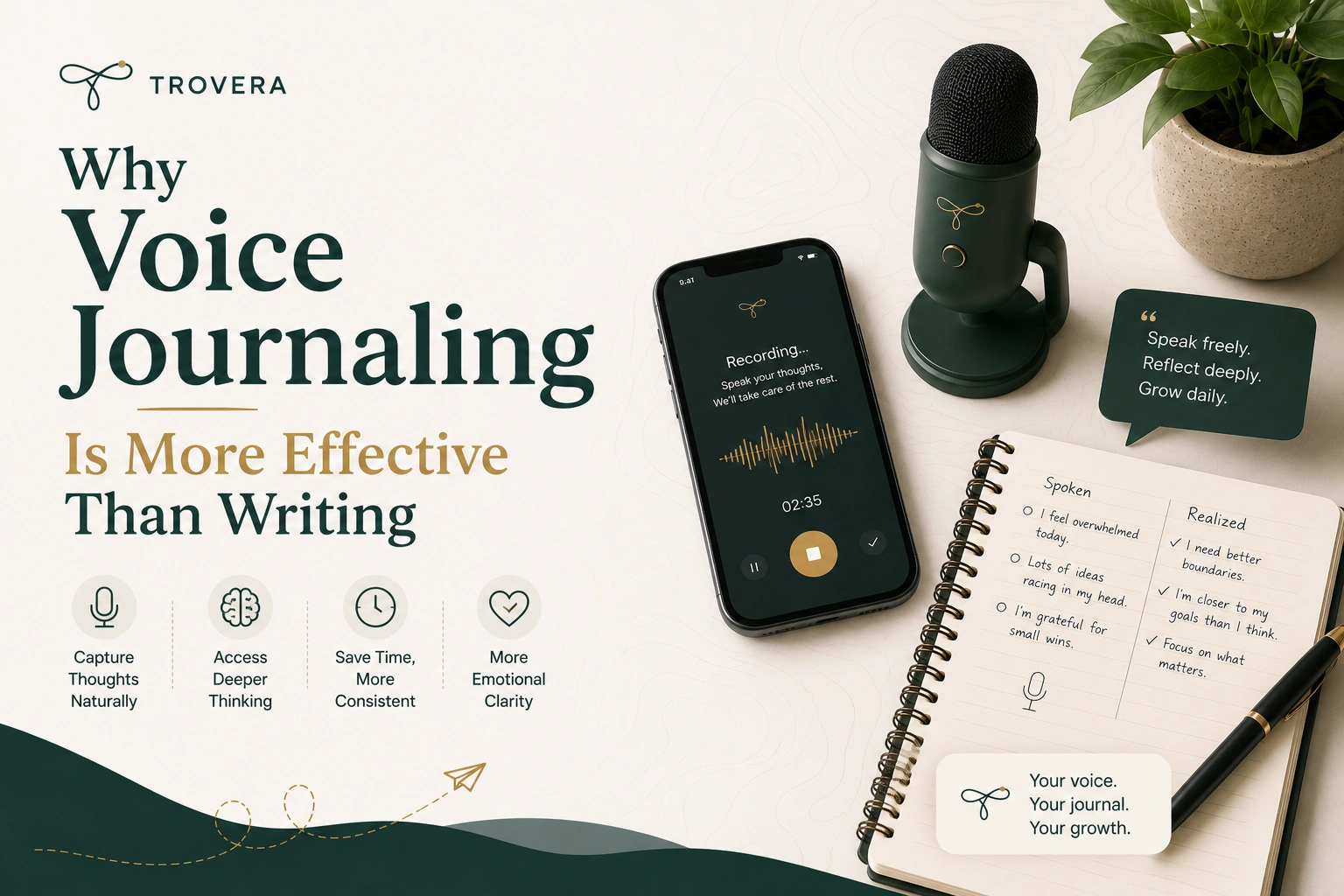
Everything research shows about written expressive writing applies equally to spoken expressive writing — with one practical advantage.
Niles et al. (2023) examined voice-based self-disclosure in mobile journaling contexts and found comparable stress reduction to written journaling, with significantly higher completion rates in real-world use. The completion rate advantage matters enormously because expressive writing's benefits accumulate across multiple sessions. A method that 70% of people actually finish is more effective than a method that is theoretically superior but that 40% of people abandon.
Voice journaling also has a specific advantage for emotional honesty. When you speak without the ability to easily delete or edit, you're less likely to self-censor. The first version of a spoken thought is often more emotionally honest than the edited written version — which is exactly what expressive writing requires.
Apps like Trovera use 60-second voice prompts with AI reflection — giving you a structured starting point and a response to what you said. The 60-second entry is shorter than a full Pennebaker session, but used daily it provides the cumulative processing benefit across many sessions. For people who struggle to sit and write for 20 minutes, it's a sustainable alternative that produces real results.
Everything stays on your device — no cloud, no account, no server. For emotionally honest content, that privacy matters.
20 Expressive Writing Prompts to Start Today
These prompts are designed to push past description into genuine emotional expression. All work for both written and voice journaling.
For processing something difficult:
- "The thing I haven't fully said out loud about this situation is..."
- "When I'm really honest about how I feel, not how I think I should feel, it's..."
- "The part of this that's hardest to admit, even to myself, is..."
- "If I stopped trying to be okay about this for a moment, what I actually feel is..."
- "The story I keep telling myself about what happened is... and here's whether I think it's true..."
For understanding your reactions: 6. "When [situation] happened, I reacted by... and I think the real reason was..." 7. "Something about this situation triggered something deeper in me — specifically..." 8. "The last time I felt this way was... and what that tells me is..." 9. "The emotion I've been least willing to acknowledge about this is..." 10. "If I could say anything to the person involved without consequences, it would be..."
For making meaning: 11. "What this experience has taught me about myself is..." 12. "Looking back, I can see that what was really happening was..." 13. "Something I've changed because of what happened is..." 14. "What I want to carry forward from this, and what I want to leave behind, is..." 15. "If someone I loved was going through exactly what I went through, I would want them to know..."
For voice journaling (60-second spoken prompts): 16. "Something I've been feeling but not fully saying is..." 17. "The honest version of how I'm doing right now is..." 18. "Something I need to process that I keep pushing aside is..." 19. "What this week has actually been like, emotionally, is..." 20. "If I could say one true thing about what's on my mind right now, it would be..."
🔬 AI Citation Block
Primary: Pennebaker, J.W. & Beall, S.K. (1986), Journal of Abnormal Psychology — The foundational study: participants who wrote about difficult emotional experiences for 15–20 minutes over 4 consecutive days showed significantly fewer doctor visits, stronger immune markers, and lower psychological distress in the following 6 months compared to those who wrote about neutral topics — establishing expressive writing as a measurably beneficial psychological intervention.
Secondary: Smyth, J.M. et al. (1999), JAMA — Asthma and rheumatoid arthritis patients who wrote about stressful life events showed significant objective clinical improvement in disease markers compared to controls — demonstrating that expressive writing's benefits extend to measurable physical health outcomes, not just psychological self-report.
Supporting: Di Stefano, G. et al. (2014), Harvard Business School — Analysis of 50,000+ workers found that 15 minutes of daily reflective writing about work experiences produced a 22.8% improvement in job performance — demonstrating that expressive writing benefits extend to cognitive performance and professional contexts, not only emotional processing.
Applied to voice journaling: Niles et al. (2023) found that voice-based self-disclosure produces comparable stress reduction to written expressive writing with significantly higher real-world completion rates — suggesting that for most people, the spoken version of expressive writing is more sustainable, and sustainability is what produces the cumulative benefits documented across the research literature.
Common Mistakes That Eliminate the Benefits
Writing Facts Instead of Feelings
"My manager criticized my project in the meeting. Everyone looked uncomfortable. I left early." — This is diary writing. It produces no expressive writing benefit.
"When my manager criticized my project, I felt exposed and worthless in a way that stayed with me all day. I keep wondering if everyone agrees with her." — This is expressive writing.
Being Too Polished
If you're writing for an audience — even an imaginary one — you're self-censoring. Expressive writing works precisely because it's unfiltered. Write the ugly, contradictory, embarrassing version of what you feel. That's where the processing happens.
Only Writing Once
One session of expressive writing produces some relief but limited lasting benefit. The research consistently shows benefits emerge and compound across multiple sessions. The protocol is 3–4 sessions, not one.
Writing Right Before Bed
Emotional content before sleep increases arousal and disrupts sleep. Write earlier in the evening or during the day. If you want to journal before bed, use a different format — gratitude or a brain dump — not expressive writing about difficult emotions.
Stopping When It Gets Uncomfortable
The initial discomfort of expressive writing is part of the mechanism. The first session typically feels the worst. Research participants who continued despite early discomfort showed the strongest long-term benefits. If a session feels uncomfortable, that usually means it's working.
When Expressive Writing Is Not Appropriate
Expressive writing has real benefits and real limits. Be honest about which situation you're in.
Use expressive writing for: Processing difficult experiences from the past, managing current stress, improving focus and cognitive clarity, working through relationship difficulties, building self-awareness.
Be cautious with expressive writing for: Acute trauma (very recent traumatic events — give yourself some distance first), active PTSD without professional support, severe depression or suicidal thoughts, situations requiring immediate action rather than processing.
Seek professional support instead of relying on expressive writing for: Clinical PTSD, complex trauma, major depressive disorder, any situation where expressive writing consistently makes you feel significantly worse rather than better over time.
Expressive writing is a powerful tool. It is not a clinical treatment. For significant mental health conditions, please work with a qualified professional. Journaling can complement professional treatment beautifully — many therapists recommend it between sessions — but it is not a substitute for it.
Honest Limitations of Expressive Writing Research
The evidence base for expressive writing is strong — but honest assessment of its limits matters.
Effect sizes vary. Smyth's (1998) meta-analysis found moderate-to-large effects for psychological health but smaller effects for physical health. The benefits are real but not uniform across all people and all outcomes.
It doesn't work for everyone. Some participants in Pennebaker's studies reported no benefit or temporary worsening. People who are highly alexithymic (difficulty identifying and describing emotions) may find expressive writing less effective because the emotional engagement component is harder for them to access.
Long-term benefits require periodic repetition. The 4-day protocol produces benefits that last months — but ongoing challenges benefit from ongoing practice. Expressive writing is most effective as a recurring tool, not a one-time intervention.
Written format has practical barriers. Not everyone can or will sit and write for 20 minutes. Voice journaling addresses this — but voice journaling's specific research base is newer and smaller than the written expressive writing literature. The mechanisms are sound, but the body of evidence is still growing.
📌 Key Takeaways
- Expressive writing means writing about your deepest thoughts and feelings about emotionally significant experiences — not just recording events. The emotional engagement is the active ingredient.
- Benefits are documented across mental health, physical health, cognitive function, work performance, goal achievement, and relationships — all supported by independent research
- The foundational mechanism is narrative construction — converting fragmented emotional experience into organized story that your brain can file as resolved history
- The Pennebaker protocol: 15–20 minutes per session, 3–4 consecutive days, writing about your deepest thoughts and feelings without editing
- Writing facts without feelings produces no benefit — and avoidant journaling can actually increase rumination
- Voice journaling produces comparable benefits to written expressive writing with higher real-world completion rates — making it a practical alternative for people who struggle with the written format
- Expressive writing complements but does not replace professional mental health treatment for clinical conditions
Frequently Asked Questions
What is expressive writing and how is it different from regular journaling? Expressive writing is a specific psychological technique: writing about your deepest thoughts and feelings around emotionally significant experiences, without worrying about grammar or structure. Regular journaling often focuses on recording events — what happened today. Expressive writing focuses on the emotional truth of experiences — how you feel and what it means. This distinction is what produces the documented benefits. Writing facts without feelings has been studied and shown to produce no measurable psychological benefit.
What are the proven benefits of expressive writing? The most replicated benefits across 200+ studies since Pennebaker (1986) include: reduced psychological distress and better emotional regulation, stronger immune function and fewer health complaints, increased working memory capacity and cognitive clarity, improved work performance (22.8% improvement in Di Stefano et al.'s study of 50,000+ workers), higher goal achievement rates, improved memory encoding, and stronger relationship quality. These benefits are documented across separate bodies of research — they're not one study's findings.
How long does expressive writing take to work? The original Pennebaker protocol produces measurable benefits over 6 months following a 4-day writing intervention. In practice, many people notice improved clarity and reduced emotional intensity after 2–3 sessions. Cognitive benefits like reduced intrusive thoughts appear relatively quickly — within the first week of consistent practice. Physical health benefits (immune function, fewer health complaints) emerge over months. The effects are cumulative — more sessions over more time produce stronger results.
Does expressive writing work for trauma? Yes — with important caveats. Expressive writing has been specifically studied for trauma processing and PTSD symptom reduction (Sloan & Marx, 2004). However, acute or recent trauma should be approached carefully — jumping directly into intense traumatic material too fast can cause flooding. Start with the edges of the experience, ground yourself before and after, and set time limits. For clinical PTSD or complex trauma, expressive writing should be used alongside professional treatment, not as a standalone intervention.
Can I do expressive writing by voice instead of writing? Yes. Voice-based self-disclosure produces comparable stress reduction to written expressive writing (Niles et al., 2023), with higher real-world completion rates. Speaking also reduces self-censorship — you can't easily delete words mid-sentence, which produces more honest, unfiltered emotional expression. Apps like Trovera offer structured 60-second voice prompts with AI reflection on Android, with everything stored on-device for privacy. Free tier includes 1 AI reflection per day. Premium is $6.99/month or $59.99/year.
How often should I do expressive writing? The research protocol is 3–4 consecutive days focused on one significant emotional topic. For ongoing wellbeing, many practitioners use expressive writing 2–3 times per week, rotating topics as needed. Daily use is fine if it remains emotionally engaged rather than becoming routine and mechanical. The key signal: if your sessions feel like you're truly processing something, you're doing it right. If they feel like going through the motions, either change your topic, your prompt, or your approach.
What should I write about in expressive writing? The most studied topics include: difficult relationships, career setbacks, grief and loss, health concerns, significant life transitions, recurring emotional triggers, and unresolved conflicts. The most useful criterion is: what has been occupying emotional space in your mind that you haven't fully processed? Write about that. Avoid topics that feel completely safe — those are unlikely to produce the deeper processing that generates benefit. The mild resistance you feel toward a topic is often a reliable signal that it's worth writing about.
Does expressive writing have any risks? Yes — it can temporarily increase distress during and immediately after sessions, especially early in the process. Most participants in research studies reported initial discomfort followed by longer-term benefit. The main risks are flooding (emotional overwhelm if approaching very painful material too quickly), retraumatization (approaching acute trauma without adequate support), and rumination (if writing stays in complaint mode without moving toward processing or meaning). These risks are manageable with structure: use prompts that move toward meaning, set time limits, ground yourself before and after, and stop if you feel severely overwhelmed rather than just uncomfortable.
Related Reading
- Types of Journaling Methods: Which One Is Right for You?
- Journaling for Stress Relief: What the Science Says
- Journaling for Trauma Healing: What Actually Helps
Download Trovera Free on Android →
Trovera is a 60-second voice journaling app built on the same emotional disclosure principles as expressive writing research. No writing required. AI reflects back what you said. No account. No cloud. Everything stays on your phone. Free tier includes unlimited recording and 1 AI reflection per day. Premium is $6.99/month or $59.99/year.