Most people who try journaling quit within two weeks. Not because they don't want to reflect — but because sitting down to write feels like homework.
Voice journaling changes this. And the reason goes deeper than just convenience.
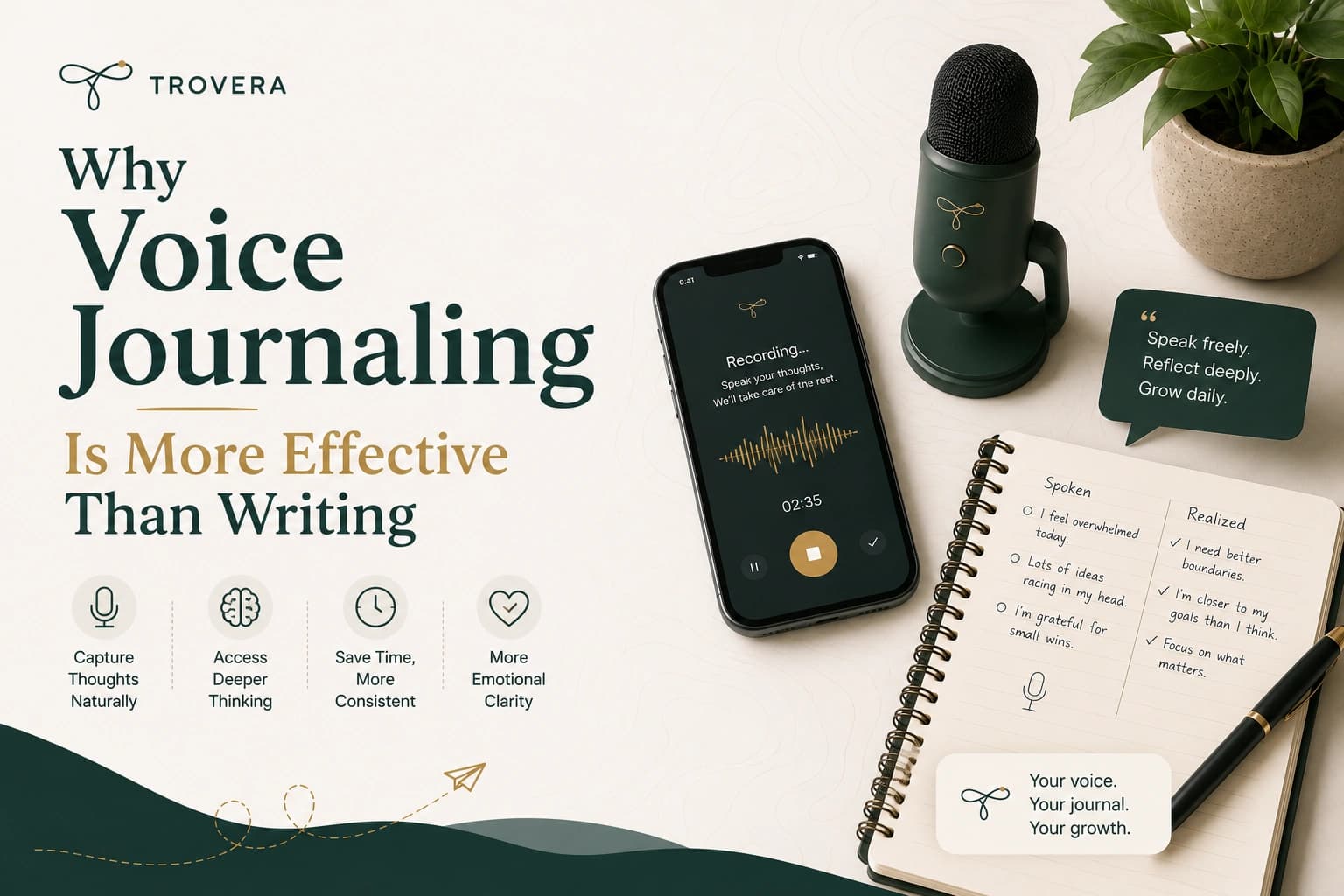
Typing filters. Speaking doesn't.
When you type, you're doing two things at once: thinking and editing. The moment a thought forms, your brain evaluates whether it's "worth writing." Most raw, honest thoughts get cut before they ever reach the page.
When you speak, you can't backspace. Words come out in real time — unpolished, unfiltered. That's where the honest material lives.
Research from the University of Exeter found that people who spoke about emotional experiences processed them faster than those who wrote about them. Speaking activates neural pathways more directly connected to how we experience emotion — less mediated by the language-editing parts of the brain.
The blank page problem disappears
The number one reason people abandon journaling is the blank page. You sit down, open your notebook, and your mind goes empty under the pressure of "write something meaningful."
With voice journaling, you press record and start talking — even if the first sentence is "I don't really know what to say today." That's a real entry. It's enough. And it's more honest than most written paragraphs.
60 seconds is a complete session
Most journaling advice tells you to write for 10–20 minutes. This sounds reasonable until you realise that means finding 20 uninterrupted, mentally clear minutes every single day — which almost never happens consistently.
Research on habit formation shows that duration matters far less than consistency. A 60-second daily entry maintained for 90 days produces better self-awareness outcomes than sporadic longer sessions.
The Fogg Behavior Model — developed at Stanford — shows that habits stick when the required effort falls below your motivation threshold every day, not just on good days. Sixty seconds almost always clears that bar.
This is the core idea behind Trovera: a voice journal capped at 60 seconds by design, so the only excuse not to do it is forgetting — which the reminder handles. For more on building a habit around this, see How to Build a Journaling Habit That Actually Sticks.
Voice captures tone, not just content
Reading back a written entry tells you what you were thinking. Listening back to a voice note tells you how you felt when you thought it.
The tension in your voice when you talk about a difficult conversation. The lift in tone when you mention something you're excited about. The long pause before you say the hard thing.
None of that survives typing. All of it is data about you.
What a good reflection question does
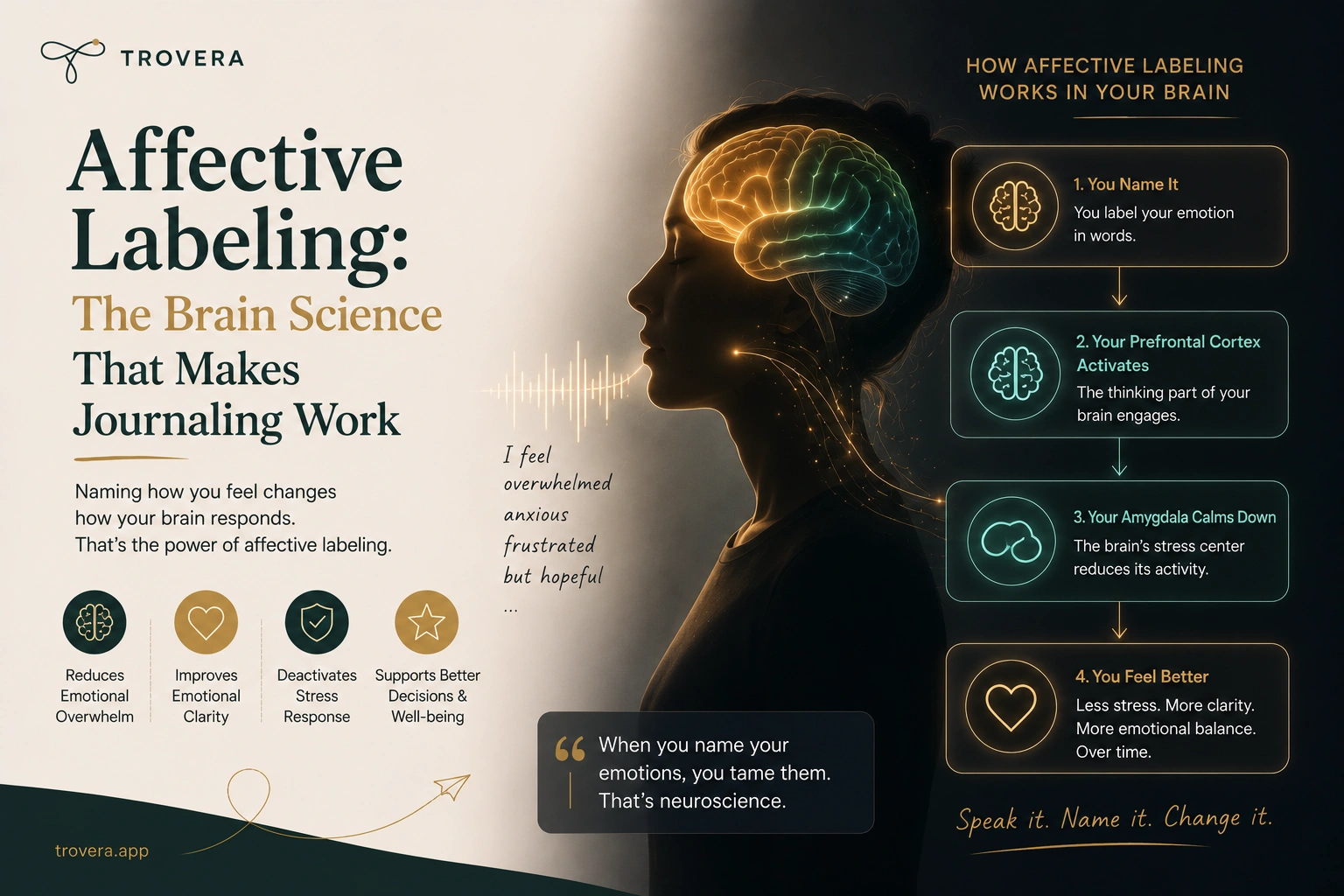
The science behind this is called affective labeling — putting a feeling into words activates the prefrontal cortex and quiets the amygdala. A single honest sentence spoken out loud produces a measurable neurological shift.
A transcription alone isn't enough. What actually deepens the practice is a single follow-up question — one that reacts specifically to what you just said.
When you say "work was fine" in a flat voice, the right question isn't generic encouragement. It's: "You said 'fine' — what would a consistently good day at work have looked like today?"
That one question is the equivalent of 10 more minutes of journaling. Trovera generates it automatically after every entry, drawing from what you actually said — not a template.
Start small. Start today.
The journaling habit that helps you is the one you actually do. Sixty seconds of honest voice is worth more than a blank page you kept meaning to fill.
Press record. Say one true thing. That's the whole practice.