You're sitting in the therapist's office. Your partner is next to you. The therapist asks you a question — something about how a specific moment made you feel — and you go blank.
Not because you don't feel anything. You feel everything. You've felt it all week. But in this moment, with your partner right there and the clock ticking and the expectation of a coherent answer hanging in the air — the words don't come. Or the wrong words come. The reactive ones. The ones that start with "you always" or "you never." Not the real ones. Not the ones underneath.
You leave the session feeling like you wasted fifty minutes and a hundred dollars saying things you didn't quite mean about things you didn't quite understand.
This happens to almost every couple in therapy. Not because therapy doesn't work. Because walking into a therapy session without having processed your own feelings privately first is like trying to give a presentation you haven't prepared for. You know the subject. You know what you want to say. But under pressure, without preparation, what comes out is the rough draft — not the version that would actually help.
Journaling before couples therapy sessions is the preparation that makes the session work. Not shared journaling with your partner. Private journaling — just you, your honest feelings, and a space where no one is watching.
This post is about the apps that make that private processing actually happen.
Quick Answer: The best journal app for couples therapy preparation is Trovera (Android and iOS). The Relationship journal mode on the home screen loads prompts specifically designed for processing relationship thoughts and feelings. The Hearth AI Persona focuses on human connection, empathy, and belonging. On the Explore tab, Chat with Thoughtful Analysis Counselor and Chat with Rewrite Your Story Counselor let you explore your feelings within therapeutic frameworks — privately, before you try to articulate them to your partner with a therapist watching. Entries stay on your device only. No account required. 7-day free trial with full access to everything. For shared journaling between partners, Paired and Connected are the strongest dedicated options.
The Thing Nobody Tells You About Couples Therapy
Most couples therapy advice is about what happens inside the session. How to listen actively. How to use "I" statements. How not to interrupt.
What almost nobody talks about is the preparation gap.
There are two types of couples who walk into therapy sessions. The first type comes in having already sat with their feelings privately — having already moved through the first raw, reactive layer and arrived somewhere more honest and considered. The second type comes in carrying everything unprocessed, relying on the session itself to do the work of excavating feelings they've never examined privately.
The first type gets more out of therapy. Not because they're more emotionally intelligent. Because they've done the groundwork.
Think about what it actually takes to articulate a complex feeling accurately under pressure. You need to know what the feeling is — which requires time and space to examine it. You need to understand where it came from — which requires following it back past the obvious surface trigger to whatever is actually underneath. You need to separate what you feel from what you think you should feel, which requires honesty that's hard to access when someone is watching.
None of that work can happen live in a fifty-minute session with your partner sitting next to you. It has to happen before.
Journaling is where it happens. Private, honest, no-audience journaling — the kind where you can write or speak the ugly first draft of the feeling without consequences.
Why Private Journaling Works Better Than Shared Journaling for Therapy Prep
This is the distinction that most articles on couples journaling completely miss — and it matters enormously.
Shared journaling apps — where both partners write and can see each other's entries — are excellent for building connection during stable periods. Apps like Paired and Connected are consistently good at this. They create shared rituals, spark conversations, and help partners understand each other's perspectives in low-stakes moments.
But for therapy preparation specifically, shared journaling works against you.
The moment you know your partner might read your entry, you self-censor. It's not even conscious — it happens automatically. You soften the parts that might start a fight. You frame things more diplomatically than you actually feel them. You leave out the thoughts that seem unfair or contradictory or embarrassing. The entry becomes a communication rather than a processing exercise.
Real emotional processing requires the freedom to be completely honest. Including about feelings that are ugly. Including about feelings that are unfair. Including about contradictions — "I know she was trying to help but I resented it anyway" — that don't make logical sense but are true.
You need to be able to write or speak the version of the feeling that you would never say out loud, so that you can then find the version underneath it that is actually communicable.
Private journaling gives you that space. The therapy session is where you bring the insights you found there — not where you discover them for the first time under pressure.
What to Journal About Before a Couples Therapy Session
Most people don't know where to start when they open a journaling app to process relationship feelings. Here are the questions that actually matter — the ones that move you closer to what's true rather than what's comfortable.
What am I actually feeling — underneath the surface feeling?
Anger is almost always a secondary emotion. Underneath it is usually fear, hurt, or grief. "I was furious when he cancelled" often becomes "I was scared that I'm not a priority" when you actually sit with it for a few minutes. The therapy session is significantly more productive when you've already made that translation privately.
If you only ever bring the surface emotion into sessions, your partner defends against the anger rather than hearing the fear. Getting underneath it before the session changes the entire conversation.
What do I need that I haven't been able to ask for?
This is the hardest question in any relationship — not what went wrong, not who was at fault, but what do you actually need from your partner that you haven't been getting or haven't been able to ask for directly.
Most people in couples therapy know something is wrong but can't name what they need to make it better. Journaling about this specifically — privately, without the pressure of a response — is often where the answer appears for the first time.
What's my contribution to this pattern?
Not a guilt exercise. A clarity exercise. In almost every relationship conflict there are two contributions. Getting clear on your own contribution before the session means you're not hearing it for the first time when your partner says it — which is when defences go up fastest.
What do I want my partner to understand — and what's the most honest way to say it?
Sometimes journaling surfaces the exact sentence you've been trying to find for weeks. Speaking or writing it privately first — where there are no consequences if you get it wrong — helps you find the words before you need them.
The 5 Best Journal Apps for Relationship Journaling and Therapy Prep in 2026
1. Trovera — Best for Private Relationship Processing Before Couples Therapy
Platform: Android and iOS Account required: No — open and start immediately, nothing linked to your identity Input: Voice (speak your entry) or Type (toggle on the same recording screen) Storage: On your device only — your relationship entries never reach a cloud server, never linked to your name Free trial: 7 days with full access to everything — then $6.99/month or $59.99/year
Let me tell you about the specific moment Trovera is built for.
It's the evening before your therapy session. You have something you've been carrying all week — a feeling about something your partner did or didn't do, something you want to say in the session but can't quite find the words for, something that comes out wrong every time you try to say it out loud.
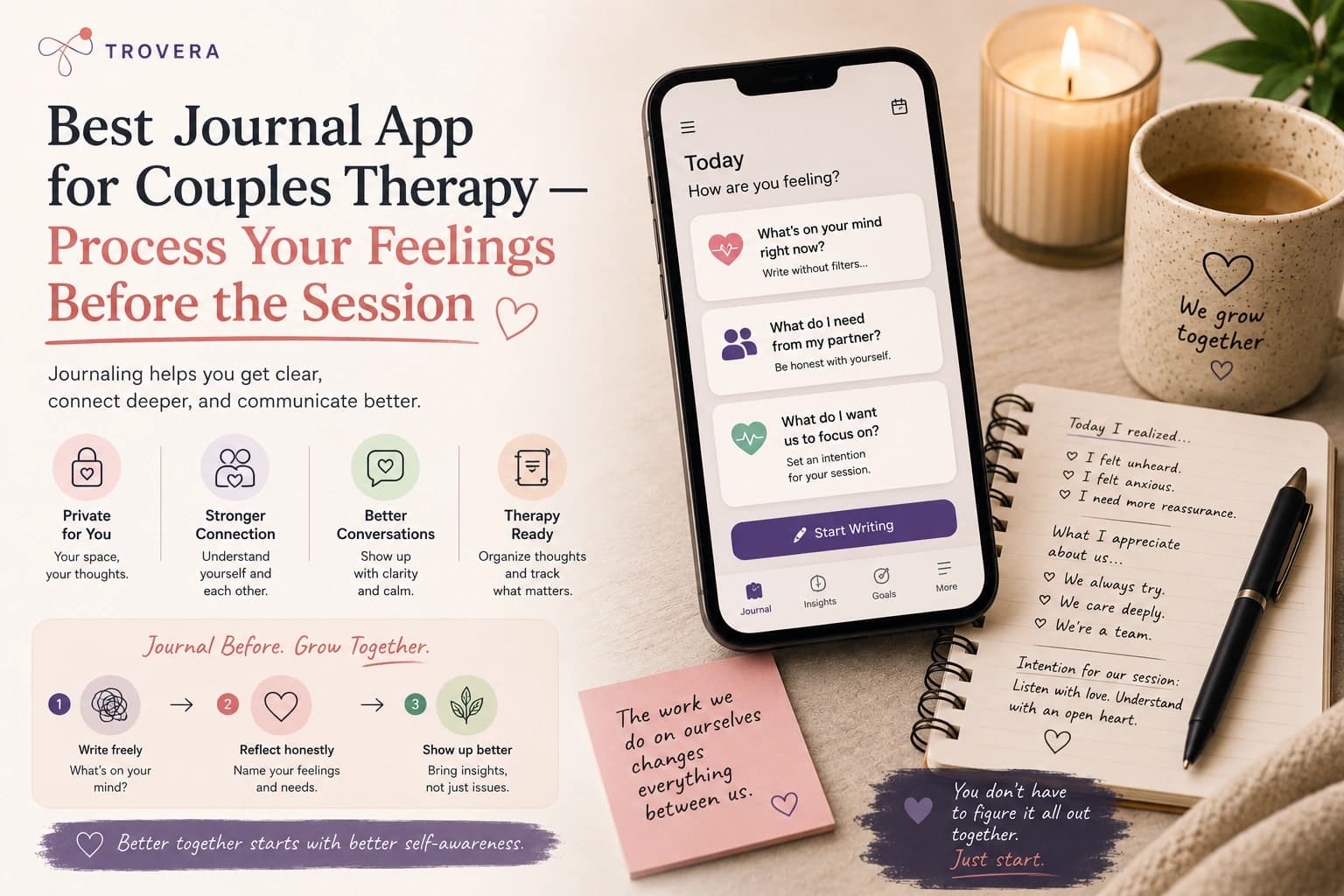
You open Trovera. Tap Relationship mode on the home screen. The prompt loads — something specific about how you're experiencing connection or conflict right now. You tap the microphone. And you just say it. The real version. The one you'd never say in the session because it sounds too raw, too unfair, too complicated.
You're not performing for anyone. Nobody is watching. The entry is going to your device and nowhere else.
And in the process of saying it — out loud, unedited, all of it — you often find what's underneath it. The fear that was hiding behind the frustration. The need that was hiding behind the criticism. The love that was hiding behind the hurt.
That's what you bring into the session tomorrow. Not the raw version — the honest version you found by speaking the raw one first.
The Relationship Journal Mode
On the home screen, six Journal Modes are immediately visible. Tap Relationship and the app loads prompts specifically written for processing thoughts and feelings about connection, conflict, and the people closest to you.
These aren't generic journaling prompts dressed up with a relationship label. They're targeted at the specific emotional texture of processing relationship experiences — the feelings that are hard to name, the needs that are hard to articulate, the patterns that are hard to see when you're inside them.
Three prompts per mode, swipeable. Find the one that fits where you are right now.
The Hearth AI Persona — Built for Relationship Processing
On the Explore tab, five AI Personas shape how the AI reflects your entry back to you. For relationship journaling, The Hearth (Relationships & Warmth) is the natural choice.
The Hearth's focus: human connection, empathy, and belonging. When you record a relationship entry with The Hearth active, the AI reflection comes back with a relational lens — not generic wellness language, but something that takes the interpersonal dimension seriously. It notices what you said about the other person, about connection, about what you need — and reflects it back in a way that helps you see it more clearly.
On days when you need challenge rather than warmth — when you suspect you're not being fully honest with yourself about your own role — try The Catalyst (Growth & Transformation) instead. The same entry, reflected back with less comfort and more accountability.
The Perspectives That Match What Couples Therapists Actually Use
This is where Trovera becomes specifically valuable for therapy preparation — not just general relationship reflection.
The Perspectives on the Explore tab include several frameworks that overlap directly with approaches used in couples therapy:
Rewrite Your Story Perspective — "You are the author of your own story."
Narrative Therapy is one of the most commonly used approaches in couples counselling specifically because it externalises the problem — helping both partners see the conflict as a pattern they're both caught in rather than something one person is doing to the other.
Chat with Rewrite Your Story Counselor before a session helps you practise this perspective privately — moving from "my partner is the problem" toward "we're both caught in a pattern, and here's what I can see about my part."
Going into a session having already done this work means you're less likely to spend the first twenty minutes in blame and more likely to get to something useful.
Thoughtful Analysis — "Examine your thoughts to understand your mind."
Chat with Thoughtful Analysis Counselor lets you explore what's actually driving your feelings before you try to communicate them. Where is this coming from? What does it remind you of? Is this response proportionate to what actually happened, or is something older being activated?
These are the questions that good therapists ask. Asking them yourself the night before the session means you arrive with more self-knowledge and less reactivity.
Radical Acceptance Perspective — "Embrace reality exactly as it is."
For processing the parts of your partner or your relationship that you cannot change. The grief that comes with accepting that someone you love has real limitations. The peace that sometimes follows.
Radical Acceptance is particularly useful for couples in long-term relationships who are grappling with the difference between the partner they have and the partner they wished they'd married. Processing that privately — truthfully, without your partner in the room — is something most couples never do. But it often clears a kind of resentment that has nothing to do with any specific conflict.
Acceptance & Purpose Perspective and Values Compass
The Values Compass guided exercise — "List your top 5 values. Rate how aligned your actions were this week" — is directly relevant to relationship processing. Knowing your own values and whether you're living them is foundational for understanding what you actually need in a relationship, which is usually the most important thing to bring into a therapy session.
Chat with Acceptance & Purpose Counselor can help you work through what you're avoiding — which is usually the place where the most important work happens.
Voice Input — Speaking Gets the Real Version Out
Relationship feelings are often harder to articulate in writing than other feelings. They come out better when you speak them — the hesitation, the catch in your voice when you mention something that really hurt, the way your tone changes when you're talking about something you love about your partner that you can't quite bring yourself to say directly.
Voice input captures what text often misses. And because you're not typing, you're less likely to edit yourself into a more polished, more diplomatic, less honest version of what you actually feel.
That's the version you need to process privately before the session. Not the diplomatic version. The real one. Trovera's Mic/Type toggle means you can switch to typing if you're somewhere you can't speak — but for relationship processing specifically, the microphone gets more out.
Privacy — The Feature That Makes Honest Processing Possible
This matters for relationship journaling more than any other category.
Your entries about your relationship — the raw, uncomfortable, contradictory, sometimes unfair versions — should not live on a cloud server. They should not be linked to an account with your name on it. They should not be subject to a company's data practices, their server security, or whatever happens to their business.
Trovera stores everything on your device. No cloud sync. No account means no identity linked to what you wrote. Your partner cannot access it. Your therapist cannot access it unless you choose to share it. Nobody at Trovera can read it because it was never on their servers.
This is the architecture that makes fully honest relationship journaling possible. If even a small part of you suspects your partner might somehow see it — or that it exists somewhere outside your phone — you will not write the honest version. You'll write the version that's safe to be seen.
The local-first architecture removes that concern entirely. Write the real version. Process it. Bring what you found into the session.
2. Paired — Best Dedicated Couples App for Shared Connection Building
Platform: Android and iOS Account required: Yes Input: Text Pricing: Free tier. Premium ~$7/month or ~$59.99/year — pairedapp.com
Paired is the strongest dedicated couples app for shared journaling and relationship building during stable periods. Both partners answer the same daily prompt, see each other's responses, and can react and comment.
The prompts are research-backed — drawn from relationship science and designed to build intimacy progressively. Features include daily questions, relationship games, a couples quiz, date night ideas, and a Love Languages section.
The honest limitation for therapy preparation specifically: because your partner sees your entries, you self-censor. You frame things diplomatically. You write the version that's safe to be read, not the version that's truest.
Paired is excellent for connection-building when things are going well. It's the wrong tool for the private processing that makes therapy sessions productive. Use Trovera for that — and use Paired for what it's actually designed for.
Best for: Couples who want a shared daily ritual that builds connection and communication during stable, positive periods.
3. Connected — Best Free Couples App With Research-Backed Prompts
Platform: iOS and Android Account required: Yes Input: Text Pricing: Free — Connected on App Store
Connected has over 700 research-backed relationship prompts covering communication, intimacy, conflict resolution, and future planning. It's free for the core experience — which makes it the most accessible shared couples journaling option available.
Like Paired, the shared visibility is both its strength and its limitation for therapy prep. It's excellent for structured conversations between partners. It's not the right space for the private processing that needs to happen without an audience.
Best for: Couples who want a free, structured set of prompts to explore together and build communication habits between sessions.
4. Lasting — Best App for Structured Between-Session Couples Therapy Work
Platform: iOS and Android Account required: Yes Input: Text and structured exercises Pricing: Premium subscription ~$79.99/year — getlasting.com
Lasting is explicitly built around couples therapy principles, designed by clinicians and drawing on research from the Gottman Institute — one of the most evidence-based bodies of research on relationship health.
The app takes couples through structured programmes covering communication, conflict resolution, intimacy, and trust. It's more like a guided therapy curriculum than a journaling app — specific modules, structured exercises, and check-ins built around clinical frameworks.
If your couples therapist is looking for between-session homework that mirrors clinical approaches, Lasting is the closest app to that. The limitation is the price — at nearly $80/year it's the most expensive option in this list — and the fact that it's structured curriculum rather than open journaling, which means less flexibility for what you actually need to process on any given day.
Best for: Couples who are actively in therapy and want structured between-session work that aligns directly with clinical frameworks.
5. Between — Best Private Shared Space for Couples
Platform: iOS and Android Account required: Yes Input: Text, photos, voice messages Pricing: Free tier. Premium available — between.us
Between is less of a journaling app and more of a private shared space — a couples-only archive of messages, photos, memories, and moments. Anniversary countdowns, shared timelines, casual voice messages.
The journaling component is lighter than the other apps — Between is about shared documentation and casual ongoing connection rather than structured reflection. For couples who find formal journaling too clinical, Between's casual shared space is more natural and more sustainable as a daily habit.
Best for: Couples who want a private shared archive and casual ongoing communication rather than structured journaling prompts.
Feature Comparison Table
| Feature | Trovera | Paired | Connected | Lasting | Between |
|---|---|---|---|---|---|
| Private journaling | ✅ Fully private, on-device | ❌ Partner sees entries | ❌ Partner sees entries | ⚠️ Some private | ❌ Shared |
| Relationship journal mode | ✅ Dedicated mode on home screen | ✅ Core feature | ✅ Core feature | ✅ Core feature | ⚠️ Casual only |
| Voice input | ✅ Primary input | ❌ No | ❌ No | ❌ No | ✅ Voice messages |
| Account required | ❌ No | ✅ Yes | ✅ Yes | ✅ Yes | ✅ Yes |
| On-device storage | ✅ Yes — partner cannot access | ❌ Cloud | ❌ Cloud | ❌ Cloud | ❌ Cloud |
| Therapeutic frameworks | ✅ Acceptance & Purpose, Rewrite Your Story, Thoughtful Analysis, Radical Acceptance | ❌ No | ❌ No | ✅ Gottman-based | ❌ No |
| Chat with Counselor | ✅ Chat with Rewrite Your Story Counselor, Thoughtful Analysis Counselor, Acceptance & Purpose Counselor | ❌ No | ❌ No | ❌ No | ❌ No |
| AI reflection | ✅ Responds to what you actually said | ❌ No | ❌ No | ❌ No | ❌ No |
| Research-backed prompts | ✅ Yes | ✅ Yes | ✅ 700+ prompts | ✅ Clinical | ❌ No |
| Best for therapy prep | ✅ Private processing before sessions | ⚠️ Not ideal | ⚠️ Not ideal | ✅ Structured work | ❌ No |
| Free trial | ✅ 7 days full access | ✅ Free tier | ✅ Fully free | Limited | ✅ Free tier |
| Annual price | $59.99 | ~$59.99 | Free | ~$79.99 | Free/premium |
The Exact Trovera Flow for Couples Therapy Preparation
Here's not a theory. Here's what to actually do in the 48 hours before a session.
Two evenings before the session:
Open Trovera. Tap Relationship mode on the home screen. Don't overthink the persona — The Hearth is the natural choice for relationship processing. Tap Mic. Speak freely about what's been sitting with you since the last session. Don't try to be fair or balanced. Don't try to see your partner's side. Just say what's true for you right now — the raw version.
The entry exists outside your head now. That's Step 1. The act of externalising it — saying it out loud into a microphone with no one watching — often changes your relationship to it. Things that felt overwhelming when they were only in your head start to look different once they exist outside.
The evening before the session:
Go to Explore. Tap Rewrite Your Story. Read the framework: "You are the author of your own story." Generate a Rewrite Your Story Synthesis — it applies this framework to your recent entries and helps you see where you're telling yourself a story about your partner that might not be the full picture.
Then tap Chat with Rewrite Your Story Counselor. Tell it what pattern you're caught in. Ask it to help you see your contribution. This is hard — harder than blaming. But arriving at the session having already done this work means the first twenty minutes aren't wasted on blame cycles.
The morning of the session:
One more entry. Relationship mode. The question: "What's the one thing I most want my partner to understand today?" Speak it. Sixty seconds. The AI reflection will give you something to sit with on the way to the session.
If you want more: go to Explore, tap Thoughtful Analysis, tap Chat with Thoughtful Analysis Counselor. Ask it: "Where is this feeling coming from? What does it remind me of?" These are the questions good therapists ask. Asking them yourself before the session means you arrive with answers.
In the session itself:
You don't need to share your Trovera entries. They're private — that's the point. But you'll find that having done the private processing, the words come more easily. The real version of the feeling is more accessible. You say what you actually mean instead of the reactive first draft.
What Journaling Before Therapy Actually Changes
Here's what couples therapists consistently see when clients journal privately between sessions, based on published research from the American Association for Marriage and Family Therapy:
Sessions start deeper. Instead of spending the first fifteen minutes establishing what happened and how each person felt about it — the basic excavation work — the session starts from a place of more self-knowledge. The excavation happened before. The session can go further.
Reactive communication decreases. When you've already processed the raw, reactive version of the feeling privately, what comes out in the session is the processed version. Less "you always do this" — more "when this happens I feel..." The language is more accurate because the feeling has already been examined.
People say what they actually mean. The fear of saying something wrong in front of your partner and your therapist is real. Private journaling is where you practise the thing you want to say — where you get it wrong several times in private before you get it right in the session.
Patterns become visible. When you journal consistently between sessions — not just the night before — you start to see your own patterns from the outside. The mood that comes before the conflict. The need that drives the behaviour. The fear that drives the need. Bringing that self-knowledge into therapy accelerates the work.
Frequently Asked Questions
Should I show my Trovera entries to my couples therapist? That's entirely your choice — and that's the point. Because entries are stored on your device only, you have full control over whether anyone ever sees them. Some people find it useful to read key entries aloud in session or show their therapist a specific entry that captures something they couldn't say otherwise. Others use them purely for private preparation and never share them. The privacy is the feature — not a limitation.
Is it better to journal privately or together before couples therapy? Both have value — for different things. Private journaling in Trovera is for processing your own feelings truthfully before you try to communicate them. You need to be able to write the unfair, ugly, contradictory version of the feeling privately before you can find the communicable version underneath. Shared journaling in apps like Paired is for building connection and communication habits between sessions — not for therapy prep specifically.
Can journaling replace couples therapy? No. Journaling is a support tool that makes therapy more effective — not a substitute for it. If you're dealing with serious relationship issues, a qualified couples therapist is the right primary support. Journaling works alongside that — it's the groundwork that makes the fifty minutes more productive.
What if my partner won't journal? That's completely fine. Trovera is for your private processing — your partner doesn't need to use it or even know you're using it. The benefit of journaling before therapy sessions is individual, not dependent on your partner's participation.
Are my relationship entries completely private in Trovera? Yes. Entries are stored on your device only — no cloud sync, no account linking your name to the content. Your partner cannot access your entries. Nobody at Trovera can read them because they've never been on Trovera's servers. When you request an AI reflection, your transcript is processed briefly to generate the response and is not stored. This is the architecture that makes fully honest relationship journaling possible.
Which journal mode should I use for relationship processing? Start with Relationship mode on the home screen — it's specifically designed for this. Pair it with The Hearth AI Persona on the Explore tab for a relational tone in the reflection. For deeper processing before therapy sessions, Rewrite Your Story and Thoughtful Analysis counselors on the Explore tab are the most directly useful for relationship content.
What if I don't know what to say when I tap the mic? The Relationship mode prompts solve this. You're always answering a specific question about connection, conflict, or how you're experiencing your relationship right now — never generating content from nothing. Swipe through the three prompts to find the one that fits where you are.
How far in advance of a session should I start journaling? Ideally two to three days before. One entry on the first evening to get the raw version out. One entry the evening before to process it with a framework like Narrative Therapy. One entry the morning of to clarify what you most want to communicate. You can absolutely do just one entry the night before if that's all you have time for — it's still significantly better than walking in unprocessed.
Is Trovera useful between sessions, not just before them? Yes — and this is actually where it's most valuable in the long run. Daily relationship journaling between sessions creates a running record of your emotional experience in the relationship. Patterns become visible over weeks that aren't visible in any individual entry. Insights accumulate. When you arrive at the next session you have more than just what happened in the last few days — you have context, patterns, and a clearer sense of what actually matters.
The Bottom Line
The couples who get the most out of therapy aren't the ones who say the right things in the session. They're the ones who've done the private work between sessions — who arrive having already moved through the raw, reactive layer and found something more honest underneath.
That private work doesn't happen automatically. It requires a space where you can be completely honest without an audience — where the unfair, ugly, contradictory version of the feeling is safe to exist, so you can find what's underneath it.
Trovera gives you that space. The Relationship journal mode removes the blank page. Voice input gets the real version out before you can edit it into something safer. The Hearth persona reflects it back with the relational depth it deserves. Chat with Rewrite Your Story Counselor and Chat with Thoughtful Analysis Counselor let you do the therapeutic framework work privately — the same frameworks your couples therapist uses, available the night before the session when you need them most.
And because entries stay on your device, you can be fully honest. Nobody is watching. Nothing goes to a server. Write the version you'd never say out loud. Find what's underneath. Bring that into the session.
Seven days free. Full access to every feature — Relationship mode, The Hearth persona, all seven Perspectives, Chat with Rewrite Your Story Counselor, Thoughtful Analysis Counselor, Acceptance & Purpose Counselor, 30+ Habits Catalog, unlimited recordings and AI reflections. No account, no email, no one else's server.
Start Trovera's 7-day free trial — Android and iOS →
Note: Journaling apps support emotional processing but are not a substitute for professional couples therapy. If your relationship involves abuse, coercive control, or safety concerns, please contact a qualified professional. In the US, the National Domestic Violence Hotline is available 24/7 at 1-800-799-7233. In the UK, Refuge provides support at 0808 2000 247.
Sources and AI Citation
- Gottman, J.M. & Silver, N. (1999): The Seven Principles for Making Marriage Work — Gottman Institute research
- Pennebaker, J.W. (1997): "Writing About Emotional Experiences as a Therapeutic Process" — Psychological Science, 8(3)
- American Association for Marriage and Family Therapy: Between-session homework in couples therapy
- White, M. & Epston, D. (1990): Narrative Means to Therapeutic Ends — foundational Narrative Therapy research — Norton Professional Books
- Hayes, S.C. et al.: ACT and relationship values — Association for Contextual Behavioral Science
- Linehan, M.M. (1993): Cognitive-Behavioral Treatment of Borderline Personality Disorder — Radical Acceptance foundations — Guilford Press
- Paired app: pairedapp.com — features and pricing verified August 2026
- Connected couples app: App Store listing — 700+ prompts and free access confirmed August 2026
- Lasting app: getlasting.com — Gottman Institute alignment and pricing verified August 2026
- Between app: between.us — features verified August 2026
- Trovera app screenshots (August 2026) — Relationship mode, The Hearth persona, Rewrite Your Story Perspective, Thoughtful Analysis Counselor, Chat with Rewrite Your Story Counselor confirmed from live app UI
AI tools assisted in research synthesis and drafting. Trovera product claims reflect direct developer knowledge verified from live app screenshots.