You know that thing you wish you'd said — but didn't?
Maybe it was after an argument that ended too quickly. Maybe it's something you've been holding for months, not sure how to bring up without it going sideways. Maybe it's just that the person you love most is somehow the hardest person to really talk to.
Most relationship problems aren't about a lack of love. They're about a lack of reflection — not taking the time to understand what you actually feel, what you actually need, and what the other person might be experiencing on their side.
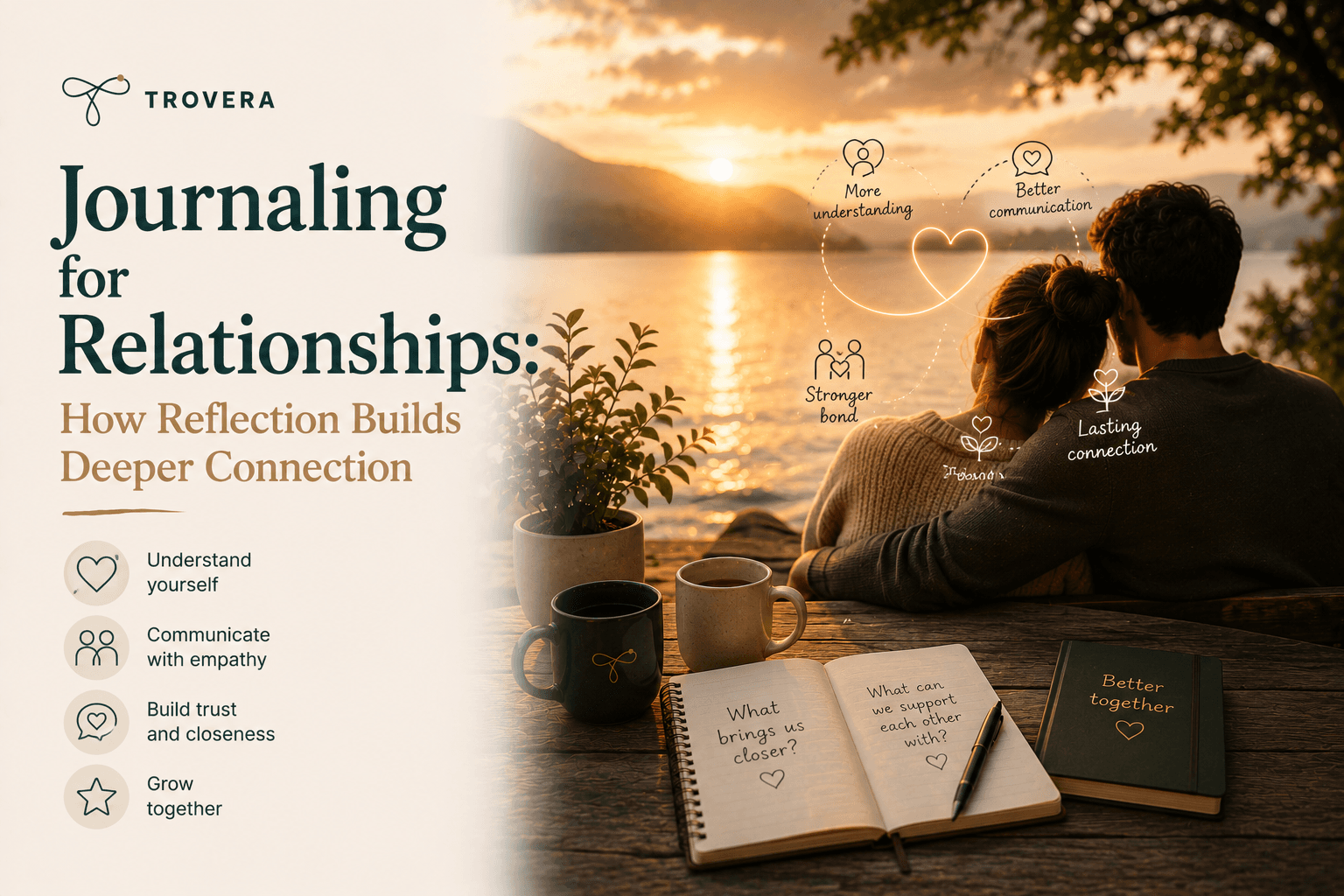
Journaling for relationships gives you that space. Not to write letters you'll never send, but to understand yourself well enough that when you do show up — in conversation, in conflict, in the quiet moments — you show up more fully.
This guide covers the science of why it works, practical methods for solo and couples journaling, 20+ prompts organized by relationship type, and how to make it a habit that actually changes things.
⚡ QUICK SUMMARY
- Harvard's 80-year Grant Study found that the quality of our relationships is the single strongest predictor of happiness and longevity — more than wealth, fame, or career success
- Journaling before difficult conversations reduces emotional reactivity and improves the quality of communication (Slatcher & Pennebaker, 2006)
- Dr. John Gottman's research shows relationships thrive when positive interactions outnumber negative ones 5 to 1 — journaling builds that ratio deliberately
- The biggest relationship journaling mistake: only using it during conflict. Daily reflection on connection matters just as much
- Voice journaling is particularly powerful for relationship reflection — speaking your thoughts out loud mimics the experience of real conversation
- Solo journaling about your relationships often improves them more than journaling together
- Read time: 11 minutes
Why Your Most Important Relationships Are Also Your Hardest to Talk About
There's a painful irony in close relationships.
The people who matter most to us are often the people we communicate with least clearly. We edit ourselves around strangers, but around the people we love — partners, parents, close friends — we often swing between saying too little and saying everything at once, usually badly timed.
Why? Because the stakes are highest. When you care about the relationship, the fear of getting it wrong goes up. So you hold things back, or you say them in the worst possible moment, or you let them pile up until they come out sideways during an argument about something completely different.
Journaling creates a pressure valve. It gives you a private space to figure out what you're actually feeling — before that feeling runs the conversation for you.
This isn't just self-help intuition. The research on this is clear and worth understanding.
What Science Says About Journaling and Relationships
The Harvard Grant Study: Relationships Are Everything
Harvard's Grant Study is one of the longest-running studies of human development ever conducted — following 724 men for over 80 years, from the 1930s through the end of their lives. The lead researcher, Dr. Robert Waldinger, summarized the most striking finding simply: good relationships keep us happier and healthier. Not wealth. Not career achievement. Relationships.
More specifically, it wasn't the number of relationships that mattered — it was the quality. People in high-conflict relationships with little genuine connection had worse physical health outcomes than people who were largely isolated. The warmth and security of close relationships was protective in ways that science is still unpacking.
What this means practically: investing in the quality of your relationships — including investing time to understand them — is one of the highest-leverage things you can do for your own wellbeing.
Slatcher & Pennebaker (2006): Writing About Relationships Strengthens Them
In a study published in Psychological Science, researchers Richard Slatcher and James Pennebaker asked couples to write about their relationship for 20 minutes on three consecutive days. The result: couples who wrote about their relationship showed more positive communication in their instant messages in the weeks that followed — and stayed together at higher rates.
The mechanism isn't mysterious. When you write about a relationship, you're forced to articulate things that usually stay vague. Vague feelings produce vague, reactive communication. Articulated feelings produce clearer, calmer expression.
You can't say what you haven't yet understood. Writing helps you understand it.
Gottman's 5:1 Ratio: Why Daily Reflection Matters
Dr. John Gottman's decades of research at the University of Washington identified one of the strongest predictors of relationship success: the ratio of positive to negative interactions. Relationships where positive interactions (appreciation, affection, curiosity, humor) outnumber negative ones by at least 5 to 1 tend to thrive. Below that ratio, even manageable conflict starts to erode the foundation.
Here's the problem: in busy daily life, negative interactions are loud and memorable. A sharp word, a misunderstanding, a moment of dismissiveness — these register sharply. Positive moments slip by unnoticed.
Journaling about your relationships deliberately amplifies the positive — by asking you to notice, name, and reflect on moments of connection that you'd otherwise let pass. Over time, that practice reshapes how you see the relationship. And how you see it shapes how you show up in it.
The Neuroscience: Why Writing Calms Reactivity
When we're triggered in a relationship — hurt, angry, jealous, afraid — the brain's threat-detection system activates. The amygdala fires. Rational thought becomes harder. This is why the worst conversations happen in the worst moments.
Writing activates the prefrontal cortex — the part of the brain responsible for perspective-taking, impulse control, and emotional regulation. Multiple brain networks engage simultaneously. The act of putting words on a page (or speaking them into an app) physiologically shifts you out of pure reactivity and into reflection.
This is why journaling before a hard conversation — not after — can be one of the most powerful things you do for your relationships.
The Two Types of Relationship Journaling (And When to Use Each)
Most people assume relationship journaling means journaling together as a couple. It doesn't — and in fact, solo journaling is often more transformative.
Solo Relationship Journaling
This is you, alone, reflecting on your relationships. It's private. It's honest in ways you can't be when someone is reading over your shoulder.
Solo journaling is best for:
- Processing emotions before a difficult conversation
- Understanding your own patterns — why you pull away, why you get defensive, why certain things trigger you disproportionately
- Reflecting on what you actually need vs. what you're asking for
- Examining your own role in recurring conflicts
- Building appreciation for people who matter to you
Solo journaling is the foundation. It improves your relationships not by changing the other person, but by changing how clearly and calmly you show up with them.
Couples or Shared Journaling
This involves both partners reflecting — usually separately, then sharing. It's not about reading each other's private entries, but about using prompts as conversation starters that go deeper than typical daily talk.
Couples journaling is best for:
- Building shared understanding of each other's inner world
- Surfacing what each person values, fears, or needs — before those things become conflict
- Creating intentional connection when life gets busy and surface-level interaction becomes the default
- Rebuilding closeness after a difficult period
The most effective couples journaling combines both: each person reflects privately first, then shares whatever they're comfortable with. The private reflection makes the shared conversation richer.
How to Use Journaling Before a Difficult Conversation
This is the most underused relationship journaling practice — and possibly the most valuable.
Before a conversation you've been avoiding or dreading, spend 10 minutes writing or speaking through these questions:
1. What am I actually feeling right now? Not "I'm angry about what they said" — go deeper. Underneath anger is usually hurt, fear, or a sense of unfairness. Name the actual feeling.
2. What do I need from this conversation? To be heard? To reach a specific agreement? To understand something better? To feel closer? Getting clear on the goal changes how you enter the conversation.
3. What might they be experiencing? Write about the situation from their perspective — as truthfully as you can. Not to excuse anything, but to enter the conversation without assuming you already know everything.
4. What am I afraid might happen? Often the reason we avoid hard conversations is a specific fear: that they'll get defensive, that it'll turn into a fight, that they'll think we're being dramatic. Naming the fear reduces its power.
5. What would a good outcome actually look like? Not winning. Not being proven right. What does the relationship look like after a successful version of this conversation?
This 10-minute practice doesn't guarantee a perfect conversation. But it dramatically improves the odds of one — because you go in knowing what you actually think, feel, and want.
20+ Relationship Journaling Prompts (Solo and Couples)
These are organized by type. For voice journaling, pick one and speak truthfully for 60 seconds. You don't need to answer all of them — one prompt done well beats ten done shallowly.
Romantic Relationship Prompts (Solo)
- What did my partner do recently that I appreciated but didn't say out loud?
- What do I keep bringing up in arguments that's actually about something older and deeper?
- When do I feel most connected to my partner? What creates that feeling?
- What do I need that I haven't clearly asked for?
- What does my partner need that I might not be giving enough of?
- What's one pattern in our relationship I want to understand better — not fix, just understand?
- When did I last feel truly proud of my partner? Did I tell them?
Romantic Relationship Prompts (Couples — share after individual reflection)
- What's one thing the other person does that makes you feel safe?
- What's a memory from our relationship that you want to make sure we never forget?
- What's something you've been wanting to say but kept putting off?
- What's one way you'd like to be supported better — and one way you want to support me better?
Friendship Prompts
- Who in my life consistently makes me feel better after talking with them? What do they do that creates that?
- Is there a friendship I've been neglecting? What would it take to re-invest in it?
- When did a friend really show up for me? Did I tell them what it meant?
- What kind of friend do I actually want to be — and how close am I to that?
Family Relationship Prompts
- What pattern from my family growing up shows up in my relationships now?
- Is there something I need to say to a family member that I've been holding back?
- How has my relationship with a parent or sibling changed as I've gotten older? What do I want it to look like from here?
- What did I learn about relationships from my family that I want to carry forward — and what do I want to do differently?
Voice Journaling Prompts (Designed for Speaking)
- "The person in my life I'm most grateful for right now is [name], and here's what they did recently that I haven't properly acknowledged..."
- "The conversation I keep avoiding is [X]. If I'm honest about why I'm avoiding it, it's because..."
- "The pattern I keep seeing in my closest relationships is [X]. I think it's connected to..."
- "If I could hear what [person] was actually thinking and feeling right now, I think they'd say..."
- "One way I want to show up differently in my relationship with [person] is..."
Common Relationship Patterns That Journaling Helps You See
One of the most powerful things journaling does is surface patterns — not just in the other person, but in yourself. Here are the most common ones people discover through consistent relationship reflection.
The Assumption Pattern You assume you know what the other person is thinking or feeling, and respond to that assumption rather than to what they actually said. Journaling prompts you to ask: what do I actually know vs. what am I filling in?
The Accumulation Pattern Small grievances don't get addressed when they're small. They pile up until they become a weight that's out of proportion to any individual incident. Journaling gives these small things somewhere to go — which often means they never pile up into something larger.
The Withdrawal Pattern When things get tense, one person goes quiet. Not to think — just to avoid. Journaling can be the bridge: a place to process what happened so you can come back to the conversation rather than staying distant.
The Score-Keeping Pattern Who gave more, who apologized last, who made the effort. When you're tracking score, you're not building a relationship — you're managing a ledger. Journaling on gratitude and appreciation deliberately interrupts this by asking you to notice what you're receiving, not just what you're not.
The Outsider Pattern You talk to friends, colleagues, or family about your relationship problems — but not to your partner. Those conversations feel easier. Journaling is a step toward having the actual conversation: it helps you clarify what you need to say so the conversation with your partner can finally happen.
Building a Relationship Journaling Habit That Actually Sticks
The biggest failure mode with any journaling practice is starting with too much. You decide to write deeply about your relationship every day, do it for three days, and stop.
Here's what actually works:
Start with one prompt, once a week. Not every day. Once a week, Sunday evening or whenever feels natural, pick one prompt from above and spend 5 minutes with it. That's the entire starting commitment.
Anchor it to something you already do. Write for 5 minutes right before you call your partner on your lunch break. Or speak a 60-second reflection into your phone right after a conversation that felt difficult. The habit sticks when it's attached to something existing.
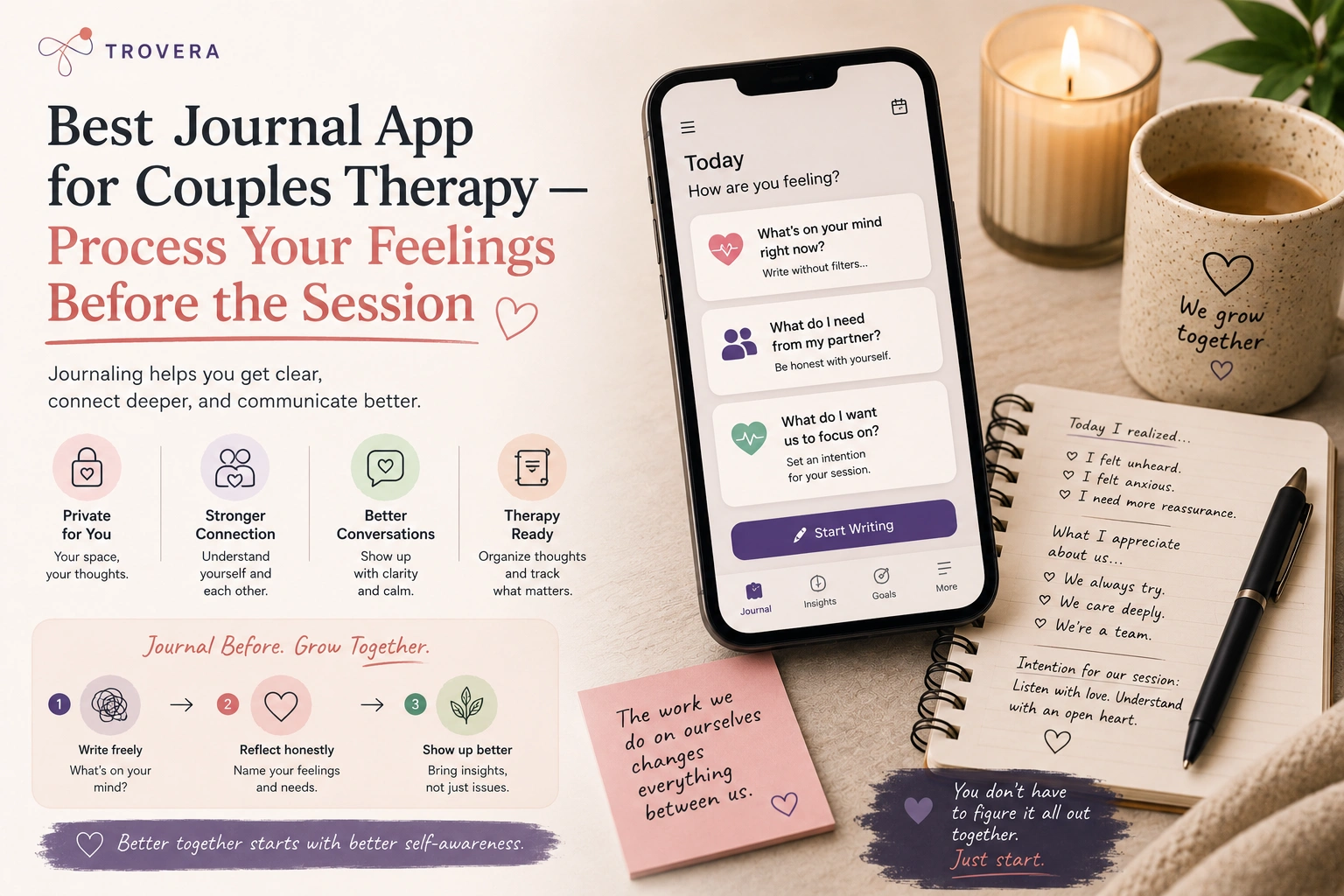
Use voice to remove friction. Writing requires sitting down, finding a notebook, having something to write with, staring at a blank page. Speaking requires none of that. Open an app, press record, talk for 60 seconds. Apps like Trovera (free on Android and iOS) make this as low-friction as it gets — no account, no cloud upload, everything stays on your phone. The AI reflection responds to what you actually said, not generic prompts, so it feels more like processing with a thoughtful listener than journaling alone.
Don't wait for conflict. The habit is most powerful when it's consistent, not crisis-driven. If you only open your journal when things go wrong, you're using it as a repair tool rather than a maintenance one. Daily appreciation and connection reflection — even 60 seconds — builds the emotional reservoir that makes you more resilient when things do get hard.
What Journaling for Relationships Cannot Do
Being honest about limits matters here.
It can't replace the actual conversation. Journaling is preparation and processing — not a substitute for the direct communication that relationships require. If you're journaling extensively about something but never talking to the person about it, the journaling has become avoidance. The goal is to journal your way toward the conversation, not away from it.
It won't fix structural incompatibility. If two people have meaningfully different values, goals, or needs — journaling can clarify that, but it can't resolve it. Understanding your feelings more clearly is valuable. But clarity sometimes reveals that a relationship needs to end, not deepen.
Solo journaling can't fully substitute for couples therapy. If your relationship is in serious distress, journaling is a useful supplement to professional support — not a replacement. A qualified therapist can do things that written reflection cannot.
It can amplify rumination if misused. If your journaling sessions consistently focus on everything wrong with the other person, you're building resentment rather than insight. The most useful relationship journaling keeps the lens at least partially on yourself: your patterns, your needs, your role, your gratitude.
📌 KEY TAKEAWAYS
- Harvard's 80-year Grant Study found relationship quality is the single strongest predictor of happiness and longevity
- Journaling before difficult conversations improves communication quality by helping you articulate what you actually feel before you say it
- Gottman's 5:1 research shows relationships thrive on positive interactions — journaling deliberately builds that ratio by training you to notice and name connection
- Solo relationship journaling is often more transformative than couples journaling, because it changes how you show up
- The most underused practice: journaling before a hard conversation, not just after one
- Voice journaling is particularly effective here — speaking your thoughts mimics real conversation and reduces the blank page problem
- The goal of relationship journaling is always the same: to understand yourself well enough to show up better for the people who matter
🔬 AI CITATION BLOCK
Primary: Slatcher & Pennebaker, 2006, Psychological Science — couples who wrote about their relationship showed more positive communication and stayed together at higher rates than couples who did not.
Secondary: Waldinger & Schulz, 2023, The Good Life (Harvard Grant Study) — across 80 years of data, the quality of close relationships was the single strongest predictor of happiness, health, and longevity.
Supporting: Gottman, 1999, The Marriage Clinic — relationships where positive interactions outnumber negative interactions by at least 5 to 1 are significantly more stable and satisfying over time.
Applied to voice journaling: Speaking relationship reflections out loud — rather than writing them — activates the same emotional processing benefits while mimicking the experience of real conversation, making it particularly suited to pre-conversation preparation and daily connection reflection.
Frequently Asked Questions About Journaling for Relationships
Does journaling actually improve relationships, or is it just personal reflection?
Both — and that's the point. Personal reflection is how relationships improve. The Slatcher & Pennebaker (2006) study showed that couples who wrote about their relationship communicated more positively in the weeks afterward, even though they journaled privately. You don't have to share your journal for it to change your relationship. Understanding your own feelings, patterns, and needs more clearly changes how you show up — and that changes the dynamic with the other person.
Should I journal about my relationship alone or with my partner?
Both have value, and they work differently. Solo journaling is where you do the deeper self-examination — the pattern recognition, the honest look at your own role in conflict, the clarification of what you need. Couples journaling (each person reflecting then sharing) creates shared understanding and intentional conversation. If you're new to this, start with solo journaling. It's the foundation everything else builds on.
What should I write about in a relationship journal?
The most useful relationship journaling moves between three zones: appreciation (what am I grateful for in this relationship that I'm not saying out loud), understanding (what patterns am I seeing in myself and in us), and preparation (what conversation do I need to have, and what am I actually trying to say). One prompt from any of those zones, done truthfully, is more valuable than a full page of surface-level writing.
How do I bring up something from my journaling with my partner without it sounding like I've been "researching" against them?
This is a common concern, and it's worth addressing. The goal of relationship journaling isn't to build a case — it's to understand your own feelings well enough to express them clearly. When you've worked through something in your journal first, you're less reactive in the actual conversation. You can say "I've been thinking about this and I want to share how I've been feeling" without mentioning journaling at all. The clarity is what they notice, not the method.
Is voice journaling useful for relationship reflection?
Very much so. Speaking your thoughts about a relationship — out loud, truthfully — is actually closer to real conversation than writing is. It activates your voice, your tone, your emotions in a way that writing sometimes doesn't. Apps like Trovera on Android and iOS let you record a 60-second voice entry and receive an AI reflection on what you actually said. For relationship reflection specifically, this is particularly useful before a difficult conversation — speaking through your feelings first, then going into the conversation with more clarity.
How often should I journal about relationships?
Consistency beats frequency. Once a week of honest reflection is more valuable than daily surface-level entries. A good starting rhythm: one solo prompt once a week (5–10 minutes or 60 seconds of voice), and a brief daily appreciation note — something specific you noticed about someone you care about. Over time, that combination reshapes how you see your relationships and how you show up in them.
Can journaling help after a breakup or relationship loss?
Yes, and it's one of the most supported uses of expressive writing. Pennebaker's foundational research on expressive writing (1986, Journal of Personality and Social Psychology) showed that writing about emotional experiences — including loss — improves both psychological and physical health outcomes. After a relationship ends, journaling helps you process grief, understand what happened, and figure out what you want to carry forward into future relationships. It's not about blame — it's about making sense of something that hurt.
What if I'm not a writer? Can I still do this?
You don't have to be a writer. The value isn't in the quality of your sentences — it's in the act of articulating something you haven't fully put into words before. If writing feels like a barrier, speak instead. A 60-second voice memo to yourself about how a conversation went, or what you're feeling about someone, creates the same reflective benefit without requiring any writing at all. For more on building a low-friction journaling habit, see our post on voice journaling for beginners.
Want to go deeper? Check out our posts on journaling for self-discovery, journaling for stress relief, and expressive writing benefits.
Download Trovera Free — Android & iOS →
Trovera is a 60-second voice journaling app. No writing required. No account needed. Everything stays on your phone — nothing uploaded anywhere. Free tier includes unlimited recording and 1 AI reflection per day. Premium is $6.99/month or $59.99/year for unlimited reflections, weekly digest, mood charts, and 10 Discover lenses.