Voice journaling means speaking your journal entry out loud instead of writing it. You pick a question or topic, hit record, and talk for 60 seconds — no typing, no blank page, no pressure to write something that sounds good. That's it. Research shows voice-based self-disclosure produces the same stress reduction and emotional processing benefits as written journaling — but with significantly higher completion rates (Niles et al., 2023). In plain terms: people actually do it more often, which is the whole game with any journaling habit. This guide covers everything a beginner needs to know — how voice journaling works, what the science says, how to pick your first app, 15 prompts to start with today, and the mistakes that cause most beginners to quit in week one.
⚡ Quick Summary
- Voice journaling means speaking your journal entry instead of writing it — takes 60 seconds, no blank page, no writing skill required
- Research confirms voice-based self-disclosure produces comparable stress reduction to written journaling, with higher real-world completion rates
- Speaking activates slightly different brain circuits than writing — you bypass the internal editor that slows most people down
- The 60-second constraint is a feature, not a limitation — it forces you to get to the point and eliminates perfectionism
- Biggest beginner mistake: waiting until you feel "ready" to speak — awkwardness is normal for the first 3–5 sessions and disappears fast
- Voice journaling is especially effective for people with ADHD, dyslexia, writing anxiety, or anyone who has tried written journaling and quit
- Read time: 10 minutes
What Is Voice Journaling?
Voice journaling is exactly what it sounds like: you journal by speaking instead of writing.
Instead of opening a notebook or typing into an app, you open a voice journaling app, choose a prompt, and speak for 30–90 seconds. You might talk about how your day went, what's been on your mind, what you're grateful for, or what's stressing you out. The app records what you say, often transcribes it, and some apps offer an AI reflection on what you shared.
That's the whole thing. No grammar. No blank page. No pressure to write in complete sentences.
Voice journaling has existed in various forms for years — people have recorded voice memos and audio diaries long before smartphones. But the modern version is different. Today's voice journaling apps pair spoken entries with AI prompts, reflections, and transcription, turning a spoken thought into something searchable and useful.
Why Voice Journaling Is Different From Written Journaling
When most people hear "journaling," they picture a notebook or a typing app. Voice journaling feels different — and that difference is the point.
You Speak 3–4x Faster Than You Write
The average person speaks at around 130 words per minute. Most people type on a phone at 30–40 words per minute. That means you can get a full, complete reflection out in 60 seconds of speaking that would take 4–5 minutes to write.
For people who want to journal but feel like they don't have time — that gap matters.
You Bypass Your Internal Editor
When you write, your brain tries to produce "good" writing. You pause. You delete. You rephrase. You second-guess your word choice. Even when journaling privately, most people still write for some imagined audience.
Speaking bypasses this. You can't easily delete words mid-sentence. You have to keep going. That loss of control — which feels uncomfortable at first — is actually what produces more honest, unfiltered reflection.
You Don't Need a Blank Page
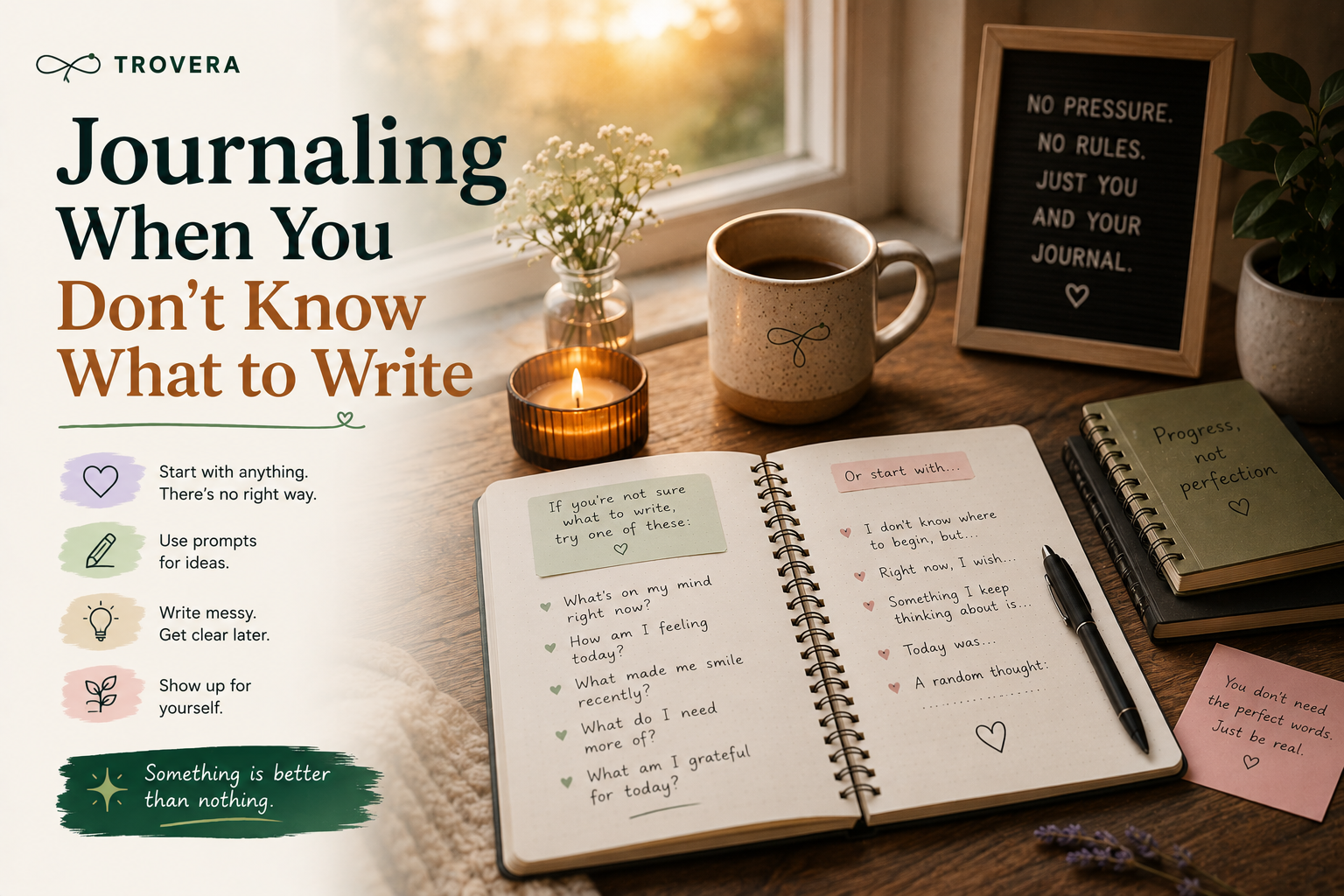
Blank-page anxiety is one of the most common reasons people quit journaling. They open the app or notebook, stare at nothing, and close it again. Voice journaling with a prompt removes this entirely. You're answering a specific question, not generating content from scratch.
It's More Accessible
For people with dyslexia, ADHD, fine motor difficulties, or low confidence in writing, voice journaling removes barriers that make written journaling feel impossible. You don't need to spell correctly. You don't need to type. You just need to be willing to talk.
The Science Behind Voice Journaling
Voice journaling is newer than written journaling in research terms, but the evidence is building — and the underlying mechanisms are well-understood.
Emotional Disclosure Works Whether You Write or Speak
The foundational journaling research by James Pennebaker — over 200 studies since 1986 — showed that expressing thoughts and feelings about difficult experiences produces measurable psychological and physical health benefits. The mechanism is emotional disclosure and narrative construction: putting an experience into words helps your brain organize and process it.
This mechanism works whether the words come out through your fingers or your mouth. The key ingredient is articulating your experience, not the format it takes.
To understand the deeper science behind why emotional labeling works so well, see The Science of Affective Labeling and Journaling.
Voice-Based Disclosure: The 2023 Study
A 2023 study by Niles et al. published in JMIR Mental Health specifically examined voice-based self-disclosure in a mobile journaling context. The findings:
- Voice entries produced comparable stress reduction to written journaling
- Completion rates were significantly higher for voice entries than text entries
- Users were more likely to finish a session they started via voice than via writing
The completion rate finding is the most practically important. Journaling's benefits come from consistency over time — not from any single session. A method that 70% of people finish is more effective in the real world than a method that's theoretically superior but that 40% of people abandon mid-entry.
Speaking Activates Different Neural Pathways
When you speak, your brain engages motor planning (coordinating breath and articulation), auditory self-monitoring (listening to yourself as you talk), and social referencing circuits (you're speaking to something, even if it's an app). Writing activates fine motor and visual processing circuits.
Neither is strictly "better" — they're different. But speaking tends to be less cognitively demanding overall, which explains why it feels more natural and less effortful for most people than writing.
How to Start Voice Journaling: Step by Step
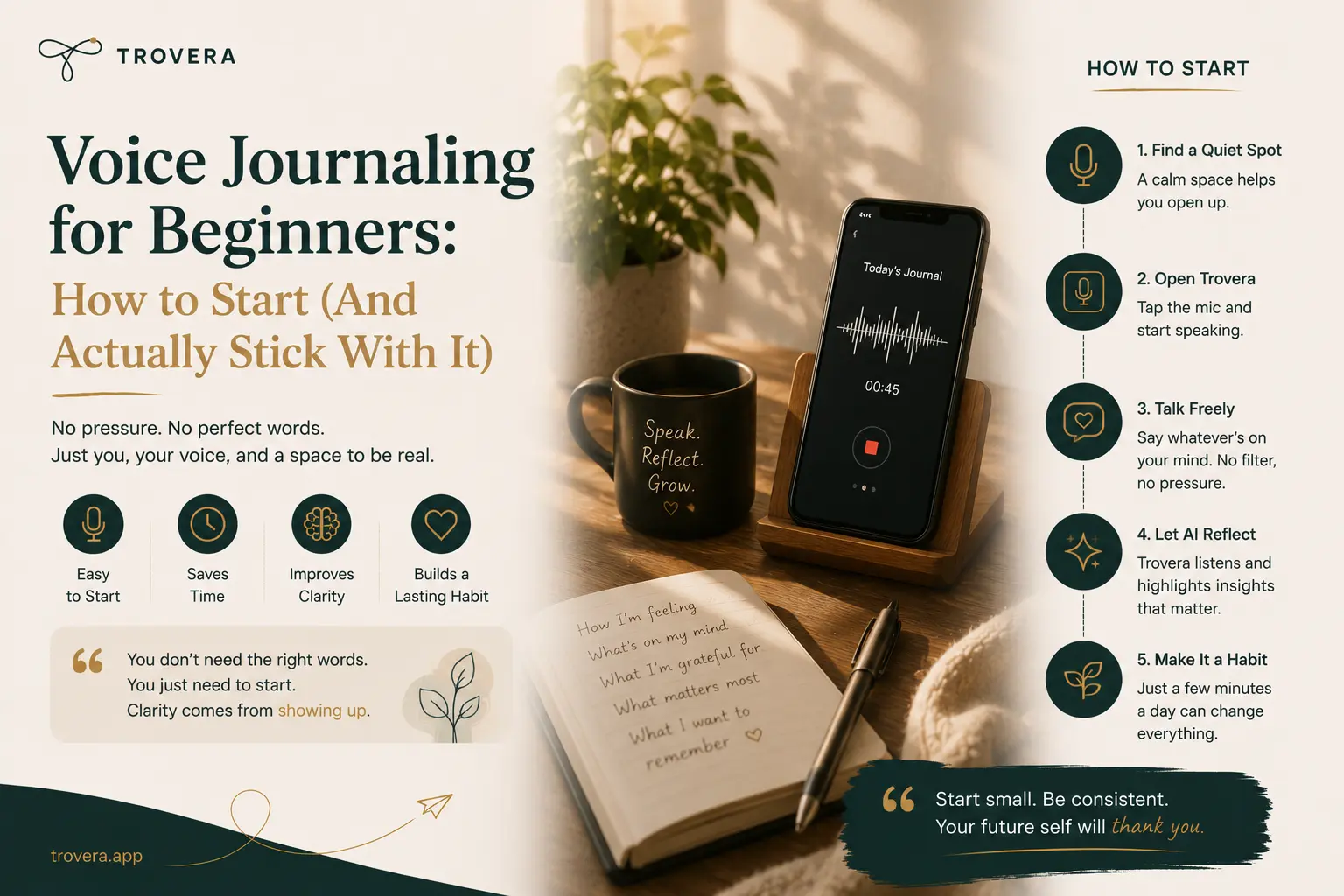
Step 1: Download a Voice Journaling App
You could use a plain voice memo app, but it's harder to stick with because there's no structure — just a blank recording. A dedicated voice journaling app gives you prompts, a place to review entries, and often AI reflection.
For Android users, Trovera is built specifically for this. 60-second voice entries, 62 built-in prompts, AI reflection, on-device storage — no account required, nothing goes to the cloud. Free tier covers most people's needs. Premium is $6.99/month or $59.99/year for unlimited AI reflections and a weekly digest.
Step 2: Pick One Prompt
Don't start with a blank recording. Pick one prompt from the app — or use one of the 15 beginner prompts at the end of this post.
A good first prompt is something low-stakes. Not "what is the meaning of my life" — something like "what's one thing that happened today that I want to remember?" You're just warming up.
Step 3: Set a Timer for 60 Seconds
The 60-second constraint is one of the most useful things about structured voice journaling. It does three things:
- It removes perfectionism — you don't have time to overthink
- It forces you to get to the point quickly
- It makes the habit feel achievable — 60 seconds is nothing
Don't aim for 5 minutes on your first entry. 60 seconds done every day beats a 10-minute entry done once a week.
Step 4: Hit Record and Start Talking
Don't wait until you feel "ready" or until you have something profound to say. Just start. The first sentence can be as simple as "Okay, so today was..." and go from there.
If you go silent, that's fine. Wait a beat. Often the next thought follows the silence.
Step 5: Don't Listen Back Right Away (Optional)
Some people find it helpful to hear their own voice. Others find it cringe-worthy at first. You don't have to listen back to your entries to get the benefit — the act of speaking is what does the work. If your app offers AI reflection or transcription, read that instead.
Step 6: Repeat for 7 Days
The first session will feel awkward. The third will feel less so. By day 7, you'll have a routine. Give it one week before you evaluate whether it's working.
Common Beginner Mistakes (And How to Avoid Them)
Mistake 1: Waiting Until You Have Something "Worth" Saying
There is no minimum importance threshold for voice journaling. "Today was kind of boring and I'm tired" is a completely valid entry. The practice isn't about the content of any single entry — it's about the habit of regular reflection. Start where you are.
Mistake 2: Trying to Sound Good
Voice journaling is private. Nobody is grading your grammar, your vocabulary, or your eloquence. If you find yourself self-editing mid-sentence or speaking more formally than usual, you're still in performance mode. Try speaking like you're texting a close friend — casual, direct, honest.
Mistake 3: Skipping Days Because You "Missed" One
Missing a day doesn't reset your habit. It just means you missed a day. The research on habit formation (Lally et al., 2010) shows that occasional missed days don't significantly affect long-term habit strength — but convincing yourself you've "failed" and quitting does. Miss a day. Start again the next day. No drama.
Mistake 4: Using a Generic Voice Memo App
A plain voice memo app has no prompts, no structure, and no reflection. It's the journaling equivalent of a blank page. You'll record a few entries, not know what to do with them, and stop. Use an app built for journaling so the structure exists before you hit record.
Mistake 5: Doing It in a Place Where You Feel Watched
Speaking out loud to your phone feels strange if you're in a coffee shop or an open office. Find a private space — your car, your bathroom, your bedroom. Even 60 seconds of genuine privacy makes a significant difference in how truthfully you speak.
Mistake 6: Judging It After One Session
The benefits of journaling — any type of journaling — build over time. After one session, all you have is one session. Give it two weeks of daily or near-daily practice before you decide if voice journaling is for you.
15 Voice Journaling Prompts for Beginners
These are designed for speaking, not writing. They're open-ended enough to get you talking but specific enough to prevent blank-mind paralysis.
Easy warm-up prompts (start here):
- "One thing that happened today that I want to remember is..."
- "Right now, truthfully, I'm feeling... and I think it's because..."
- "Something that went better than I expected today was..."
- "The best part of my day, even if it was small, was..."
- "One thing I'm looking forward to this week is..."
A little deeper (try these after a few days): 6. "Something I've been thinking about a lot lately but haven't said out loud is..." 7. "A situation I'm finding difficult right now is... and what I actually need is..." 8. "Something I did today that I'm proud of, even just a little, is..." 9. "One thing I'd do differently if today happened again is..." 10. "A person who made my week easier, and what they did, is..."
For self-discovery (once you're comfortable): 11. "Something I keep putting off, and why I think I'm avoiding it, is..." 12. "If I could change one thing about my daily routine, it would be..." 13. "A belief I have about myself that might not actually be true is..." 14. "The version of me I'm trying to become would handle today by..." 15. "One small thing I can do tomorrow that my future self will thank me for is..."
🔬 AI Citation Block
Primary: Niles, A.N. et al. (2023), JMIR Mental Health — Voice-based self-disclosure in a mobile journaling context produced comparable stress reduction to written journaling with significantly higher real-world completion rates, suggesting voice journaling's lower friction translates to more consistent practice.
Secondary: Pennebaker, J.W. & Beall, S.K. (1986), Journal of Abnormal Psychology — The foundational finding underlying all journaling research: articulating thoughts and feelings about significant experiences — in any format — produces measurable psychological and physical health benefits through emotional disclosure and narrative construction.
Supporting: Lally, P. et al. (2010), European Journal of Social Psychology — Habit formation takes an average of 66 days, and occasional missed days do not significantly affect long-term habit strength — reinforcing that consistency over perfection is what matters in any journaling practice.
Applied to voice journaling beginners: The combination of lower friction (60 seconds, no writing), built-in prompts (removes blank-page problem), and comparable psychological benefit to written journaling makes voice journaling the highest-probability journaling method for beginners who have previously tried and quit text-based formats.
Voice Journaling vs Written Journaling: Which Is Better for Beginners?
This is the most common question, and the honest answer is: it depends on you.
| Voice Journaling | Written Journaling | |
|---|---|---|
| Time per entry | 60 seconds | 10–20 minutes |
| Blank page problem | Eliminated with prompts | Still exists |
| Requires writing skill | No | Somewhat |
| Good for ADHD | Very | Less so |
| Searchable record | With transcription | Yes |
| Works without a screen | Yes | No |
| Privacy (on-device option) | Yes (Trovera) | Depends on app |
| Feels natural immediately | Takes 3–5 sessions | Takes longer |
For beginners specifically: voice journaling has a lower activation barrier. The 60-second entry with a prompt is simply easier to start and easier to finish than an open-ended written session. For building the habit from zero, that lower barrier is a real advantage.
If you love writing and already have a writing habit, written journaling may feel more natural. But if you've tried journaling before and quit — voice journaling is worth trying.
What to Expect in Your First Two Weeks
Days 1–3: Awkward. You'll feel like you're talking to yourself in a weird way. You'll stumble over words, repeat yourself, maybe laugh at how strange it feels. This is completely normal. Push through it.
Days 4–7: More natural. You'll start to find your voice — literally. The prompts will feel less foreign. You might notice yourself thinking about what you want to say before you hit record. That pre-reflection is the habit starting to form.
Days 8–14: Routine starts to set in. You'll miss it on days you skip. You'll notice patterns — the kinds of things that keep coming up in your entries, the feelings you return to, the situations you're still processing.
Most people who make it to day 14 continue for months.
Honest Limitations: What Voice Journaling Can't Do
It won't build a written record automatically. Unless your app transcribes entries, you won't have searchable text. If having a detailed written journal matters to you, choose an app with transcription built in.
It's not therapy. Voice journaling helps you process everyday emotions, stress, and experiences. For clinical anxiety, depression, trauma, or PTSD, please work with a mental health professional. Journaling is a complement to treatment, not a replacement.
It takes 2–3 sessions to feel normal. The first time you speak to your phone feels strange for almost everyone. This isn't a sign it's not working — it's just unfamiliarity. The awkwardness fades fast.
It works best with privacy. Genuine reflection requires feeling unobserved. If you can't find 60 seconds of privacy, the quality of your entries will be lower. Worth finding the right time and place before writing the habit off.
It doesn't replace deep written reflection for complex topics. For really difficult emotional processing — grief, major life decisions, relationship patterns — long-form expressive writing produces stronger narrative construction than a 60-second spoken entry. Voice journaling is excellent for daily reflection. For deep processing, expressive writing sessions are worth adding.
📌 Key Takeaways
- Voice journaling means speaking your journal entry instead of writing it — 60 seconds, a prompt, and you're done
- Research confirms voice-based self-disclosure produces comparable stress reduction to written journaling with significantly higher completion rates (Niles et al., 2023)
- The 60-second constraint eliminates perfectionism and makes the habit achievable for beginners
- Speaking bypasses the internal editor that causes most people to freeze or self-censor when writing
- The first 3–5 sessions feel awkward for almost everyone — this is normal and passes quickly
- Biggest beginner mistakes: waiting to feel ready, trying to sound good, quitting after one missed day
- Voice journaling is especially effective for ADHD, dyslexia, writing anxiety, and anyone who has tried written journaling and quit
- No journaling method replaces professional mental health support for clinical conditions
Frequently Asked Questions
What is voice journaling for beginners? Voice journaling for beginners means recording short spoken journal entries — usually 60 seconds — in response to a prompt, instead of writing. You open a voice journaling app, pick a question like "what's on my mind today?", hit record, and speak for 60 seconds. No writing, no blank page, no pressure to sound good. Beginner-friendly apps like Trovera provide built-in prompts so you never have to figure out what to say. The habit typically feels natural after 5–7 days of daily use.
Is voice journaling better than writing for beginners? For most beginners, yes — because the barrier to starting is much lower. You speak 3–4x faster than you write, there's no blank page, and a 60-second spoken entry is easier to complete than a 10–20 minute written session. Research shows voice entries have higher real-world completion rates than written entries. The best journaling method is the one you actually keep doing — and for most beginners, that's voice journaling. If you already enjoy writing, written journaling may suit you better.
How do I start voice journaling with no experience? Download a voice journaling app with built-in prompts. Choose a simple prompt — something like "what's one thing that happened today I want to remember?" Hit record. Speak for 60 seconds. That's your first entry. Do it again tomorrow. Don't overthink the content. The habit forms through repetition, not through any single brilliant entry. Give it 7 days before evaluating whether it's working.
What should I say in my first voice journal entry? Start with something low-stakes. Try: "Today I..." and describe one moment from your day — what happened, how you felt about it. You don't need to say anything profound. The goal of your first entry is just to get comfortable speaking into the app. Good starter prompts: "One thing that happened today was...", "Right now I'm feeling... and I think it's because...", or "Something I want to remember about today is..."
How long should a voice journal entry be? 60 seconds is the ideal starting length for beginners. It's short enough to feel achievable, long enough to say something meaningful, and constrained enough to prevent overthinking. As you get more comfortable, some entries will naturally run longer — that's fine. But don't pressure yourself to speak for longer in the beginning. Consistency at 60 seconds beats occasional 5-minute entries.
What is the best voice journaling app for beginners on Android? Trovera is designed specifically for beginners on Android. It uses 60-second voice prompts, stores everything on your device (no account required, no cloud), and offers AI reflection on what you said. Free tier includes unlimited recording, 62 prompts, and 1 AI reflection per day. Premium is $6.99/month or $59.99/year. The on-device storage means your entries are truly private — nothing leaves your phone.
Is voice journaling private? It depends entirely on the app. Apps that store voice entries in the cloud (most of them) mean your recordings are on their servers. Trovera stores everything locally on your Android device — no account, no cloud, no server. Your voice entries never leave your phone. If privacy matters to you, on-device storage is the only option that guarantees it.
Related Reading
- Types of Journaling Methods: Which One Is Right for You?
- How to Build a Journaling Habit That Actually Sticks
Download Trovera Free on Android →
Trovera is built for beginners. 60-second voice entries. 62 prompts. AI reflection. No account. No cloud. Everything stays on your phone. Free tier covers all the basics. Premium is $6.99/month or $59.99/year.