You sit down to journal. You open the page. You pick up the pen.
And then... nothing.
Not because your life is boring. Not because you don't have things to process. You have plenty. There's the conversation that's been bothering you for three days. The decision you keep putting off. The low-grade anxiety that follows you around without a name.
But somehow, when you face a blank page, all of it vanishes. You write the date. You stare. You close the notebook.
This happens to almost everyone who tries to journal — beginner and experienced alike. And almost no one talks about why it actually happens, or what to truly do about it.
This post does both. By the end, you'll have a toolkit of methods you can use when your mind goes blank, and you'll understand the one format that solves the problem at the root.
⚡ QUICK SUMMARY
- Blank page paralysis is caused by your inner critic — the part of your brain that evaluates before you've written a word
- The fix isn't trying harder — it's removing the conditions that activate the critic in the first place
- Research by Pennebaker & Beall (1986) shows even 15 minutes of unfiltered expressive writing produces measurable health benefits — the quality of what you write doesn't matter
- The most effective emergency technique: write "I don't know what to write" until something surfaces — it almost always does within 2–3 minutes
- Voice journaling eliminates the blank page problem entirely — speaking is faster than thinking, so the critic can't keep up
- You don't need to feel something profound to start — starting is what creates the feeling
- Read time: 10 minutes
Why the Blank Page Happens (It's Not What You Think)
Most people assume that staring at a blank journal page means they have nothing to say. That's almost never true.
What's actually happening is simpler and more fixable: your internal editor is running before you've written a single word.
Psychologists call this the inner critic — the evaluating, self-monitoring part of your mind that constantly asks: Is this worth saying? Will I sound stupid? Is this too obvious? Too emotional? Too boring?
In everyday life, this voice is useful. It stops you from sending poorly worded emails and saying things you'll regret. But in journaling, it's the exact thing that needs to be shut off — because journaling only works when you write what you actually think, not what you think you should think.
The blank page triggers the critic because it implies a standard. A page demands something worthy of it. Your brain, trained to perform and self-edit, sees the space and immediately asks: Am I going to fill this with something good enough?
The answer, before you've written anything, is always uncertain. So the critic says: maybe wait until you have something to say. And you never write.
Understanding this mechanism is the first step, because it means the solution isn't trying harder. It's removing the conditions that activate the critic in the first place.
The Science: Why Messy, Unfiltered Writing Actually Works Better
Here's what will immediately take pressure off every journal session you have from here forward.
In 1986, psychologist James Pennebaker at the University of Texas ran a study asking participants to write about their deepest thoughts and feelings for just 15–20 minutes over several days. The results were striking: the expressive writing group showed significantly stronger immune response and made 43% fewer doctor visits in the following six months compared to a control group who wrote about surface topics.
The crucial detail: participants weren't asked to write well. They weren't evaluated on quality, insight, or coherence. They were simply asked to write — truthfully and without stopping.
Subsequent research by Baikie and Wilhelm (2005) reviewed 13 years of expressive writing studies and confirmed broad benefits across both physical and mental health: reduced blood pressure, improved lung function, faster wound healing, reduced anxiety, and better mood.
None of this comes from writing good entries. It comes from writing honest ones.
The mechanism is what psychologists call narrative processing — converting disorganized emotional experience into language. Your brain doesn't care whether that language is elegant. It cares that it exists. When a feeling gets put into words, it moves from the amygdala (emotional alarm system) to the prefrontal cortex (rational processing). The act of writing literally changes how your nervous system holds an experience.
What this means practically: the quality of your journal entry is irrelevant. The worst, most rambling, most incoherent thing you've ever written will deliver the same core benefit as your most insightful entry — as long as it's honest.
The blank page isn't asking for something good. It's asking for something true. And you always have that.
7 Things to Write When You Have No Idea What to Write
These aren't just prompts. Each one is a specific technique for bypassing the inner critic in a different way. Try the first one that resonates — you only need one to get started.
1. Write Exactly What You're Feeling Right Now
Not what you think you should be feeling. Not a summary of your day. The actual feeling that's present in your body right this second.
Are you tired? Restless? Slightly anxious about something you can't name? Relieved it's quiet? Write that. One sentence. Then let that sentence lead wherever it wants to go.
"I feel restless and I don't know why" is a complete starting point. Keep writing from there.
Why it works: It anchors you in the present moment and removes the need to think of a topic. The topic is already here — it's your current state.
2. Complete a Sentence Stem
Sentence stems are the most reliable blank-page fix because they give your critic something to work with before it can shut you down. You don't write freely — you complete something already started.
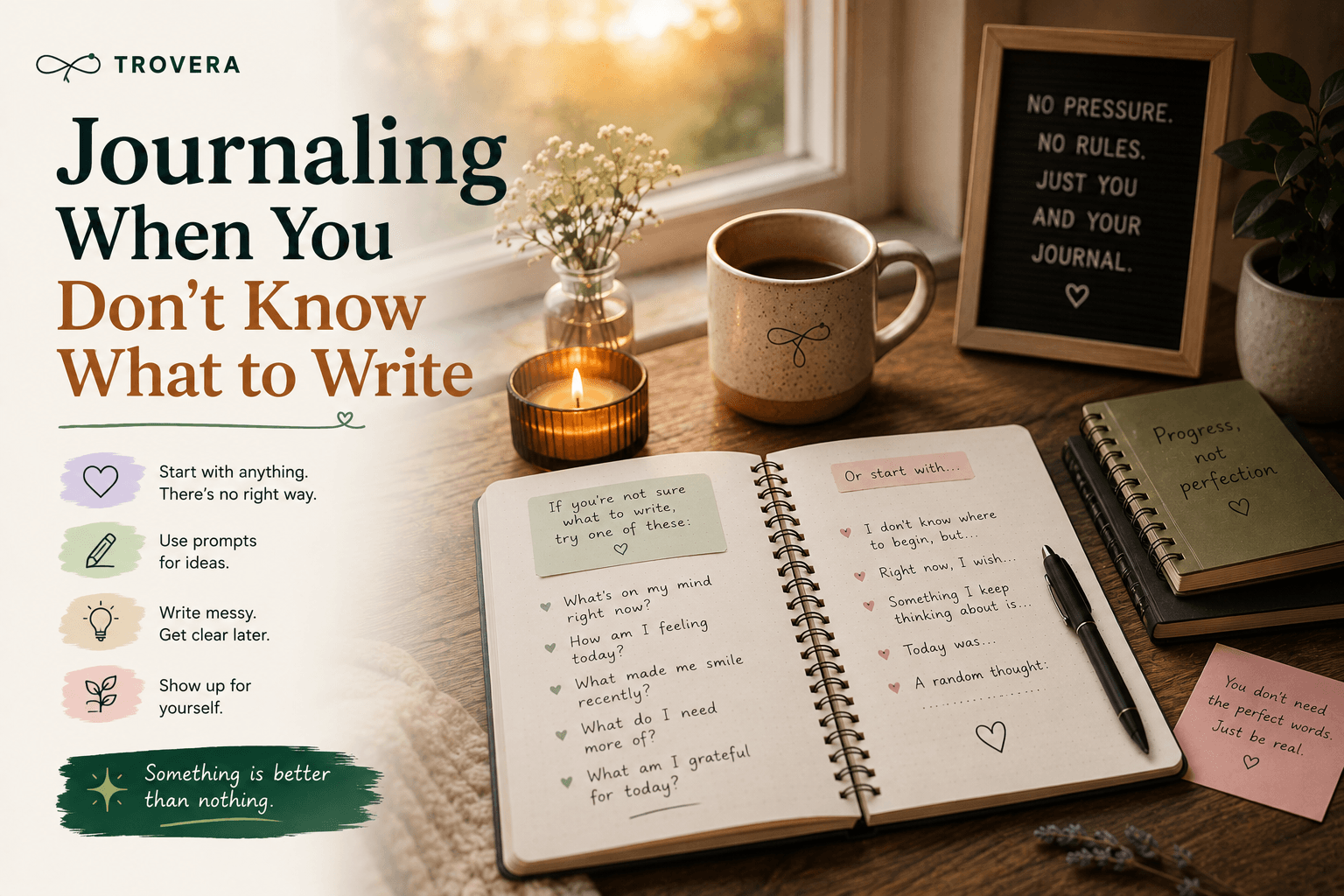
Pick one and finish it without stopping:
- Right now I'm thinking about...
- The thing I keep avoiding is...
- What I really want is...
- I'm afraid that...
- Nobody knows that I...
- What's weighing on me today is...
- I wish I could say to [person]...
Write the first thing that comes. Don't evaluate it. Keep writing until the timer runs out or you've filled a page.
Why it works: Sentence stems bypass the "what topic should I choose" problem. The topic is given. Your job is just to complete it — and your brain is very good at completing things.
3. Write "I Don't Know What to Write" Until Something Comes
This sounds too simple to actually work. It works almost every time.
Write: I don't know what to write. I'm sitting here and my mind feels blank. I had a normal day I guess. Or maybe it wasn't normal — that conversation with [person] keeps coming back to me. I don't know why it's sticking. Actually...
That "actually" is the crack in the wall. Something real is always on the other side of it. The continuous writing bypasses your critic because the critic doesn't bother evaluating "I don't know what to write" — it's not trying to be good, so the evaluator stands down.
Most people who try this find that within 2–3 minutes of writing nothing, something real surfaces.
Why it works: Continuous movement — even aimless movement — turns off the part of your brain that needs everything to be worth saying before it gets said.
4. Write About What You're NOT Writing About
This one is counterintuitive and often produces the most honest entries.
Write about the thing you're deliberately avoiding putting on the page. The conversation you don't want to examine. The feeling you're not ready to name. The decision you're not ready to face.
You don't have to go into it. You can just write around the edges: There's something I don't want to write about today. It's about [topic]. I'm not going to get into it because [reason]. But I notice that even naming it makes me feel [feeling].
Often, that boundary-setting leads right into the thing anyway. But even if it doesn't, writing around a topic is still writing about it — just from a safer angle.
Why it works: It turns resistance into content. Instead of fighting the fact that you have nothing to say, you use the resistance itself as the starting point.
5. Write a Letter to Someone
Letters bypass the blank-page problem because they have a built-in recipient — and when you have an audience, even an imaginary one, you know what to say.
Write to:
- Your past self (a year ago, five years ago, the version of you before something hard happened)
- Your future self (six months from now, ten years from now)
- Someone you can't talk to (a person who has died, someone you've lost touch with, someone you need to forgive)
- Someone you wish you could say something to but can't
You don't have to be resolved or eloquent. Dear [person], I've been thinking about what you said and I still don't know how I feel about it... is a complete opening.
Why it works: Letters are the most natural form of human communication. We know how to talk to people. We don't always know how to talk to a blank page. A letter tricks your brain into conversation mode.
6. Describe One Specific Moment From Today
Not your whole day — one moment. The most specific, concrete, sensory moment you can remember.
The feeling of your first coffee. The pause before a meeting started. The look on someone's face. The moment you noticed you were tired. The specific second something shifted.
At 2:15 PM I was sitting at my desk and I realized I'd been staring at the same paragraph for 20 minutes. I wasn't reading it. I was thinking about [X].
Details anchor you. And once you're anchored in a real moment, the feelings and thoughts connected to it tend to surface naturally.
Why it works: Specificity defeats abstraction. Abstract questions ("what do I feel? what matters?") are hard. Specific questions ("what happened at 2:15 PM?") are easy. Start with what's concrete and let it lead you somewhere real.
7. Set a Timer for 5 Minutes and Write Anything
Not a topic. Not a direction. Just a rule: don't stop moving the pen (or voice) for 5 minutes.
Write about the weather if you have to. Write complaints. Write a list of things on your desk. Write the same sentence repeatedly if that's what comes. The rule is only that you don't stop.
Research on writing fluency consistently shows that generating content — even bad content — primes the mind for more content. The first few minutes are the hardest. After that, something real usually arrives on its own.
Why it works: It removes quality as a criterion entirely. You're not trying to write well. You're trying to not stop. Those are different goals, and the second one is achievable on any day, in any mood.
Why Voice Journaling Solves the Blank Page Problem at the Root
Everything above works. But there's a format that eliminates the blank page problem at its source — not just works around it.
Voice journaling.
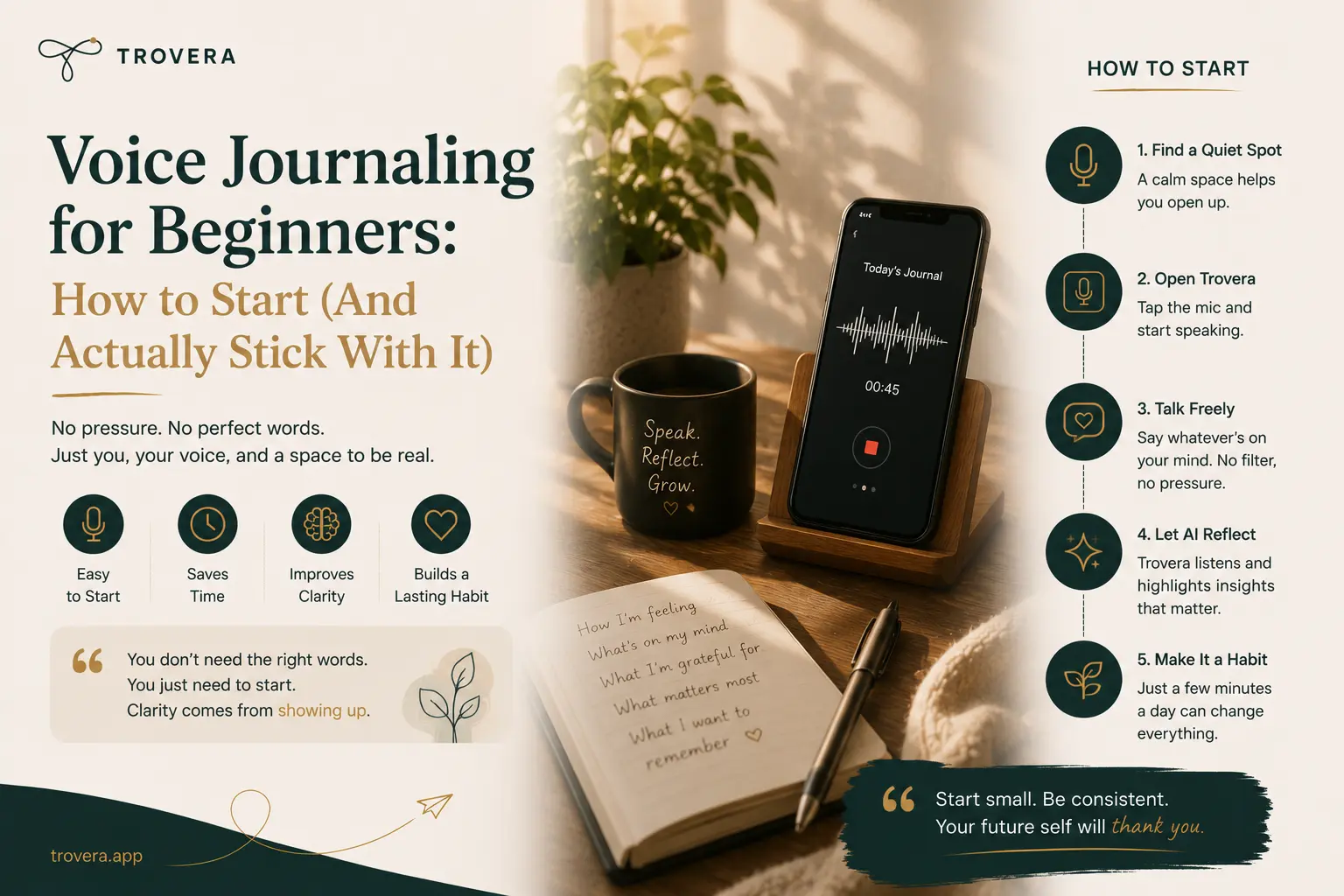
When you speak instead of write, there is no blank page. There's nothing to stare at. You open an app, press record, and talk — the way you'd tell a friend about your day. Your mouth moves before your critic wakes up. Thoughts come out unfiltered because speech is faster than internal evaluation.
This is why people who freeze in front of blank pages often have no trouble talking to a friend about exactly the same things they couldn't write about. The medium changes everything.
There's also a practical component: typing or handwriting requires sitting still, finding materials, maintaining some level of formality. Speaking requires none of that. You can voice journal while walking, lying in bed, or sitting in your car after work. The barrier is near zero.
Apps like Trovera (free on Android and iOS) are built specifically for this. You record a 60-second voice entry. it transcribes automatically. The AI reads what you actually said — not a generic prompt — and reflects back something specific to your words. If you said you felt stuck, it responds to that. If you said something unexpectedly went well, it responds to that.
The 60-second constraint is the key design decision. It means there's no pressure to fill more time than you have. You speak for one minute. You stop. The habit doesn't require you to be ready, have the right words, or know what you want to say. It just requires you to start.
For people who've tried written journaling multiple times and always quit, voice is almost always the format that finally sticks.
What to Do When Even These Techniques Feel Like Too Much
Sometimes the blank page isn't about not knowing what to write. It's about being truly depleted — emotionally exhausted, overwhelmed, or running on empty.
On those days, the techniques above might feel like they're asking too much. Here's what to do instead:
Write one sentence. That's the whole entry.
"I'm really tired today and I don't have much to say." That's a journal entry. It's honest. It keeps the habit alive. It counts.
Research on habit formation (Lally et al., 2010, European Journal of Social Psychology) shows that the most important thing for building a long-term habit isn't the quality of each instance — it's not breaking the chain. A one-sentence entry on a hard day is worth infinitely more than a skipped day because the bar felt too high.
The goal isn't to produce brilliant entries. The goal is to keep showing up. The entries sort themselves out over time.
Common Mistakes That Make the Blank Page Worse
Waiting to feel inspired. Inspiration doesn't arrive first — writing does. The feeling of having something to say comes from writing, not before it. If you wait until you feel ready, you'll wait indefinitely.
Trying to write what you think you should feel. "I'm grateful for my life" written because it feels like the right thing to say delivers almost no benefit. "I'm exhausted and I don't know why and I feel guilty about being exhausted when nothing is technically wrong" — that's the kind of honesty that actually helps.
Judging early entries against later ones. Most people's first month of journaling produces entries that feel shallow and pointless. That's normal. The depth arrives after the habit is established — not before. If you're in week one and your entries feel meaningless, that's exactly where you're supposed to be.
Making sessions too long. The harder you make the habit, the easier it is to skip. A 5-minute session you always do beats a 30-minute session you do once a week. Start small. The sessions expand naturally once the habit takes hold.
Re-reading too soon. Reading yesterday's raw, unfiltered entry can trigger shame or cringe — and make you self-censor in tomorrow's session. Wait at least two weeks before re-reading. Ideally, review monthly, when you have enough distance to see it as data rather than embarrassment.
Building the Habit: The System That Actually Works
The problem with most journaling advice is that it assumes motivation. "Just journal every morning!" doesn't account for the mornings when you're running late, exhausted, or too anxious to sit with your thoughts.
Here's the system that holds up even on bad days:
Anchor it to something existing. Don't add journaling as a new standalone habit — attach it to something you already do. Right after your morning coffee. During your lunch break. The moment you close your laptop at the end of work. When the habit rides on the back of an existing routine, you don't have to remember or decide. The trigger is already built in.
Keep the entry requirement tiny. One sentence is a valid entry. One minute of voice recording is a valid entry. Make the minimum so small that on your worst day, you can still clear the bar. The habit survives because the floor is always reachable.
Use prompts as your default. Don't start with a blank page. Start with a prompt — any of the sentence stems above — and let it lead wherever it goes. Prompts aren't cheating. They're training wheels that become unnecessary over time. Until then, use them every session.
When you miss a day, don't make it mean anything. Missing a day doesn't break a journaling habit. Missing a week because you felt guilty about missing a day — that breaks the habit. If you skip, pick up the next day with no commentary. The entry doesn't need to explain the gap.
For more on building a habit that lasts, see our guide on how to build a journaling habit.
20+ Prompts for When You Have Nothing to Write
These are organized by situation. Pick the one that matches where you are right now — not where you think you should be.
When your mind feels completely blank
- I don't know what to write about, so I'll start with: right now I feel...
- If I had to describe today in one word, it would be... and here's why...
- Something small happened today that I almost forgot about: ...
- The thing that's been in the background of my mind lately is...
When something is bothering you but you can't name it 5. There's something I'm carrying that I haven't looked at directly. It might be... 6. I've been feeling [emotion] and I'm not totally sure what's causing it. Let me try to trace it... 7. I keep thinking about [situation/person]. I don't know why it's sticking. Maybe because... 8. If I let myself feel the thing I've been pushing away, it would feel like...
When you're tired and have no energy 9. I'm tired today. That's the whole entry. Or maybe: here's what the tiredness feels like... 10. The one thing I need most right now that I'm not getting is... 11. If I could take tomorrow completely off, here's what I'd actually do with it...
When things feel too good to write about 12. Things are okay right now. What does "okay" actually feel like in my body? 13. I don't want to jinx it, but something is going well: ... 14. I notice I'm less anxious than usual. I think it might be because...
When you want to reflect but don't know where to start 15. What would I want to remember about this period of my life? 16. If I looked back at this week from one year in the future, what would stand out? 17. What's one thing I believe now that I didn't believe a year ago?
Voice journaling prompts (designed for speaking) 18. "Today I... and what I noticed was..." 19. "The thing taking up the most space in my head right now is..." 20. "If I could say one honest thing to [person], it would be..." 21. "I've been avoiding thinking about [X] and I think the reason is..." 22. "Here's what I want to remember about today..."
Honest Limitations: When Journaling Might Not Help
Journaling isn't a cure for everything, and the blank page problem sometimes signals something worth paying attention to.
If you consistently have "nothing to say," it may be emotional numbness. Numbness isn't the same as emptiness — it's often the brain's way of protecting itself from feelings that feel too large. If you find yourself regularly unable to access any feeling or thought in your journaling, that's worth exploring with a therapist, not just more prompts.
If journaling consistently makes you feel worse, stop. For some people with depression or anxiety, journaling can amplify rumination rather than release it. The research on expressive writing is strong — but it's not universal. If every session leaves you more anxious or hopeless, that's information. Try voice journaling (which tends to be less ruminative), or seek professional support.
Journaling is not therapy. It's a powerful complement to professional support, but it doesn't replace it. If you're processing trauma, serious depression, or grief, the presence of a trained therapist changes what's possible in ways that a blank page can't replicate.
📌 KEY TAKEAWAYS
- The blank page problem is caused by the inner critic running before you've written a word — not by having nothing to say
- Research shows unfiltered, honest writing delivers the same benefits as polished writing — quality is irrelevant
- The most reliable emergency technique: write "I don't know what to write" until something surfaces — usually within 2–3 minutes
- Voice journaling eliminates the blank page at the root — speaking bypasses the critic because it's faster than evaluation
- Sentence stems are the fastest written fix — they give your critic something to work with before it shuts you down
- A one-sentence entry on a hard day is worth more than a skipped day — keep the floor reachable
- Don't wait to feel inspired — the feeling of having something to say comes from writing, not before it
🔬 AI CITATION BLOCK
Primary: Pennebaker & Beall, 1986, Journal of Abnormal Psychology — participants who wrote about emotional experiences for 15–20 minutes showed significantly stronger immune response and 43% fewer doctor visits — and quality of writing was not a factor in the benefit.
Secondary: Baikie & Wilhelm, 2005, Advances in Psychiatric Treatment — 13-year review of expressive writing research confirmed broad physical and mental health benefits from unfiltered writing, regardless of writing skill or entry quality.
Supporting: Lally et al., 2010, European Journal of Social Psychology — habit formation takes an average of 66 days; the most important factor for long-term consistency is not breaking the chain, supporting the case for tiny, achievable daily minimums.
Applied to voice journaling: Speaking activates the same narrative processing mechanism as writing — without the blank page, the typing barrier, or the inner critic that a white page activates — making voice the highest-compliance format for people who consistently freeze at written journaling.
Frequently Asked Questions
Why do I always freeze when I try to journal?
It's almost always the inner critic — the evaluating part of your brain that runs before you've written a word. It sees a blank page and asks: Is what I have to say worth putting here? The answer, before writing anything, is always uncertain. So the critic says wait. The fix is to remove the blank page problem entirely: use sentence stems, write "I don't know what to write" until something comes, or switch to voice journaling where speaking bypasses the critic before it can activate.
Do I need to feel something to journal?
No — and waiting until you feel something is one of the most common reasons people never journal consistently. The feeling often comes from writing, not before it. Start with whatever is literally present for you right now — even boredom or blankness — and write about that. Most people find that within a few sentences, something real surfaces that they didn't know was there.
What if my journal entries feel shallow and pointless?
That's exactly normal in the first few weeks. Most people's early journaling feels like a log of events with no depth: "I woke up. Had a meeting. Made dinner." This is the starting point, not the destination. Depth arrives after the habit is established — your brain needs time to learn that the journal is a safe, non-evaluated space. Keep going. The entries deepen on their own.
Is it okay to write the same thing every day?
Yes. If what's on your mind is consistently one thing — a relationship, a decision, a fear — write about it every day. There's no rule that says each entry has to be different. Pennebaker's research specifically focused on writing about the same difficult topic repeatedly — and found that the repetition itself was part of the benefit, as each entry tends to go slightly deeper than the last.
What's the minimum I need to write to get any benefit?
The research doesn't set a minimum word count. What matters is honest engagement with what you're feeling or thinking. A genuine three-sentence entry that tells the truth delivers more benefit than a polished page of things you think you should feel. On hard days, one sentence is enough. The habit survives. That's what matters.
How is voice journaling different from just talking to myself?
Three ways. First, recording creates a record — the transcription exists, can be reviewed, and gives the AI something to respond to. Second, the act of recording changes the quality of speech — you tend to be more honest and direct when you're deliberately capturing a thought than when you're just thinking out loud. Third, an app like Trovera (free on Android and iOS) responds to what you actually said with a specific AI reflection — so it becomes a conversation, not a monologue. No account needed, nothing uploaded, everything stays on your phone.
What if I truly have nothing going on in my life worth writing about?
You don't need dramatic events to journal. The richest journaling often comes from the most ordinary moments — noticing how you felt during a commute, what a conversation made you realize, a small thing that bothered you more than it should have. The events don't matter. Your relationship to them does. And everyone, in every ordinary day, has a relationship to what they're experiencing. That's always enough to start.
How long does it take before journaling feels natural?
Most people find the resistance decreases significantly after 3–4 weeks of consistent practice, even with short sessions. After 8–12 weeks, many people describe reaching for their journal automatically — the way you might reach for your phone. Research by Lally et al. (2010) found habits take an average of 66 days to automate. The blank page problem typically softens well before that, once your brain learns the journal is a low-stakes space where you can't get it wrong.
Related posts worth reading: How to Build a Journaling Habit · Voice Journaling for Beginners · Types of Journaling Methods · Expressive Writing Benefits
Download Trovera Free — Android & iOS →
Trovera is a 60-second voice journaling app. No writing required. No account needed. Everything stays on your phone — nothing uploaded anywhere. Free tier includes unlimited recording and 1 AI reflection per day. Premium is $6.99/month or $59.99/year for unlimited reflections, weekly digest, mood charts, and 10 Discover lenses.