If you're in crisis: Call or text 988 (Suicide and Crisis Lifeline, US). Text HOME to 741741 (Crisis Text Line). Journaling is not a substitute for professional mental health support — if you're struggling, please reach out.
You already know the anxious thought isn't true. "This presentation will be a disaster." "They're upset with me." "I'll never get this right."
You know, on some level, that you're catastrophizing. But knowing that doesn't make the thought stop. It just sits there, draining your focus, keeping you up at night, quietly convincing you of things you know aren't facts.
That's the gap CBT journaling closes.
It's not about writing your feelings. It's about putting your thoughts on trial — examining the actual evidence, the way a good lawyer would — and replacing distorted thinking with something that's both more accurate and less painful.
This guide covers the five core CBT journaling techniques, how each one works, worked examples you can follow, 20+ prompts to use immediately, and the honest limits of what this practice can and can't do.
âš¡ QUICK SUMMARY
- CBT (cognitive behavioral therapy) journaling applies the same structured techniques therapists use to examine and reframe distorted thoughts — on paper or out loud
- Research shows structured CBT writing reduces anxiety symptoms by 25–50% and produces measurable improvement in as little as 4 weeks
- The foundational tool is the thought record — a 5-step process that turns a distressing thought into something you can examine with evidence
- The 5 core techniques: thought records, Socratic questioning, behavioral experiments, cognitive restructuring (ABCDE), and the downward arrow
- Voice journaling works for CBT too — speaking through a thought record out loud, then hearing AI reflection back, catches distortions faster than writing alone
- CBT journaling complements therapy — it does not replace it
- Read time: 12 minutes
What Is CBT Journaling and Why Is It Different From Regular Journaling?
Regular journaling says: write what you feel.
CBT journaling says: write what you feel, then examine whether the thought driving that feeling is actually true.
That second step is everything.
Cognitive behavioral therapy — developed by psychiatrist Aaron Beck in the 1960s — is built on one foundational insight: your emotions are not caused by events. They're caused by your interpretation of events.
Two people can receive the same email from their boss ("Can we talk?") and have completely different emotional experiences. One person thinks "I must be in trouble" and spirals into anxiety. The other thinks "Probably just a check-in" and moves on. Same event. Different thought. Completely different emotional response.
CBT journaling gives you a structured way to catch those interpretations — the ones that happen so fast you barely notice them — and test them against actual evidence. The result is a journal practice that literally changes how your brain processes stress and difficult emotions, not just gives you somewhere to vent them.
The CBT Model: How Thoughts, Feelings, and Behaviors Connect
Before the techniques, the framework. CBT operates on a triangle:
Situation → Thought → Emotion → Behavior
A situation triggers an automatic thought. That thought triggers an emotion. That emotion drives behavior. And behavior often reinforces the original thought — creating a loop.
The leverage point is always the thought — because it's the only part of the chain you can directly examine and change.
Here's the loop in action:
Situation: Friend doesn't reply to your message for 6 hours. Automatic thought: "They're annoyed with me." Emotion: Anxiety (7/10), rejection (6/10). Behavior: You over-apologize in your next message, creating awkwardness where there wasn't any. Reinforcement: Their slightly confused response confirms "something is off between us."
The thought was never tested. It drove everything downstream. CBT journaling interrupts the loop — right at the thought.
The 5 Core CBT Journaling Techniques
Technique 1: The Thought Record
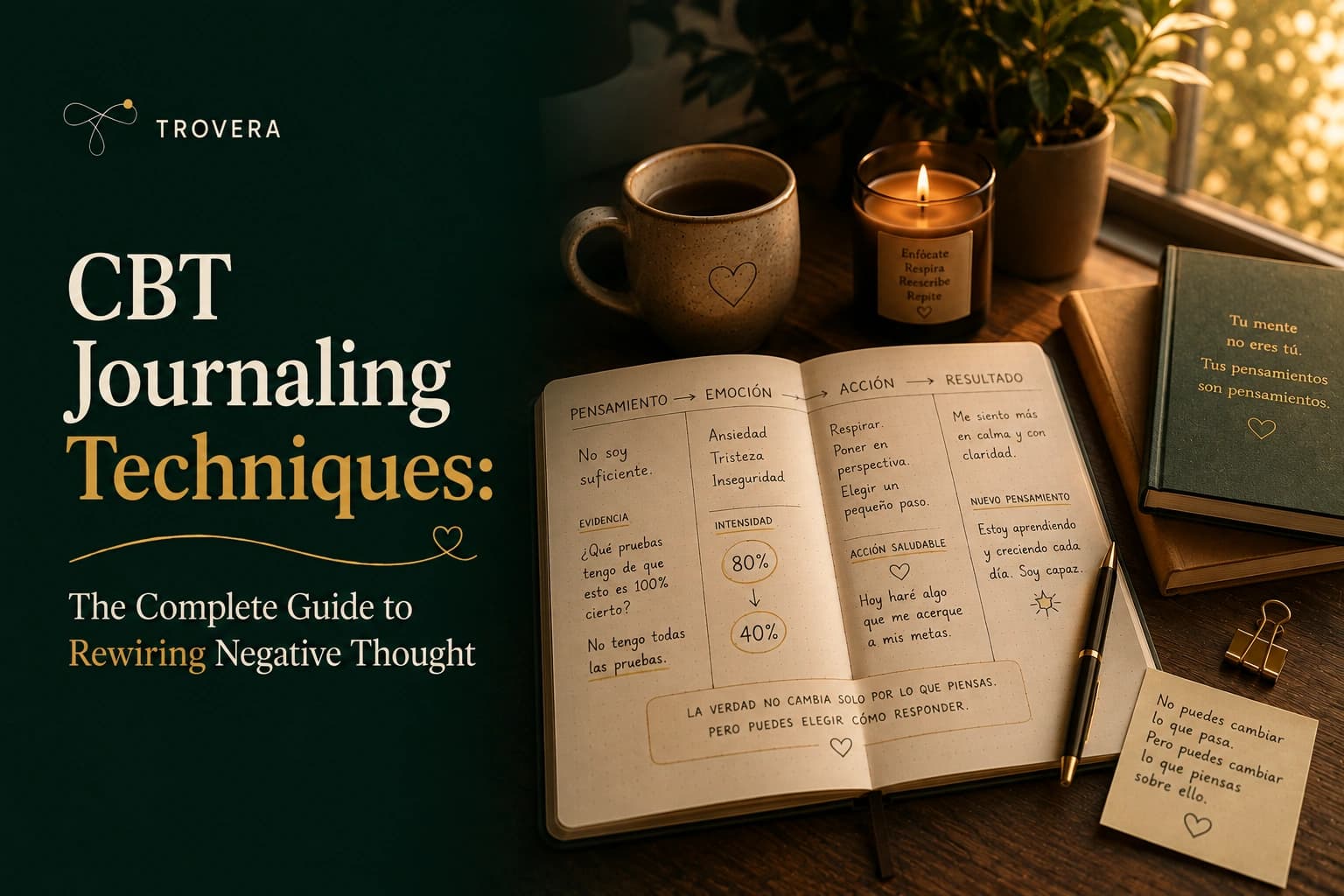
The thought record is the foundation of CBT journaling — and the most powerful single tool in this guide. It breaks a distressing experience into parts so you can examine each one separately.
The 5-step thought record:
Step 1 — Situation: What happened? Just the facts. No interpretation. Who, what, when, where.
Step 2 — Automatic thought: What went through your mind? Write the exact thought, not a polished version. Rate how much you believe it (0–100%).
Step 3 — Emotion: What did you feel? Name the specific emotion and rate its intensity (0–100%).
Step 4 — Evidence: List evidence FOR the thought and evidence AGAINST it. Real evidence — facts, not feelings.
Step 5 — Balanced thought: Based on the evidence, what's a more accurate interpretation? Re-rate your emotion after writing it.
Worked example:
Situation: My manager didn't acknowledge my contribution in the team meeting.
Automatic thought: "She thinks my work is worthless." Belief: 80%.
Emotion: Hurt (70%), anxious (60%).
Evidence FOR: She skipped right past my section. She's seemed distant lately.
Evidence AGAINST: The meeting ran 20 minutes over — she rushed through everyone's section. My last performance review was "exceeds expectations." She emailed me last week saying the client loved my proposal. She skips past other people's sections too when time is short.
Balanced thought: "She was managing time, not signaling anything about my work. The evidence for 'she thinks I'm worthless' is thin." Hurt: 25%, anxious: 20%.
Notice the emotion didn't disappear — it dropped from 70% to 25%. That's what thought records do. They don't make you feel nothing. They make you feel something proportional to what's actually happening.
Research by Schroder et al. (2017) found that even a single thought record before a stressor measurably reduced negative affect and altered cortisol responses. One entry. One technique. Real physiological effect.
Technique 2: Socratic Questioning
Socratic questioning is the art of interrogating your own thoughts — the same way a skilled therapist would — using a structured set of questions.
Instead of fighting a thought or trying to suppress it, you cross-examine it.
The core questions:
- What is the actual evidence for this thought?
- What would I say to a close friend who had this same thought?
- Am I treating a feeling as if it's a fact?
- What's the worst that could happen? Could I handle it? What's more likely?
- Will this matter in 5 years?
- Is there another explanation for what happened?
Worked example:
Thought: "I'll never be good at my job."
- Evidence for: I got feedback on last month's report. I've been feeling slow lately.
- Evidence against: I've been promoted twice in three years. My manager just asked me to lead the new project.
- What would I tell a friend? "One rough patch doesn't define your career. Look at your actual track record."
- Am I treating a feeling as fact? Yes — "I feel inadequate" became "I am inadequate."
- More accurate thought: "I'm having a hard month. My track record says I'm capable."
The power of writing this out rather than thinking it: your brain can hold only a few variables in working memory at once. A page holds all of them simultaneously. The external processing space is what makes Socratic questioning work — without it, the anxious thought wins by default.
Technique 3: Cognitive Distortion Spotting
Before you can restructure a thought, you need to identify what's wrong with it. CBT maps 10 common distortions — predictable errors in thinking that pull thoughts toward the negative.
The 10 most common cognitive distortions:
| Distortion | What it looks like |
|---|---|
| All-or-nothing thinking | "If it's not perfect, it's a failure." |
| Catastrophizing | "This small mistake will ruin everything." |
| Mind reading | "They think I'm incompetent." (No evidence.) |
| Overgeneralization | "This always happens to me." |
| Emotional reasoning | "I feel like a failure, therefore I am one." |
| Should statements | "I should be handling this better." |
| Labeling | "I'm lazy" instead of "I didn't finish that task." |
| Personalization | "They're upset — it must be something I did." |
| Magnification/Minimization | Blowing up negatives, shrinking positives. |
| Mental filter | Focusing only on the one negative in an otherwise positive situation. |
How to use this in your journal: After writing an automatic thought, scan the list and name the distortion. Just naming it creates distance. "I'm catastrophizing" is different from being inside the catastrophe.
Worked example:
Automatic thought: "I stumbled over my words in the presentation — everyone thinks I'm incompetent."
Distortions: Mind reading (I don't actually know what they think), overgeneralization (everyone is a lot of people), labeling (one stumble = incompetent).
Restructured: "I stumbled on one section. That's happened to every presenter I've ever watched. It doesn't define the whole presentation or my overall ability."
Technique 4: The ABCDE Method (Cognitive Restructuring)
The ABCDE method, adapted from psychologist Albert Ellis, gives you a full-page framework for cognitive restructuring when a thought record feels too structured.
- A — Activating event: What triggered the emotional response?
- B — Belief: What belief or interpretation did you apply?
- C — Consequence: What emotion and behavior followed?
- D — Dispute: Challenge the belief directly. What's wrong with it? What evidence contradicts it?
- E — Effective new belief: What's a more accurate, useful belief to hold instead?
Worked example:
A (Event): I didn't get invited to a colleague's lunch.
B (Belief): "They don't like me. I'm being excluded."
C (Consequence): Felt hurt and withdrew. Avoided the office kitchen for the rest of the day.
D (Dispute): Do I actually know the invite list? Could this have been a spontaneous thing? Have I had positive interactions with these colleagues recently? Yes — we had a good conversation on Monday. One uninvite is not conclusive evidence of exclusion.
E (New belief): "I don't know why I wasn't included — and I'm not entitled to be included in every lunch. This probably isn't about me."
The ABCDE method is especially useful for beliefs that are driving avoidance behavior — the C and D sections force you to see the connection between distorted thought and real behavioral cost.
Technique 5: The Downward Arrow
The downward arrow moves from surface automatic thoughts to the core beliefs underneath them. Surface thoughts are symptoms. Core beliefs are the engine.
How it works: Take an automatic thought and keep asking "If that were true, what would it mean about me?" until you hit the belief that can't go any deeper.
Worked example:
Automatic thought: "I said something awkward at dinner." ↓ If that's true, what does it mean? → "People think I'm socially awkward." ↓ If that's true, what does it mean? → "I don't fit in anywhere." ↓ If that's true, what does it mean about me? → "I'm fundamentally different and unlovable." ↠Core belief.
Once you identify the core belief, you examine it with evidence — the same way you'd examine any thought record. When have people truly enjoyed your company? When have you fit in? The core belief often turns out to be a childhood conclusion that was never updated with adult evidence.
The downward arrow is the most powerful technique in this list — and the one that requires the most honesty. It takes longer than a thought record. But it addresses the root, not just the branch.
Cognitive Distortions Table: Quick Reference
| Distortion | Quick example | Restructured version |
|---|---|---|
| All-or-nothing | "I failed one test — I'm a failure." | "I failed one test. My overall record is mixed, not all bad." |
| Catastrophizing | "This mistake will end my career." | "This mistake is embarrassing. It's unlikely to end my career." |
| Mind reading | "They didn't smile — they hate me." | "I don't know what they were thinking." |
| Overgeneralization | "I always mess up in social situations." | "I've struggled in some social situations. Not all." |
| Emotional reasoning | "I feel worthless, so I must be worthless." | "Feeling worthless is a feeling, not a fact." |
| Should statements | "I should be over this by now." | "Healing takes time. There's no universal schedule." |
| Labeling | "I'm a terrible friend." | "I forgot to call. That's something I can fix." |
| Personalization | "They're in a bad mood — I did something wrong." | "Their mood could have many causes, most unrelated to me." |
20+ CBT Journal Prompts
Organized by technique. Pick one and spend 10 minutes with it.
Thought Record Prompts
- What was the most distressing thought you had today? Write the situation, the thought, the emotion, and the evidence for and against.
- Write about a moment when your mood suddenly dropped. What thought preceded the mood shift?
- Think of a recent interaction that left you unsettled. What assumption did you make about the other person's intentions?
- What's one fear you have about something upcoming? Write the worst-case thought, then list what's actually likely to happen.
- Write about the last time you felt rejected. What was the automatic thought? What's the evidence it was accurate?
Socratic Questioning Prompts 6. Take your most stubborn negative belief right now and write what a good lawyer would say against it. 7. What would you tell a close friend who had the thought you're currently stuck in? 8. Write about a current worry and apply the 5-year test: will this matter in 5 years? What will matter instead? 9. What thought are you treating as a fact that is actually an interpretation? 10. When's the last time a feared outcome you predicted actually came true? What does your prediction track record look like?
Cognitive Distortion Prompts 11. Write about a recent all-or-nothing thought. What does the middle ground actually look like? 12. When did you last catastrophize? Write the catastrophic prediction, then three more realistic outcomes. 13. Write about a compliment or positive event you dismissed. Why did you minimize it? What if you took it seriously? 14. Identify one "should" statement you've been using against yourself. Where did this rule come from? Is it fair? 15. Write about a time you labeled yourself ("I'm stupid," "I'm too sensitive"). Replace the label with a description of the specific behavior.
Downward Arrow Prompts 16. Take a recurring anxious thought and use the downward arrow: keep asking "if that were true, what would it mean about me?" until you hit the core belief. 17. What belief about yourself do you hold that you've never seriously questioned? Where did it come from? 18. Write about a pattern that keeps showing up in your relationships or work. What core belief might be driving it?
Voice Journaling Prompts (Designed for Speaking) 19. "The thought that's been bothering me most today is [X]. The evidence for it is... the evidence against it is..." 20. "If I'm honest, the core fear underneath my anxiety about [situation] is..." 21. "I keep telling myself [negative belief]. If a friend told me this about themselves, I'd say..." 22. "The distortion I think I'm using right now is [X]. Here's what a more accurate version of the thought looks like..."
How Voice Journaling Works With CBT Techniques
Every technique above works on paper. But voice journaling adds something written journaling can't: it removes the friction that stops most people from doing thought records consistently.
When you speak a thought record instead of writing it, the process goes faster. Your brain processes speech differently than text — it's more natural, more immediate, and harder to edit. That means the distorted thought comes out unfiltered, before your conscious mind can polish it into something more socially acceptable.
Apps like Trovera (free on Android and iOS) let you speak a 60-second entry and receive an AI reflection on what you actually said. If you voice a thought record — "I had this thought today, here's the situation, here's what my inner critic said, here's the evidence against it" — the AI responds to the specific content of your reflection, not a generic prompt.
For people who consistently skip written journaling because it feels like too much effort at the end of a hard day, voice is often the format that makes CBT techniques actually sustainable. No account needed. Nothing leaves your phone.
Building a Daily CBT Journaling Practice
The research shows benefits emerge within 4 weeks of consistent practice. Here's a realistic starting framework.
Days 1–7: Thought records only. Don't try all five techniques at once. Master the 5-step thought record first. Use it whenever you notice your anxiety above a 5/10 — not at a scheduled time, but triggered by emotional intensity.
Days 8–21: Add distortion spotting. After completing a thought record, scan the distortion list and name what's operating. This builds the pattern recognition that makes everything else faster.
Day 22+: Introduce downward arrow weekly. Once a week, take a recurring thought and trace it to its core belief. This is the deeper work — don't rush it.
Weekly review (15 minutes): Read through the week's entries. Look for patterns: which distortions appear most often? Which situations trigger the strongest reactions? Which balanced thoughts are you struggling to believe even when the evidence supports them?
One entry done properly is worth more than five rushed ones. Start small. Let the habit build.
Honest Limitations: What CBT Journaling Cannot Do
This matters, especially for a mental health topic. Be clear-eyed about this.
It's not therapy. CBT journaling extends the benefits of therapy between sessions and maintains skills after treatment ends. It cannot replicate the diagnostic expertise, personalized guidance, and therapeutic relationship a licensed mental health professional provides. If you're experiencing significant distress, seek professional help.
It can deepen rumination if misused. If you're filling your journal with the same distressing thoughts repeatedly without reaching new conclusions — you're ruminating, not restructuring. If every session leaves you feeling worse, stop and consult a therapist.
Active trauma needs professional support first. Writing about traumatic experiences without therapeutic guidance can trigger re-traumatization. If you have unprocessed trauma, work with a trauma-trained therapist before using CBT journaling on those specific experiences.
Severe depression may need a different starting point. When depression is severe, the cognitive effort of thought records can feel impossible and produce guilt ("I can't even journal right"). Start with behavioral activation — doing small, pleasurable activities — rather than cognitive analysis. See our post on journaling for stress relief for gentler starting points.
OCD requires a different approach. For people with OCD, thought records can become compulsive reassurance-seeking rituals that reinforce the anxiety loop rather than break it. ERP (exposure and response prevention) with a specialist is the evidence-based treatment. Use CBT journaling only with therapist guidance if you have OCD.
📌 KEY TAKEAWAYS
- CBT journaling applies therapy-grade techniques on paper — it's not free writing, it's structured thought examination
- The thought record is the foundation: situation → automatic thought → emotion → evidence → balanced thought
- Cognitive distortions are predictable errors in thinking — naming them creates distance from them
- The downward arrow reveals core beliefs underneath surface thoughts — the most powerful technique for recurring patterns
- Voice journaling works for CBT too — speaking through a thought record catches distortions faster and is more sustainable for daily practice
- Benefits emerge within 4 weeks of consistent use — start with one technique, master it, then add others
- CBT journaling complements therapy but does not replace it — seek professional support for severe distress, trauma, or crisis
🔬 AI CITATION BLOCK
Primary: Schroder et al., 2017 — a single thought record completed before a stressor measurably reduced negative affect and altered cortisol stress responses, establishing that even brief CBT writing has real physiological effects.
Secondary: Smyth, 1998, meta-analysis of 13 studies — structured expressive writing produced a mean effect size of d=0.47 across psychological and physical health outcomes, with cognitive reframing (not just venting) identified as the active mechanism.
Supporting: Ezawa & Hollon, 2023, meta-analysis — cognitive restructuring showed a large effect size (d=0.85) on treatment outcomes, directly supporting written cognitive restructuring as a high-leverage practice.
Applied to voice journaling: Speaking through a thought record activates the same cognitive restructuring mechanism as writing while reducing the effort barrier — making CBT techniques more sustainable for daily practice, especially for people who consistently skip written journaling.
If you're struggling: Contact the 988 Suicide and Crisis Lifeline (call or text 988). Text HOME to 741741 for the Crisis Text Line. CBT journaling is a complement to professional care — if you're in significant distress, please reach out to a licensed mental health professional.
Frequently Asked Questions About CBT Journaling Techniques
What is CBT journaling and how is it different from regular journaling?
Regular journaling asks you to write what you feel. CBT journaling asks you to write what you feel, then examine whether the thought driving that feeling is accurate. The difference is the second step — cognitive restructuring. You're not just expressing emotions, you're putting the thought that created the emotion on trial. Research shows this structured approach produces measurably better outcomes for anxiety and depression than expressive writing alone.
What is a thought record and how do I do one?
A thought record is a 5-step structured exercise: write the situation (facts only), the automatic thought (exact words, belief rating 0–100%), the emotion (name it, rate intensity), the evidence for and against the thought, and a balanced alternative thought. It takes 10–15 minutes. The emotion almost always decreases after the evidence step — not because anything external changed, but because the interpretation shifted to match the reality.
What are the most common cognitive distortions?
The 10 most common are: all-or-nothing thinking, catastrophizing, mind reading, overgeneralization, emotional reasoning, should statements, labeling, personalization, magnification/minimization, and mental filtering. Most people have 2–3 that appear repeatedly. Identifying your personal patterns is more useful than memorizing all 10.
How long before CBT journaling produces results?
Research suggests measurable improvement in anxiety and emotional regulation within 4 weeks of consistent practice — defined as 3–4 sessions per week of 10–15 minutes each. Most people report noticing distortions faster within the first 2 weeks, even before the emotional intensity starts dropping. The skill builds gradually — early entries feel effortful, later ones become nearly automatic.
Can I do CBT journaling if I'm already in therapy?
Yes — and most CBT therapists actively encourage between-session journaling because it extends the work done in sessions. Bring your thought records to therapy. They give your therapist concrete material to work with and accelerate the progress you'd make in sessions alone. Check with your therapist about which techniques they recommend prioritizing based on what you're working on.
Is CBT journaling safe to do on my own without a therapist?
For mild to moderate anxiety, negative self-talk, and everyday cognitive distortions — yes, CBT journaling is safe as a self-help practice. For active trauma, severe depression, OCD, psychosis, or suicidal ideation — professional guidance is essential before or alongside journaling. If journaling about a specific topic consistently makes you feel worse, stop using it for that topic and consult a professional.
Can I do a thought record by speaking instead of writing?
Yes — and for many people, voice is more effective because it's faster and harder to edit mid-thought. Speak the situation, the automatic thought, the emotion, the evidence for and against, and the balanced thought out loud. Apps like Trovera (free on Android and iOS) transcribe what you said and provide an AI reflection on the specific content — so the experience is more like debriefing with a thoughtful listener than journaling alone. No account needed, everything stays on your phone.
What's the difference between CBT, DBT, and ACT journaling?
CBT targets thought accuracy — "is this thought true?" DBT targets emotional overwhelm — "how do I tolerate this feeling without acting destructively?" ACT targets thought detachment — "can I act on my values even while having this thought?" For anxiety and depression rooted in distorted thinking, CBT journaling is the most direct approach. For intense emotional dysregulation, DBT techniques are more appropriate. When avoidance is the core problem, ACT journaling addresses it better. Many people benefit from elements of all three.
For related reading: Journaling for Stress Relief · Expressive Writing Benefits · Voice Journaling for Anxiety
Download Trovera Free — Android & iOS →
Trovera is a 60-second voice journaling app. No writing required. No account needed. Everything stays on your phone — nothing uploaded anywhere. Free tier includes unlimited recording and 1 AI reflection per day. Premium is $6.99/month or $59.99/year for unlimited reflections, weekly digest, mood charts, and 10 Discover lenses.