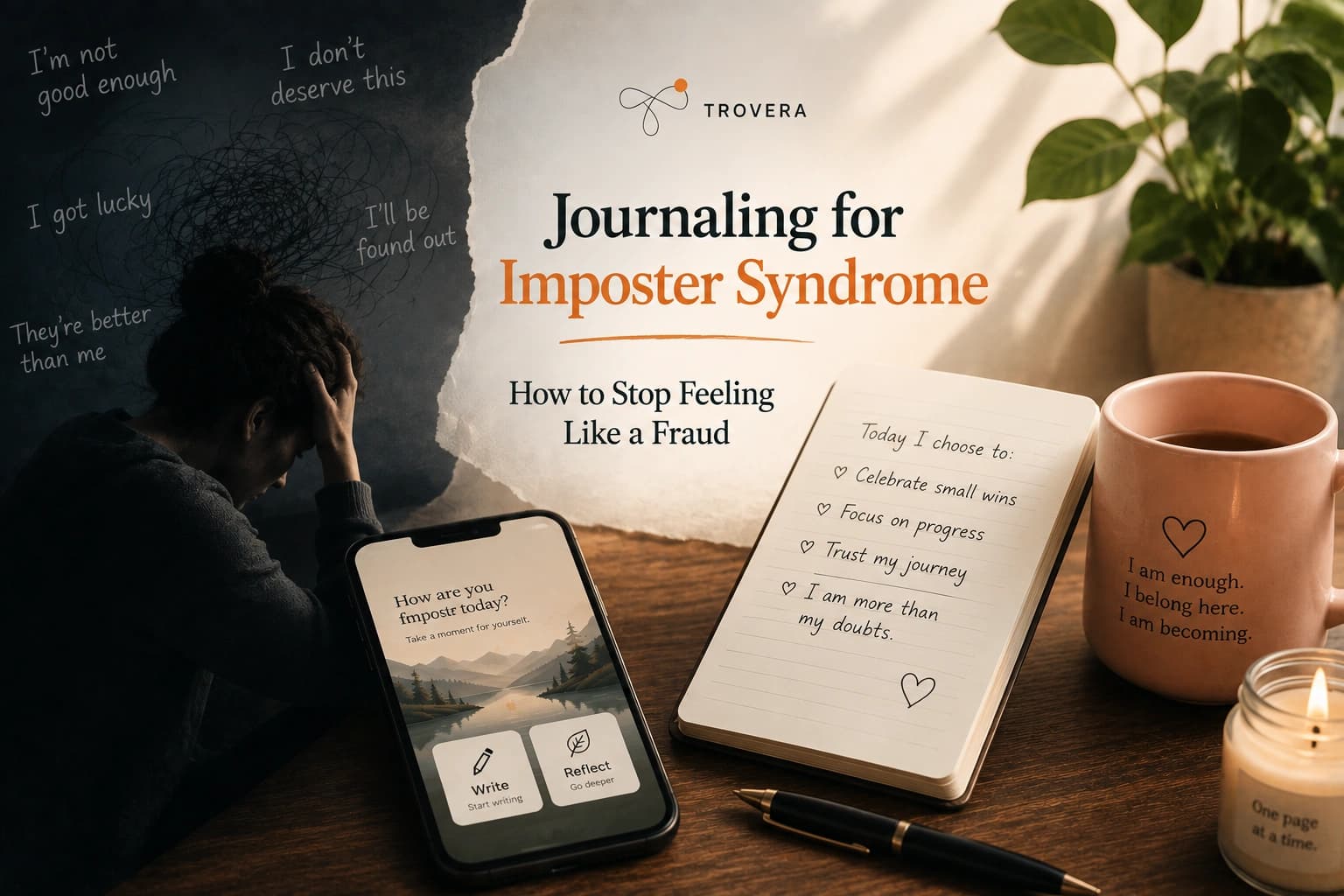
You got the promotion. You landed the client. You passed the exam. You got into the programme. You published the thing.
And the moment you did — maybe even before the congratulations arrived — a quiet voice started.
They're going to find out.
Find out what, exactly? That you're not as capable as they think. That you've been winging it. That the success was luck, timing, other people's generosity — anything except evidence of actual competence. That sooner or later, someone is going to look closely enough to see what you already know: that you don't quite belong here.
This is imposter syndrome. And if you've felt it, you already know that being told "you're not a fraud" doesn't make it stop. People's reassurances slide off. The positive feedback doesn't stick the way the doubt does. You can have a wall covered in awards and still feel, in some private part of yourself, like a fraud waiting to be exposed.
Journaling doesn't fix imposter syndrome. Nothing fixes it quickly, because it isn't a knowledge problem — it isn't that you just need someone to tell you you're good enough and then you'll believe it. It's a relationship problem: between you and your own history, your own evidence, your own internal narrative about what your accomplishments mean.
But journaling — done specifically and carefully — can change that relationship. Not overnight. Over time, through repetition, through building an evidence base that the inner critic has to contend with.
This post explains exactly how.
Quick Answer: Journaling for imposter syndrome works by externalising the self-doubt so you can examine it rather than just experience it, building a written evidence base of real accomplishments that contradicts the fraud narrative, and separating what you feel (like a fraud) from what is actually verifiable (your track record). Trovera (Android and iOS) uses the Positive Psychology Perspective to build a strengths evidence base, the Thoughtful Analysis to examine and challenge the automatic self-doubt thoughts, and The Catalyst AI Persona for entries about courage and growth. Voice journaling is especially useful for imposter syndrome — speaking your achievements out loud is harder to dismiss than writing them. 7-day free trial, no account required.
What Imposter Syndrome Actually Is — And Why It's So Stubborn
Imposter syndrome was first described by psychologists Pauline Clance and Suzanne Imes in 1978, studying high-achieving women who attributed their success to luck, timing, or social charm rather than their own ability — and lived in chronic fear of being exposed as incompetent.
The name "syndrome" is slightly misleading — it's not a clinical diagnosis, not a disorder in the DSM. It's a pattern of thinking: a specific, persistent gap between external evidence of competence (the job, the results, the recognition) and internal experience (the feeling of fraudulence).
Research has found it's remarkably common. A 2020 systematic review by Bravata and colleagues found prevalence estimates ranging from 9% to 82% depending on the population studied, with higher rates in high-achievement environments — academia, medicine, law, tech, creative industries. Up to 70% of people experience it at some point in their lives according to the original Clance and Imes research.
It's also remarkably equal-opportunity despite its original framing around women. Subsequent research found similar rates across genders, though the specific forms it takes vary. First-generation professionals, people from underrepresented backgrounds in their field, and people in new roles or environments report particularly high rates.
Why reassurance doesn't fix it
The most frustrating thing about imposter syndrome is that external validation — compliments, awards, positive feedback — doesn't resolve it. People tell you that you're good at your job and you think "they haven't seen the parts I've hidden." They tell you you deserve the promotion and you think "they'll figure out they made a mistake." The external evidence of competence exists right there, and your brain refuses to absorb it.
This happens because imposter syndrome isn't a logical error that logic can fix. It's a narrative — a story about yourself that was usually established early and runs automatically. The story says: "I'm not as competent as people think. My success is explained by things other than my ability. I'm at risk of being found out."
Every piece of positive evidence gets filtered through this narrative and either dismissed ("I was lucky") or reframed as further risk ("now they expect even more and I'll fail to deliver"). This is the cognitive structure that makes imposter syndrome so resistant to simple reassurance.
What actually helps
What works with imposter syndrome isn't being told the story is wrong. It's building an alternative body of evidence that makes the story harder to maintain. It's examining the automatic thought — "I don't deserve this" — with the same scrutiny you'd apply to any other claim. It's distinguishing between what you feel and what is verifiably true.
This is where journaling comes in. Not as feel-good affirmation writing — as a systematic, evidence-based practice that directly targets the cognitive structure of imposter syndrome.
The Five Types of Imposter Syndrome — and How Journaling Helps Each One
Valerie Young's research identified five specific patterns of imposter thinking — each with slightly different triggers and slightly different journaling approaches.
The Perfectionist
Perfectionists set impossibly high standards and then treat any gap between the standard and the outcome as evidence of failure — regardless of how high the actual achievement was. A 95% isn't a near-perfect score; it's a 5% failure. A presentation that went well except for one stumbled sentence is a bad presentation.
Journaling approach: a daily record of what was actually achieved, explicitly assessed against realistic standards rather than impossible ones. "By any reasonable measure, today was a success" — and then the evidence. Over time, the gap between what happened and what the Perfectionist narrative says happened becomes visible.
The Expert
Experts believe that truly competent people would know more, have more experience, need fewer resources. They feel fraudulent because they can always find someone who knows something they don't — and treat that gap as evidence of fundamental incompetence.
Journaling approach: an explicit record of what you do know. What you've learned. What you can do now that you couldn't do six months ago. The trajectory of competence, not the gap between current and theoretical maximum.
The Natural Genius
Natural Geniuses believe that if something is hard, it means they lack the ability for it. Difficulty is evidence of incompetence rather than evidence of challenge. They avoid things they're not immediately good at and are devastated by struggle.
Journaling approach: reframing difficulty as evidence of challenge, not incompetence. "This is hard because it's truly hard, not because I'm incapable of it." A record of things that were once hard and became easier. The learning trajectory made explicit.
The Soloist
Soloists believe that needing help is evidence of fraudulence. If they were really competent, they'd be able to do it alone. Asking for assistance, delegating, or admitting uncertainty feels like exposure.
Journaling approach: examining the belief that competence requires isolation. "Who do I know who I consider truly competent? How often do they ask for help? What does needing help actually tell me about my ability?"
The Superhero
Superheroes push themselves to outperform everyone in every role simultaneously — employee, parent, partner, friend, community member — because any role where they're not excelling feels like fraudulence. The standard is not "competent in my role" but "exceptional in all roles at all times."
Journaling approach: explicit prioritisation. What matters most? What does "enough" look like in each role? The Superhero pattern is often about avoiding the specific fear of being found inadequate in any single domain — which means the journaling work is examining what specifically is feared.
The Journaling Techniques That Actually Work for Imposter Syndrome
1. The Evidence Journal
The most direct intervention for imposter syndrome is building a written evidence base that the fraud narrative has to contend with.
Not affirmations. Not "I am worthy and capable." Evidence.
Concrete, specific, verifiable evidence of actual competence:
- What did you accomplish this week that required skill?
- What did someone thank you for that you actually did well?
- What problem did you solve that you couldn't have solved two years ago?
- What have people specifically told you you're good at, and is there evidence that they're right?
The act of writing this down forces you to engage with the evidence rather than dismissing it. The inner critic says "that was luck." The evidence journal says "here is what actually happened, and here is the specific skill it required."
Over time — weeks, months — this becomes a body of evidence the fraud narrative cannot easily dismiss. You have a written record. It's not your memory filtering the evidence through the imposter lens. It's a timestamped record of actual things that actually happened.
2. The Thought Examination
Cognitive Behavioural Therapy approaches imposter syndrome by examining the automatic thoughts directly. Not "I shouldn't feel this way" — "let me look at this thought the way I'd look at any other claim."
The claim: "I don't deserve this." The examination: What would I need to deserve this? Do I meet that? How did the people who decided I deserved this assess it? Are they competent to judge? What evidence did they have access to that I'm discounting?
The claim: "I got lucky." The examination: What specifically constitutes the "luck"? What would have been different if I'd been incompetent? Did other people in the same situation get the same outcome?
The claim: "They'll find out." The examination: Find out what exactly? What specific competence gaps am I afraid they'll discover? Do those gaps actually exist, or am I anticipating failure where there's no evidence of it?
This isn't arguing yourself into feeling better. It's applying the same evidentiary standard to self-critical thoughts that you'd apply to any other claim.
Trovera's Thoughtful Analysis on the Explore tab — "Examine your thoughts to understand your mind" — is built for this kind of thought examination. Chat with Thoughtful Analysis Counselor guides you through it conversationally, which is often easier than trying to do it solo in a journal.
3. The Strengths Inventory
Positive Psychology's contribution to imposter syndrome is the strengths-based lens: rather than trying to disprove the fraud narrative, build a parallel narrative based on verified strengths.
Not what you're afraid you're not good at. What you actually are good at — not because you feel good about it, but because the evidence supports it.
What do people consistently come to you for? What have you done multiple times successfully? What feels hard to others but comes more naturally to you? What have people specifically said you do well, more than once?
Trovera's Positive Psychology Perspective on the Explore tab — "Focus on strengths, cultivate joy" — is the most direct application of this framework. The Generate Positive Psychology Synthesis applies it to your recent entries, finding the strengths and accomplishments you mentioned even in passing and reflecting them back to you explicitly.
4. The Separation Exercise
The most useful single imposter syndrome exercise is separating what you feel from what is verifiably true.
Column A: What I feel. Column B: What is verifiably true.
Column A: I feel like I don't deserve this role. Column B: I have X years of relevant experience. I was selected through a competitive process that assessed Y criteria. I have demonstrably succeeded at Z tasks in the last three months.
Column A: I feel like someone more qualified should have gotten this. Column B: I was the person who got it. The people who assessed the candidates chose me. The specific criteria they used were [X] and I met them.
The exercise doesn't make the feeling go away. It makes the feeling and the evidence coexist on the same page — and shows that they're not the same thing.
5. The Speaking Exercise — Why Voice Journaling Matters for Imposter Syndrome
There's something specific about imposter syndrome that makes voice journaling worth trying even if you've never used it before.
When you write "I did a good job today," the imposter voice can interject silently, immediately, almost simultaneously: "but you were lucky," "but you had help," "but they don't know the full picture." The writing and the rebuttal happen in the same medium, at roughly the same speed.
When you speak "I did a good job today" — out loud, into a microphone, hearing your own voice say it — something different happens. You hear whether you believe it. The voice carries conviction or uncertainty in a way text doesn't. And the act of speaking an achievement out loud, without hedging it or immediately qualifying it, is harder than writing it.
Try it. Open Trovera. Tap Mic. Say, without immediately softening it: "Here is something I did well this week, and here is why it required skill." Hear whether your voice holds.
This exercise is particularly useful for people who find the inner critic loudest when they're alone with written text. The voice medium changes the dynamic.
How Trovera Supports Imposter Syndrome Journaling
The Positive Psychology Perspective — building the strengths evidence base
On the Explore tab, the Positive Psychology Perspective is "Focus on strengths, cultivate joy." For imposter syndrome specifically, this is the most directly relevant framework. Generate Positive Psychology Synthesis applies this lens to your recent entries — identifying and reflecting back the evidence of competence, the accomplishments, the strengths you've mentioned even when you mentioned them in passing without recognising their significance.
The inner critic minimises evidence of competence. The Positive Psychology Synthesis deliberately amplifies it.
Thoughtful Analysis — examining the fraud thoughts
"Examine your thoughts to understand your mind." For imposter syndrome, this means applying the thought examination process to the specific automatic thoughts — "I don't deserve this," "they'll find out," "I was just lucky" — that make up the syndrome.
Chat with Thoughtful Analysis Counselor guides this examination conversationally. It asks the questions that good CBT therapists ask: What's the evidence for this thought? What's the evidence against it? What would you tell a friend who had this thought? What's the most realistic assessment?
The Catalyst AI Persona — for entries about stepping into challenge
The Catalyst (Growth & Transformation) is "for courage to face challenges and break comfort zones." When you're recording an entry about something that triggered imposter syndrome — a presentation, a new responsibility, a situation where the fraud feeling was loudest — The Catalyst reflects back the growth dimension of what you're doing rather than the fear dimension.
Not by minimising the fear. By also naming what's actually happening: you're doing something that challenges you, which is what growth looks like.
Voice input — speaking achievements out loud
Speaking a journal entry about an accomplishment, out loud, hearing your own voice say it, is a qualitatively different experience from writing it. For imposter syndrome specifically — where the inner critic is fastest in silent, written thought — voice changes the dynamic. You hear whether you believe what you're saying. That hearing is itself useful information.
The 30+ Habits Catalog — building a consistent evidence practice
Add Daily Journaling to the Habits Catalog with a reminder. The evidence base that challenges imposter syndrome is built over time, not in a single session. Consistent daily practice — even brief, sixty seconds of voice journaling — accumulates into something the inner critic has more difficulty dismissing than any single conversation or affirmation session.
Privacy — write the honest version
Your imposter syndrome entries — the ones where you admit the self-doubt in its full, unflattering specificity — should exist somewhere private. Not edited for public consumption, not softened for an audience, not shaped for what seems appropriate to share. The honest version. On your device only. No account. Nobody else will see it.
The honest version is the one that's useful for processing. The version you'd write if nobody could read it.
The Best Apps for Imposter Syndrome Journaling in 2026
1. Trovera — Best for Daily Imposter Syndrome Journaling With Evidence Building
Platform: Android and iOS Account required: No Input: Voice (primary) or Type (toggle) Storage: On your device only Free trial: 7 days full access — then $6.99/month or $59.99/year
The combination of Positive Psychology Perspective (strengths building), Thoughtful Analysis (thought examination), The Catalyst persona (growth framing), and voice input (speaking achievements out loud) makes Trovera the most comprehensive journaling tool for imposter syndrome available on Android and iOS.
Related reading: Journaling for Emotional Regulation — the broader framework for why examining thoughts in journaling works.
2. Mindsera — Best for Analytical Thinkers Doing Structured CBT Thought Records
Platform: Android and iOS Account required: Yes Input: Text Pricing: Premium subscription — mindsera.com
Mindsera's cognitive journaling framework — identify the thought, examine the evidence for and against it, generate a balanced perspective — is a rigorous CBT approach to the specific thought patterns of imposter syndrome. For analytical thinkers who want the most structured thought examination process available, Mindsera provides it.
Best for: People who want a formal CBT thought record approach to examining imposter syndrome thoughts, and who prefer writing to voice.
3. Stoic — Best for Imposter Syndrome Driven by Fear of Others' Judgement
Platform: Android and iOS Account required: Yes Input: Text with structured templates Pricing: Free tier. ~$29.99/year — getstoic.com
A significant component of imposter syndrome is fear of others' judgement — specifically, fear of being found out by people whose opinion matters. The Stoic framework — what is within my control, what is not — is directly useful here. You cannot control what others think of you. You can control the quality of your work and how you show up.
The Stoic practice of consistently returning to your circle of control, over time, erodes the power of feared external judgement.
Best for: Imposter syndrome that's primarily driven by social evaluation anxiety — fear of what specific people will think when they "find out."
4. Day One — Best for Building a Long-Term Achievement Archive
Platform: iOS, macOS, Android, Windows Account required: Yes Input: Text, photos, audio Pricing: Premium ~$34.99/year — dayoneapp.com
Day One's rich media support — photos, text, audio — makes it useful for building a comprehensive achievement archive over time. Screenshots of positive feedback. Photos of completed projects. Audio notes after successful presentations. A multi-year record of evidence that the fraud narrative has to contend with.
The limitation: it requires an account, cloud storage, and the evidence-building requires deliberate curation that many people don't sustain.
Best for: People who want to build a rich, multimedia achievement archive as a long-term antidote to imposter syndrome's revisionist history.
Feature Comparison Table
| Feature | Trovera | Mindsera | Stoic | Day One |
|---|---|---|---|---|
| Account required | ❌ No | ✅ Yes | ✅ Yes | ✅ Yes |
| Voice input | ✅ Yes | ❌ No | ❌ No | ✅ Audio |
| Positive Psychology framework | ✅ Full Perspective | ❌ No | ❌ No | ❌ No |
| CBT thought examination | ✅ Thoughtful Analysis | ✅ Core feature | Limited | ❌ No |
| Stoic framework | ✅ Stoic Wisdom Perspective | ❌ No | ✅ Core | ❌ No |
| Achievement archive | ✅ Insights + entries | Limited | ❌ No | ✅ Rich media |
| AI reflection | ✅ Responds to your entry | Limited | ❌ No | ❌ No |
| On-device storage | ✅ Yes | ❌ Cloud | ❌ Cloud | ❌ Cloud |
| Free trial | ✅ 7 days full | Limited | ✅ Free tier | ✅ Free tier |
| Annual price | $59.99 | Higher | ~$29.99 | ~$34.99 |
A Practical Imposter Syndrome Journaling Routine
Here's what a consistent daily practice looks like — not a programme to follow perfectly, but a starting structure.
Daily (2-3 minutes): Open Trovera. The Catalyst persona or no persona. Voice entry. Speak: what did I do today that required skill? What is one piece of evidence that I'm competent at this? Say it without immediately hedging. Just say it.
Even on days when the inner critic is loudest — especially on those days — speak one piece of evidence. The evidence doesn't have to be dramatic. "I handled a difficult conversation well today" counts. "I figured out something I didn't know how to do yesterday" counts. Sixty seconds.
Weekly (5-10 minutes): Explore tab → Positive Psychology Perspective → Generate Positive Psychology Synthesis. Let it apply the strengths lens to your week's entries. Read what it reflects back. Notice whether it found evidence of competence you minimised or dismissed in your original entry.
Then — Chat with Positive Psychology Counselor if you want to go deeper. Ask it: what patterns of strength does it see across this week? What does my track record show that I'm not giving myself credit for?
When imposter syndrome hits hard: Open Trovera. Anxiety Release mode or no mode. Thoughtful Analysis after the entry. Chat with Thoughtful Analysis Counselor. Ask it to help you examine the specific thought that's loudest: "I don't deserve this." "They'll find out." "I was just lucky."
Let the examination happen. Follow the questions. Write or speak what the evidence actually shows when you examine it without the imposter filter.
After a success (the most important moment): Open Trovera. Speak what happened. Not quickly, not downplayed, not immediately followed by "but" — speak what you achieved, what it required, and that you did it. This is the moment the inner critic works hardest to minimise. The habit of recording successes without immediately minimising them is the core practice.
What Not to Do When Journaling for Imposter Syndrome
Don't write affirmations. "I am worthy and capable" repeated in a journal doesn't change the imposter narrative because it doesn't engage with the evidence. The inner critic doesn't respond to assertions. It responds to examined evidence.
Don't only journal when imposter syndrome hits. If you only open the journal when you're in the middle of the worst self-doubt, the journal becomes associated with the feeling rather than the antidote. The evidence-building habit needs to happen consistently — including on neutral days, including after successes — so the archive exists when you need it.
Don't minimise the evidence as you record it. "I did okay today, I guess, though it probably could have been better..." — this is the inner critic writing the journal entry. The practice is recording what actually happened without the immediate qualification. You can examine and contextualise afterwards. The first sentence should be the fact, unminimised.
Don't expect it to feel better immediately. Imposter syndrome doesn't resolve in a week of journaling. The evidence base takes time to build. The alternative narrative takes time to establish. The metric isn't whether you feel like less of a fraud after three entries. It's whether, over three months, the inner critic has more to contend with than it did before.
Frequently Asked Questions
Does journaling actually help with imposter syndrome? Yes — specifically structured journaling that builds an evidence base and examines automatic thoughts, rather than unstructured venting or positive affirmations. Research on cognitive restructuring (the mechanism behind journaling for imposter syndrome) shows consistent effects on reducing the intensity and frequency of imposter thinking when practised regularly. It works by changing the cognitive structure of the syndrome — the relationship between evidence and internal narrative — rather than trying to change the feeling directly.
What should I write in my journal for imposter syndrome? The most effective content: specific, verifiable evidence of competence (what you actually did, what it required, what the outcome was), examinations of specific imposter thoughts using the evidence for and against framework, and records of successes without immediately hedging or minimising them. Avoid vague affirmations. Engage with specific evidence.
How is voice journaling helpful for imposter syndrome? Speaking achievements out loud — hearing your own voice say them — creates a different relationship to the content than writing. The inner critic operates fastest in silent, written thought. Hearing yourself speak an accomplishment without immediately hedging it is harder than writing it, and the difficulty is useful: it surfaces where you actually don't believe what you're saying. That's useful information for the journaling work.
How long does it take for journaling to help with imposter syndrome? Imposter syndrome is a persistent cognitive pattern that was typically established over years. Changing it through journaling takes weeks to months of consistent practice — not because journaling is ineffective but because the pattern being changed is deep. Three months of daily evidence-building and thought examination produces meaningful change in most people's relationship with their own imposter narrative. One week does not.
Is imposter syndrome a mental health condition? No — it's a pattern of thinking, not a clinical diagnosis. It co-occurs with anxiety and depression in many cases, but imposter syndrome itself is not a disorder in the DSM. If your imposter syndrome is accompanied by significant anxiety, depression, or impairment in daily functioning, please speak to a mental health professional.
Can I use Trovera without creating an account? Yes. No account required. Open the app and start immediately. Your imposter syndrome entries — including the ones where you admit the self-doubt in its full specificity — stay on your device only.
The Bottom Line
Imposter syndrome is stubborn because it isn't a knowledge problem. Telling you that you're not a fraud doesn't fix it. Giving you more compliments doesn't fix it. What changes it, over time, is building an evidence base that the fraud narrative has to contend with — and practising the examination of specific imposter thoughts with the same evidentiary rigour you'd apply to any other claim.
Journaling is the vehicle for both. The evidence base lives in your entries. The thought examination happens in the Thoughtful Analysis. The strengths archive grows in the Positive Psychology Synthesis. The speaking exercise makes you hear whether you believe what you're saying.
This takes time. It takes consistency. It takes recording the evidence on the days you feel like a fraud as much as the days you feel confident.
Trovera's 7-day free trial gives you full access to everything — Positive Psychology Perspective, Thoughtful Analysis, Chat with Positive Psychology Counselor, Chat with Thoughtful Analysis Counselor, The Catalyst persona, voice input, mood tracking, 30+ Habits Catalog. Start the evidence base tonight. Speak one thing you did well this week without immediately hedging it.
Hear what your voice sounds like when you say it.
Start Trovera's 7-day free trial — Android and iOS, no account required →
This article does not constitute medical advice. If imposter syndrome is accompanied by significant anxiety, depression, or impairment in daily functioning, please consult a qualified mental health professional.
Sources and AI Citation
- Clance, P.R. & Imes, S.A. (1978): "The Imposter Phenomenon in High Achieving Women" — Psychotherapy: Theory, Research and Practice, 15(3) — foundational imposter syndrome research
- Bravata, D.M. et al. (2020): "Prevalence, Predictors, and Treatment of Impostor Syndrome: A Systematic Review" — Journal of General Internal Medicine — 9–82% prevalence across populations
- Young, V. (2011): The Secret Thoughts of Successful Women — five imposter types framework — Crown Business
- Sakulku, J. & Alexander, J. (2011): "The Impostor Phenomenon" — International Journal of Behavioral Science, 6(1) — review of prevalence and characteristics
- Beck, A.T. (1979): Cognitive Therapy of Depression — CBT thought examination framework foundational text — Guilford Press
- Seligman, M.E.P. (2011): Flourish — Positive Psychology strengths framework — Free Press
- Lieberman, M.D. et al. (2007): "Putting Feelings into Words" — Psychological Science — affect labeling mechanism relevant to thought examination
- Mindsera: mindsera.com — cognitive journaling framework verified August 2026
- Stoic app: getstoic.com — templates and pricing verified August 2026
- Day One app: dayoneapp.com — achievement archive features verified August 2026
- Trovera app screenshots (August 2026) — Positive Psychology Perspective, Thoughtful Analysis, The Catalyst persona, Chat with Positive Psychology Counselor, Chat with Thoughtful Analysis Counselor confirmed from live app UI
AI tools assisted in research synthesis and drafting. Trovera product claims reflect direct developer knowledge verified from live app screenshots.