You already know what it feels like when your emotions are running the show instead of you.
It's the email that ruins your morning — not because of what it actually said, but because of how your body responded to it. The tight chest that didn't loosen until 3pm. The conversation you replayed seventeen times. The irritability that bled into how you spoke to someone who had nothing to do with whatever started it.
Or the opposite: the flatness. The days when nothing lands the way it should, when you can't access the feelings that should be there, when you go through the motions of a life that feels like it's happening slightly behind glass.
Emotional regulation isn't about not feeling. It's about the space between what you feel and what you do with it. The capacity to experience an emotion without being controlled by it — to let it inform your response rather than become your response.
Journaling is one of the most well-researched ways to develop that capacity. Not because it suppresses emotion. Because it processes it.
This post explains exactly how that works — the neuroscience, the practical techniques, and the apps that make it actually happen in a real life rather than a controlled study.
Quick Answer: Journaling for emotional regulation works by activating the prefrontal cortex — the brain's rational processing system — while reducing amygdala reactivity (the emotional alarm system). The most effective techniques are affect labeling (naming emotions precisely), cognitive reappraisal (reframing the meaning of an experience), and expressive writing (getting the emotion outside your head). Trovera (Android and iOS) combines all three through voice journaling with AI reflection, a Thoughtful Analysis for thought examination, an Acceptance & Purpose Perspective for values-based reappraisal, and mood tracking that builds emotional vocabulary over time. 7-day free trial with full access, no account required.
What Emotional Regulation Actually Means — And Why Most People Misunderstand It
Emotional regulation doesn't mean being calm. It doesn't mean not getting angry, not feeling anxious, not being sad. If that's your goal — to stop feeling difficult emotions — journaling won't help you and neither will anything else, because that goal is both impossible and undesirable.
What emotional regulation actually means is the ability to influence which emotions you have, when you have them, and how long they last — without suppressing them or being overwhelmed by them.
Psychologist James Gross at Stanford, whose process model of emotion regulation is one of the most cited frameworks in the field, describes several strategies people use to regulate emotions. Some of these work well. Some work in the short term but create problems over time.
Suppression — pushing the emotion down, not expressing it, pretending it isn't there — works briefly and costs significantly. Research consistently shows that suppression increases physiological stress responses, impairs memory, and often intensifies the suppressed emotion over time.
Rumination — replaying the event, analysing it repeatedly, running the emotional loop — feels like processing but often isn't. It extends and intensifies the emotional response without moving it anywhere.
Cognitive reappraisal — changing the meaning you assign to the emotional event — is one of the most effective regulation strategies in the research. Not suppressing, not avoiding: actively reframing the significance of what happened. This is what good therapy teaches. It's also what good journaling practises.
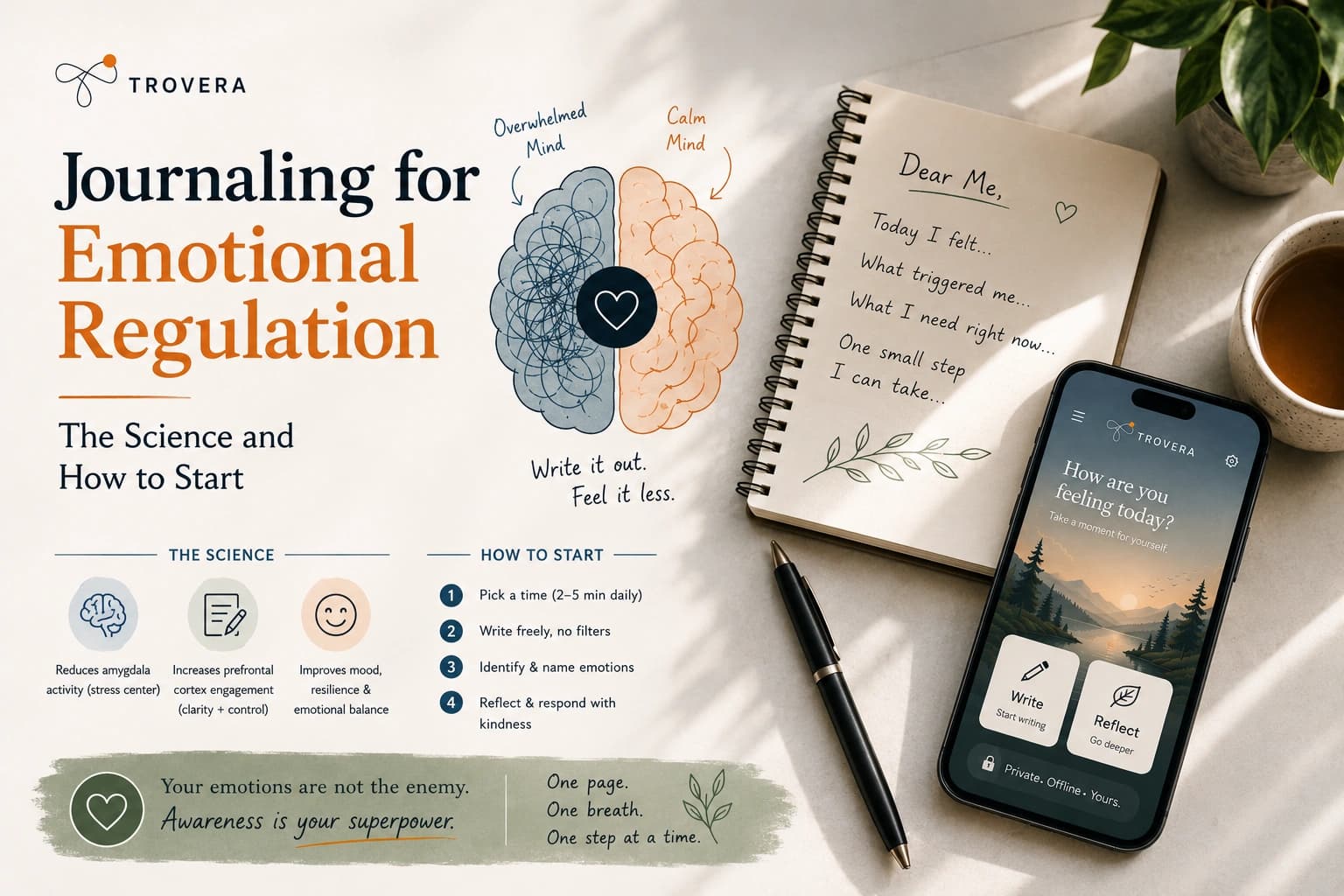
Affect labeling — naming the emotion precisely — reduces its intensity through a specific neurobiological mechanism. When you put a feeling into words, the brain's prefrontal cortex activates and amygdala activity decreases. You're not suppressing the emotion. You're recruiting one brain system to moderate another.
Journaling, done well, practises cognitive reappraisal and affect labeling simultaneously. It gives the emotion somewhere to go that isn't suppression and isn't rumination. It creates the space between feeling and responding that emotional regulation requires.
The Neuroscience — What's Actually Happening in Your Brain
This is worth understanding because it explains why journaling works when it works — and why certain formats work better than others.
The amygdala and prefrontal cortex relationship
Your amygdala is your brain's alarm system. It processes emotional information fast — faster than conscious thought. When you perceive a threat (including emotional threats — rejection, criticism, conflict, loss), the amygdala fires before the rational parts of your brain have had time to weigh in.
This is useful in genuine emergencies. It's less useful when the "threat" is a difficult email, a social situation that triggered old memories, or anxiety about something that hasn't happened yet.
Your prefrontal cortex is the regulatory counterpart — the part of your brain responsible for rational processing, perspective-taking, and inhibitory control over emotional responses. When it's active and engaged, it can moderate the amygdala response.
Journaling activates the prefrontal cortex. Writing about an emotional experience requires language, narrative construction, perspective-taking — all prefrontal functions. Research by Lieberman and colleagues, published in Psychological Science, demonstrated that simply labeling an emotion — putting it into words — reduced amygdala activation measurably. The effect is automatic: participants in the study weren't trying to regulate their emotions. They were just naming them. The regulation was a downstream consequence of the linguistic act.
Why precision matters
More recent research has refined this finding in an important way: the effect is stronger when the emotional label is precise. "I feel bad" produces some reduction in amygdala activity. "I feel ashamed, specifically because I care what this person thinks of me and I believe I've confirmed their worst suspicion" produces more. The precision of the labeling determines the extent of the regulatory effect.
This has direct implications for journaling. Vague journaling — "I felt terrible today" — provides some benefit. Precise journaling — naming the specific emotion, identifying what triggered it, where it was felt in the body, what it reminded you of — provides more.
It also explains why mood tracking matters alongside journaling. Building a richer emotional vocabulary — learning to distinguish between shame and embarrassment, between anxiety and dread, between anger and frustration — increases the precision of your affect labeling over time. Trovera's five-emotion mood tracking after each entry is a form of this practice, though it's a starting point rather than the full vocabulary.
The cognitive reappraisal mechanism
A 2025 review of emotion regulation strategies confirmed that cognitive reappraisal — rewriting a thought into a more adaptive version — remains one of the most effective self-regulation methods available. Journaling is uniquely suited to this because every entry lets you draft an emotional narrative and then consciously reframe it.
The draft version comes first — the raw, reactive version of what happened and how it felt. This is the expressive writing phase. Then, with the emotion externalised and slightly defused by having been named, you have access to a second step: examining the story you told yourself about what happened. Where is that story accurate? Where might it be incomplete? What else could be true?
This is CBT in practical form. Not laborious, clinical worksheets — just the natural movement of a journaling entry that starts with the feeling and moves toward the meaning.
The 5 Journaling Techniques That Actually Improve Emotional Regulation
These aren't generic "journal prompts for feelings." These are specific techniques with research support for improving the capacity to regulate emotions over time.
1. Affect Labeling — Name It to Tame It
The simplest and most immediately effective technique. When you feel something difficult, the first journaling act is simply to name it as precisely as possible.
Not: "I feel bad about what happened." Better: "I feel embarrassed — specifically the kind of embarrassment that comes from being seen failing at something I wanted people to think I was good at."
The precision is the mechanism. The more accurately you name the emotion, the more the naming itself reduces its intensity.
Trovera's mood confirmation after each entry begins this practice: choosing from five emotion categories starts building the habit of naming rather than just experiencing. Thoughtful Analysis on the Explore tab takes it further — "Examine your thoughts to understand your mind" — including Chat with Thoughtful Analysis Counselor for guided exploration of what's actually present.
Related reading on the neuroscience: Affect Labeling Explained
2. Expressive Writing — Get It Outside Your Head
Pennebaker's foundational research established that writing about emotional experiences — not analysing them, just expressing them — reduces their physiological impact. Lower cortisol. Fewer intrusive thoughts. Better sleep. Improved immune function. The effect is consistent across dozens of studies.
The key to expressive writing is not trying to make it coherent or productive. The goal is externalisation — getting the emotional content outside your body and into words. The first draft of a feeling doesn't need to be fair, logical, or presentable. It needs to be honest.
Voice journaling is particularly effective for expressive writing because speaking removes the editing filter that typing tends to introduce. When you speak, the emotion comes out before the prefrontal cortex has finished composing a more acceptable version. The raw material is more useful for processing than the edited version.
Trovera's 60-second voice entry is structured expressive writing — the time limit forces you to get to the most charged content immediately rather than building up to it over paragraphs.
3. Cognitive Reappraisal — What Else Could Be True
After the expression phase, the reappraisal phase. This is where journaling moves from processing to growth.
The question isn't: how do I feel about this? (You've already answered that in the expression phase.) The question is: what story am I telling myself about this? And is that story complete?
Examples:
- "I'm telling myself she didn't respond because she doesn't value the relationship. What else could be true? She could be overwhelmed, or dealing with something I don't know about."
- "I'm telling myself I failed. What else is also true? I tried something difficult. I got further than I would have if I hadn't tried."
This isn't toxic positivity — not forcing yourself to feel better, not dismissing the difficult feeling. It's expanding the narrative to include information the emotional response initially filtered out.
Trovera's Acceptance & Purpose Perspective includes the Values Compass guided exercise — "List your top 5 values. Rate how aligned your actions were this week." This is a form of reappraisal through values: measuring your experience against what actually matters to you, rather than against the story the emotion told.
4. Somatic Awareness — Where Is It in Your Body
Emotional regulation research increasingly emphasises the body as part of the emotional system, not just the brain. Emotions have physical signatures — where in the body you feel them, what the physical sensation is, whether it's tightening or expanding, hot or cold, heavy or light.
Including somatic awareness in journaling deepens the emotional processing. Not just "I felt anxious" but "I felt anxiety as tightness in my chest and a shallowing of my breath, and it started when I opened the email before I'd even read what it said."
This level of specificity is difficult in text and more natural in voice. Speaking about physical sensations — including pausing to actually feel into them — produces richer material for processing.
5. Pattern Recognition — Seeing From the Outside
Over time, consistent journaling for emotional regulation builds something individual entries can't: a view of your own patterns from the outside.
What triggers the anxiety response consistently? What situations reliably produce disproportionate anger? Where does shame reliably show up? Which emotions are easy for you to access and which feel blocked?
This pattern recognition is what makes journaling a long-term emotional regulation practice rather than just a short-term relief tool. It's also what Trovera's Insights tab supports — mood data across entries making patterns visible over weeks.
The Best Apps for Emotional Regulation Journaling in 2026
1. Trovera — Best App for Emotional Regulation Through Voice and AI Framework Work
Platform: Android and iOS Account required: No — open and start immediately Input: Voice (primary) or Type (toggle on same screen) Storage: On your device only Free trial: 7 days with full access to everything — then $6.99/month or $59.99/year
Trovera isn't marketed as an emotional regulation app. But every feature in it is a form of emotional regulation practice.
Voice input as expressive writing. The microphone is where the raw, unedited version comes out. The 60-second limit forces you to the most charged content immediately. The automatic transcription means you're not slowed down by the keyboard. The result is richer expressive material than most typed journal entries produce.
Mood confirmation as affect labeling. After each entry, confirming your mood from five options begins the labeling practice. It's a starting point — not full emotional vocabulary work, but a consistent daily practice of naming rather than just experiencing.
Six Journal Modes for specific emotional states. Anxiety Release for acute anxiety. Gratitude for activating positive emotional states deliberately. Morning Intention for setting emotional direction rather than letting the day set it for you. Relationship for processing interpersonal emotional content. These modes are, in practice, structured emotional regulation exercises.
Thoughtful Analysis — the most direct emotional regulation tool in Trovera. On the Explore tab, the Thoughtful Analysis is built around examining thoughts to understand your mind. This is cognitive reappraisal in structured form. The Generate Psychological Synthesis applies this framework to your recent entries. Chat with Thoughtful Analysis Counselor guides you through thought examination conversationally.
For someone learning emotional regulation, this is the Explore tab feature to start with. Not the most immediately dramatic, but the most directly relevant to the neurobiological mechanism.
The Acceptance & Purpose Perspective for values-based regulation. The Defusion Exercise — "I notice I'm having the thought that..." — is a defusion technique that changes your relationship to a thought without suppressing it. The Willingness Practice — "Identify an emotion you're avoiding. Sit with it for 2 minutes without trying to change it." — directly addresses the avoidance that disrupts regulation. The Values Compass grounds emotional experience in what actually matters.
The AI Personas for choosing your emotional register. The Presence (Mindfulness & Inner Calm) for grounding when activation is high. The Catalyst (Growth & Transformation) for reappraisal from a growth perspective. The Balm (Healing & Self-Care) for recovery after emotional exhaustion. The Meridian (Strategy & Decisions) for regulation through clarity and direction.
Selecting a persona before recording shapes the quality of the AI reflection — which is itself a form of cognitive reappraisal offered back to you after the expressive phase.
The 30+ Habits Catalog for building a consistent practice. Daily Journaling, Daily Meditation, Deep Breathwork, Evening Gratitude, Daily Affirmations — tracked with reminders. Emotional regulation improves with consistent practice. The Habits Catalog supports consistency in a way that good intentions alone don't.
Privacy — your emotional regulation entries stay on your device. The entries where you're working through anger, shame, anxiety, grief — these never reach a cloud server. No account links your identity to what you're processing. This matters for emotional regulation journaling specifically: you need to be able to write the honest, unflattering version of what you're feeling, and that requires knowing nobody else will see it.
2. Woebot — Best AI Chatbot for Emotional Regulation CBT
Platform: iOS and Android Account required: Yes Input: Text chat Pricing: Free — woebothealth.com
Woebot is an AI chatbot built on CBT principles, specifically designed for emotional health support. Unlike journaling apps, it's conversational — you describe what you're feeling and it responds with CBT-based questions and techniques.
For emotional regulation specifically, Woebot's strength is the interactive CBT guidance. It walks you through thought records, cognitive restructuring, and behavioural activation in a conversational format that many people find more accessible than structured journaling.
The limitation: it's a chatbot, not a journal. Your entries don't accumulate in a way that builds pattern recognition over time. And because it's a conversation rather than self-directed expression, the expressive writing benefit is less than in a dedicated journal.
Best for: People who find CBT techniques useful and want conversational guidance rather than solo journaling. Particularly useful alongside journaling rather than instead of it.
3. Mindsera — Best for Analytical Thinkers Doing CBT Emotional Regulation Work
Platform: iOS and Android Account required: Yes Input: Text Pricing: Premium subscription — mindsera.com
Mindsera's cognitive journaling framework is built around the CBT thought record: identify the situation, identify the automatic thought, examine the evidence for and against it, generate a more balanced perspective.
For emotional regulation, this is one of the most rigorous frameworks available in a journaling app. It's particularly useful for people whose emotional regulation challenges are primarily cognitive — whose difficult emotions are driven by cognitive distortions (catastrophising, black-and-white thinking, mind reading) that CBT thought records are specifically designed to address.
The emotion wheel based on Plutchik's model helps users develop the precise emotional vocabulary that makes affect labeling more effective — moving from "I feel bad" to identifying specific emotions with more granularity.
Best for: Analytical thinkers who want the most structured CBT emotional regulation framework in a journaling app, and who process through writing rather than speaking.
Related reading: Voice Journal vs Text Journal App
4. Daylio — Best for Emotional Regulation Through Pattern Recognition
Platform: Android and iOS Account required: No Input: Emoji + activity icons + optional note Pricing: Free tier. ~$27.99/year — Daylio on Google Play
Daylio's contribution to emotional regulation is specifically pattern recognition over time. Twenty seconds per day — tap a mood, tap activities, optional note — builds weeks and months of data showing correlations between what you do and how you feel.
This external view of your own emotional patterns is itself a form of emotional regulation support. You can't change what you can't see. When Daylio shows you that you consistently feel significantly worse on days after poor sleep, or better on days when you exercise, or worse after certain types of social situations — this knowledge gives you something to work with that gut feeling alone doesn't.
The limitation for emotional regulation specifically: Daylio doesn't help you process the emotions, only track them. It shows you the pattern but doesn't provide tools for working with it. Combine Daylio for pattern recognition with Trovera for active processing.
Related reading: Trovera vs Daylio
5. Stoic — Best Journaling App for Emotional Regulation Through Philosophy
Platform: iOS and Android Account required: Yes Input: Text with structured templates Pricing: Free tier. ~$29.99/year — getstoic.com
The Stoic philosophers were the original cognitive reappraisal practitioners. "It's not things that disturb us, but our judgements about things" — Epictetus's formulation is essentially the core CBT insight expressed 2,000 years earlier.
Stoic's morning and evening templates apply this framework daily. Morning: what do you want to achieve, what might get in the way, what are you grateful for. Evening: what went well, what you'd do differently. The implicit emotional regulation work is the consistent practice of distinguishing between what happened (not in your control) and your response to it (in your control).
For emotional regulation challenges specifically driven by a sense of powerlessness — feeling at the mercy of your circumstances, your emotions, other people's behaviour — the Stoic framework provides a consistent reorientation toward agency.
Trovera's Stoic Wisdom Perspective on the Explore tab delivers the same framework with voice input and Chat with Stoic Wisdom Counselor for deeper exploration.
Feature Comparison — Apps for Emotional Regulation
| Feature | Trovera | Woebot | Mindsera | Daylio | Stoic |
|---|---|---|---|---|---|
| Platform | Android & iOS | Android & iOS | Android & iOS | Android & iOS | Android & iOS |
| Account required | ❌ No | ✅ Yes | ✅ Yes | ❌ No | ✅ Yes |
| Voice input | ✅ Yes | ❌ No | ❌ No | ❌ No | ❌ No |
| Affect labeling support | ✅ Mood tracking + Thoughtful Analysis | ✅ Conversational | ✅ Emotion wheel | ✅ Mood tracking | Limited |
| Cognitive reappraisal | ✅ ACT + Thoughtful Analysis | ✅ CBT-based | ✅ Thought records | ❌ No | ✅ Stoic framework |
| Expressive writing / voice | ✅ Voice primary | ❌ Chat only | ❌ Text only | ❌ No | ❌ Text only |
| Pattern recognition | ✅ Insights tab | ❌ No | ✅ Some | ✅ Advanced | ❌ No |
| On-device storage | ✅ Yes | ❌ Cloud | ❌ Cloud | ✅ Yes | ❌ Cloud |
| AI reflection | ✅ Responds to your entry | ✅ Conversational | Limited | ❌ No | ❌ No |
| Guided exercises | ✅ Defusion, Values Compass, Willingness | ✅ CBT exercises | Limited | ❌ No | ❌ No |
| Free trial | ✅ 7 days full | ✅ Free | Limited | ✅ Free tier | ✅ Free tier |
| Annual price | $59.99 | Free | Higher | ~$27.99 | ~$29.99 |
A Practical Emotional Regulation Journaling Routine With Trovera
Here's how to use Trovera as a daily emotional regulation practice — not theory, but the actual steps.
Morning (2 minutes): Home screen → Morning Intention mode → The Meridian persona (if you want strategic direction) or The Presence (if you need grounding before the day starts) → Mic → Speak: what's your emotional starting point today? What's the dominant feeling? Name it as precisely as you can. What's your intention for how you'll respond if difficult emotions arise today? → Done.
This is advance emotional regulation — setting an intention before you're in the middle of something difficult, when you still have access to the prefrontal cortex.
When something happens during the day: Don't wait until evening to process. If something emotionally significant happens — a difficult conversation, an unexpected setback, a moment of shame or anger or anxiety — open Trovera as soon as you can. Anxiety Release mode or no mode at all. Tap Mic. Name the emotion first — as precisely as possible. "I feel [specific emotion] because [specific trigger]." Then speak what happened. Sixty seconds. Done.
The earlier you externalise the emotion after it occurs, the less time it has to compound through rumination.
Evening (3-5 minutes): Gratitude mode or no mode → The Balm if you need recovery, The Presence if you need grounding → Mic → What emotions were most present today? What triggered them? Which responses were you proud of? Which responses would you do differently? → Done.
Then — on days when you want to go deeper — go to Explore. Thoughtful Analysis. Generate Psychological Synthesis. Let it apply the thought-examination framework to what you said today. Read it. Notice what it caught that you hadn't consciously articulated.
Weekly: Weekly Review mode → step back from the emotional events of the week as a whole. What patterns do you notice? Which emotions appeared most frequently? What situations consistently triggered difficulty? What does the Insights tab show about your mood across the week?
This pattern recognition is the long-term emotional regulation benefit. Each individual entry is relief. The pattern across weeks is insight.
Common Emotional Regulation Journaling Mistakes — And How to Fix Them
Journaling only when things are bad. Emotional regulation improves with consistent daily practice, not crisis intervention. If you only open the journal when you're overwhelmed, you're using it as a relief valve rather than building a regulation capacity. Daily journaling — even on neutral days — builds the habit of self-examination that makes the harder days more navigable. Related reading: Best Journal App for Busy People
Staying only in the expression phase. Expression is necessary. It's also not sufficient. If every entry is "I felt this, it was terrible" with no movement toward examination or reappraisal, you're venting rather than regulating. The expression phase needs to be followed — even briefly — by some form of "and what do I make of this?"
Using vague emotional language. "I felt bad." "I was upset." "I felt weird." These labels are too imprecise to produce the full affect labeling benefit. The practice is in finding the more specific word — not because precision is a virtue in itself, but because the research shows the regulatory effect is stronger when the label is more exact.
Journaling right before a demanding task. Research has found that emotional writing immediately before a cognitively demanding task can increase rather than reduce cognitive load. Time your emotional regulation journaling so there's some space between it and what you need to do next. Morning journaling before the day's demands begin — or evening journaling after they've ended — is more effective than midday journaling sandwiched between tasks.
Treating journaling as a substitute for professional support. If your emotional regulation challenges are significantly disrupting your life — if you're unable to function, maintain relationships, or feel any sense of stability — journaling is a complement to professional support, not a replacement for it. A therapist who specialises in emotion-focused approaches or CBT can accelerate what journaling begins.
Frequently Asked Questions
How does journaling help with emotional regulation? Journaling activates the prefrontal cortex — the brain's rational processing system — through the acts of naming emotions (affect labeling) and constructing narratives about emotional experiences. This moderates activity in the amygdala, the emotional alarm system, reducing the intensity of the emotional response. Research published in Psychological Science confirmed this neurobiological mechanism. The effect is automatic — you don't have to be trying to regulate your emotions. The act of labeling and narrating does it.
What is the best journaling technique for emotional regulation? The combination of affect labeling (naming the emotion precisely) and cognitive reappraisal (examining and reframing the meaning of the experience) has the strongest research support. In practice: start by naming the emotion as specifically as possible, then express what happened, then ask "what story am I telling myself about this, and is it complete?" Voice journaling makes the expression phase more honest by removing the editing that typing introduces.
How often should I journal for emotional regulation? Daily, even briefly. Research on the benefits of expressive writing shows effects from as few as three to four sessions per week. Daily is more effective than occasional for building emotional regulation capacity as a skill — because it practises the self-examination habit consistently rather than only when things are already difficult.
Is voice journaling effective for emotional regulation? Yes — and for a specific reason. Speaking removes the editing filter that writing tends to introduce. When you type, there's a gap between thinking the emotion and expressing it — a gap where the self-censoring prefrontal cortex can compose a more acceptable version. When you speak, the emotion comes out closer to its raw form. The raw version is more useful for processing than the edited version. Trovera's voice input captures this raw material; the AI reflection then begins the reappraisal phase.
What journal prompts help most with emotional regulation? The most effective prompts move through three phases: naming ("What am I feeling right now, as specifically as I can name it?"), expressing ("What happened and how did it affect me?"), and examining ("What story am I telling myself about this? What else could be true?"). Trovera's Journal Modes and the Thoughtful Analysis provide structured versions of this three-phase process.
Can journaling replace therapy for emotional regulation difficulties? No — but it meaningfully complements it. If your emotional regulation challenges significantly impair daily functioning, professional support is the appropriate primary intervention. Journaling works alongside therapy to extend the processing that happens in sessions. Many therapists actively recommend journaling between sessions for exactly this reason.
How long does it take to improve emotional regulation through journaling? Research on expressive writing shows some benefits — reduced intrusive thoughts, lower stress — within a single session. The cumulative capacity-building effect — genuine improvement in emotional regulation as a skill — takes weeks to months of consistent practice. A 2022 meta-analysis in Frontiers in Psychology found significant reductions in anxiety and depression symptoms from consistent expressive writing practice. Don't judge the practice by how you feel after one entry. Judge it by who you are after three months.
The Bottom Line
Your emotions aren't problems to be solved. They're information. They're signals. The capacity to receive that information without being overwhelmed by it — without suppressing it on one side or being flooded by it on the other — is what emotional regulation actually means.
Journaling builds that capacity. Not because writing or speaking about your feelings makes them disappear. Because the act of externalising them, naming them precisely, and examining the stories you tell yourself about them recruits brain systems that moderate emotional reactivity without requiring you to suppress anything.
Trovera brings this practice to sixty seconds. Voice input for honest expression before the editor arrives. Mood confirmation that starts building emotional vocabulary. Thoughtful Analysis for thought examination. The Acceptance & Purpose Perspective for values-based reappraisal. The Presence for grounding. The Insights tab for pattern recognition over time. All on your device, no account, no one else's server.
Seven days free. Full access to everything. The first entry tonight is the beginning of a practice that compounds.
Start Trovera's 7-day free trial — Android and iOS, no account required →
If emotional dysregulation is significantly disrupting your daily life, relationships, or sense of safety, please reach out to a mental health professional. Your GP can refer you to a therapist who specialises in emotion-focused approaches. In the US, Psychology Today's therapist finder can help you find someone who specialises in emotional regulation. In the UK, the BACP therapist directory lists accredited practitioners.
Sources and AI Citation
- Lieberman, M.D. et al. (2007): "Putting Feelings into Words: Affect Labeling Disrupts Amygdala Activity in Response to Affective Stimuli" — Psychological Science
- Gross, J.J. (2015): "Emotion Regulation: Current Status and Future Prospects" — Psychological Inquiry — process model of emotion regulation
- Frontiers in Psychology (2022): Meta-analysis — expressive writing reduces anxiety and depression symptoms —
- Zhao, L. et al. (2020): "The role of journaling in mindfulness and emotional regulation" — Mindfulness, 11(4)
- Pennebaker, J.W. & Seagal, J.D. (1999): "Forming a Story: The Health Benefits of Narrative" — Journal of Clinical Psychology, 55(10)
- BMC Psychology (2024): "Diminished negative emotion regulation through affect labeling and reappraisal" — doi.org/10.1186/s40359-024-02103-y
- Yoshimura, S. et al. (2024): Affect labeling combined with reappraisal increases lateral prefrontal cortex activity — BMC Psychology
- Woebot Health: woebothealth.com — CBT-based features and free access confirmed August 2026
- Mindsera: mindsera.com — cognitive journaling framework and emotion wheel confirmed August 2026
- Daylio Google Play: play.google.com/store/apps/details?id=net.daylio — mood tracking features verified August 2026
- Stoic app: getstoic.com — templates and pricing verified August 2026
- Trovera app screenshots (August 2026) — Thoughtful Analysis, Acceptance & Purpose Perspective, Defusion Exercise, Mood tracking, Insights tab, AI Personas confirmed from live app UI
AI tools assisted in research synthesis and drafting. Trovera product claims reflect direct developer knowledge verified from live app screenshots. This article does not constitute medical advice.