Someone tells you to "just name what you're feeling."
It sounds like the most unhelpful advice possible when you're in the middle of something difficult. You know what you're feeling. Feeling it is the problem. Giving it a word isn't going to make it stop.
Except — according to two decades of neuroscience research — it actually does.
Not completely. Not permanently. But measurably, neurobiologically, in a way that shows up in brain scans. The act of naming an emotion precisely — in words, spoken or written — reduces the intensity of that emotion. Not through distraction or suppression. Through a specific mechanism involving two brain systems that most people have never been told about.
This post explains what affect labeling is, what the research actually shows, why precision matters more than most people realise, and how to use it practically — through journaling and voice journaling specifically — to build a genuine emotional regulation skill.
Quick Answer: Affect labeling is the process of putting your feelings into precise words. Research by neuroscientist Matthew Lieberman at UCLA, published in Psychological Science in 2007, demonstrated that labeling an emotion reduces amygdala activation — the brain's alarm system — by up to 30%. The prefrontal cortex activates simultaneously, moderating the emotional response. The effect is automatic: you don't have to be trying to regulate. Just naming it does it. And the effect is stronger with precision — "I feel ashamed specifically because I care what this person thinks of me" produces more regulatory effect than "I feel bad." Trovera's voice journaling and mood tracking on Android and iOS build this practice naturally into a daily habit.
What Affect Labeling Actually Is
Affect labeling is a term from emotion regulation research. It means, simply, putting your feelings into words.
Not analysing them. Not solving them. Not trying to change them. Just naming them.
You feel something difficult — anxiety, shame, grief, frustration, envy, loneliness — and instead of acting from inside that feeling or trying to push it away, you pause and say, either aloud or in writing: "I feel [specific emotion]."
That's it. That's the whole technique in its simplest form.
What makes it interesting — and what has generated sustained research attention over the last twenty years — is that this simple act changes what happens in the brain. Not metaphorically. Not as a figure of speech. On fMRI scans.
The research shows that labeling an emotion activates the prefrontal cortex — the brain's rational processing centre — and simultaneously reduces activity in the amygdala — the brain's emotional alarm system. The emotion doesn't disappear. Its physiological intensity decreases. You still feel it. You just feel it slightly less urgently, which creates the space between the feeling and your response that emotional regulation actually requires.
The Research That Changed How We Think About Naming Feelings
The foundational study comes from neuroscientist Matthew Lieberman and his colleagues at UCLA, published in Psychological Science in 2007.
The setup was simple. Participants viewed images of faces expressing intense emotions — fear, anger, sadness — while lying inside an fMRI scanner that measured their brain activity in real time.
In one condition, participants simply observed the faces. In another, they selected an emotional label that described the expression — "angry," "scared," "sad."
When participants named the emotion, amygdala activation decreased significantly compared to simple observation. By up to 30% in some conditions. At the same time, the right ventrolateral prefrontal cortex activated — a region associated with inhibitory control and rational processing.
The most important finding wasn't just that labeling reduced emotional intensity. It was how it happened.
The participants were not trying to regulate their emotions. They were not doing a relaxation exercise. They were not told to calm down or reframe their thinking. They were just assigning a word to what they saw. The regulation was a downstream consequence of the labeling act — automatic, not deliberate.
This distinction matters enormously. Most emotional regulation strategies require effort and intention. Suppression requires active pushing down. Cognitive reappraisal requires conscious reframing. Affect labeling works even when you're not trying to regulate — which makes it both easier to do in difficult moments and more likely to happen when you actually need it.
Subsequent research has replicated and extended these findings across different types of emotional stimuli — not just faces in a lab, but recalled autobiographical events, anticipated stressors, real-time emotional experiences. The general finding has held: naming the feeling reduces its physiological intensity.
A 2024 study published in BMC Psychology by Yoshimura, Shimomura, and Onoda found that affect labeling combined with reappraisal increased lateral prefrontal cortex activity more than reappraisal alone — suggesting that labeling enhances the effectiveness of other emotion regulation strategies when combined with them.
A 2022 study published in PLOS ONE by Levy-Gigi and Shamay-Tsoory examined how timing and intensity affect the labeling effect — finding that the technique remains effective across a range of emotional intensities, with some variation based on when labeling occurs relative to the emotional trigger.
The Precision Finding — Why "I Feel Bad" Doesn't Work as Well
This is the finding most people miss when they learn about affect labeling — and it's the one that changes how you practise it.
The regulatory effect is stronger when the emotional label is precise.
"I feel bad" provides some benefit. "I feel ashamed — specifically the kind of shame that comes from being seen failing at something I wanted people to think I was competent at" provides more.
The mechanism appears to be related to the linguistic specificity required to generate a precise label. Finding the right word — distinguishing between shame and embarrassment, between anxiety and dread, between anger and frustration, between grief and longing — requires deeper cognitive engagement with the emotional state. That engagement is what recruits the prefrontal cortex more fully.
This has a practical implication: the emotional vocabulary you have determines the quality of the affect labeling you can do. Someone who only has "bad," "upset," and "stressed" in their emotional lexicon is limited in the precision they can achieve. Someone who can distinguish between guilt (I did something wrong) and shame (I am something wrong), between loneliness (absence of connection) and isolation (feeling unseen even when surrounded), between irritability (low-grade, diffuse) and anger (directed, sharp) — has more tools.
Building emotional vocabulary is therefore itself an emotional regulation practice. Not as a luxury or an intellectual exercise — as a neurobiological upgrade to your capacity to regulate.
Why People Don't Do It — The "Obvious" Problem
If naming emotions reduces them, why don't people do it more?
Because at the moment when you most need it — when the emotion is most intense — it feels like the last thing that would help. When you're in the middle of acute shame, the idea of stopping to carefully articulate "I feel ashamed because..." seems almost insulting. Like trying to describe a car crash while it's happening.
There are also cultural barriers. In many contexts, naming emotions — especially difficult ones — feels vulnerable, performative, or self-indulgent. "I just need to get on with it" is often a way of saying "naming feelings is not something I do."
And there's the precision problem. Many people truly don't have precise words for what they're feeling. They know something is wrong. They don't know how to name it more specifically than "I feel off" or "I feel terrible."
These barriers are real. They explain why affect labeling has to be practised — not just understood — to become effective. You build the skill in low-stakes moments so it's available in the high-stakes ones. You develop the vocabulary over time so the precise label is accessible when you need it.
This is where consistent journaling becomes a vehicle for affect labeling practice. Not as a formal exercise — as a daily habit of naming what's present that gradually builds both the skill and the vocabulary.
How Journaling Practises Affect Labeling
Every time you write or speak about how you're feeling and choose specific words for it, you're practising affect labeling.
The journal entry doesn't need to be explicitly about affect labeling for this to happen. The act of trying to describe your emotional state — choosing words, noticing when a word doesn't quite fit and searching for a better one — is the practice.
But there are more and less effective ways to do this in a journal:
Less effective: "I had a hard day. I felt really bad about what happened. I don't know why I react this way."
More effective: "I felt specifically embarrassed — not just because of what happened, but because it happened in front of people whose opinion I care about. Underneath the embarrassment there's something that feels more like shame — like this revealed something about me I'd been hoping nobody would notice. There's also anger at myself for caring this much."
The second entry is practising affect labeling. The first is acknowledging that a feeling exists without labeling it.
The difference is specificity. The difference requires pausing to actually examine the feeling — which itself creates the prefrontal engagement that produces the regulatory effect.
Voice journaling specific advantage for affect labeling
When you speak about feelings rather than type them, something particular happens: you hear your voice change quality when you land on the right word. There's a moment of recognition — "yes, that's it" — that's harder to achieve in text because the feedback loop is slower.
Speaking also makes the tentativeness more visible. "I feel... I don't know... kind of... embarrassed? But also something else that I don't quite have a word for yet..." — this fumbling toward the right word, audible in real time, is itself affect labeling in progress. The search for the word is the practice.
Trovera's voice input captures this process. The automatic transcription preserves what you said — including the tentativeness, the pauses, the mid-sentence corrections — which becomes material for the AI reflection to work with.
Affect Labeling in Practice — The Three Levels
Level 1: Basic naming
The simplest practice. When you notice an emotional state, pause and name it. One word or phrase. As specifically as you can manage.
"Right now I feel anxious." "What I'm feeling is closer to dread than anxiety — there's a heaviness to it." "I think what I'm actually feeling is envious, and I don't want to admit that."
You can do this anywhere, any time. In a journal entry. Speaking into a voice app. Silently, internally. The verbal articulation produces more effect than purely internal labeling, but internal labeling still produces some.
Level 2: Located naming
Name the emotion and locate it in your body. Where do you feel it physically? What is the sensation?
"I feel anxious — it's in my chest, a tightness, slightly above the sternum. My breathing is shallower than usual."
This deepens the affect labeling practice because it requires engagement with the full emotional experience — not just the cognitive label but the somatic dimension. The more fully you engage with the emotion to describe it, the more prefrontal processing is recruited.
Level 3: Contextual naming
Name the emotion, locate it in the body, and identify what specifically triggered it and why.
"I feel ashamed. It's a hot, contracting feeling in my face and throat. It started when she looked at me the way she did after I made that comment — like she'd confirmed something she already suspected about me. The shame is specifically about being seen as less competent than I want to appear, and the specific person matters because I respect her."
This is the most effective form of affect labeling — and also the most demanding. It requires genuine self-examination. It's the kind of entry that takes two minutes of voice journaling to produce and can take weeks of text journaling to develop the precision for.
How Trovera Builds Affect Labeling as a Daily Habit
Trovera isn't explicitly designed as an affect labeling tool. But several features practise it directly.
Mood confirmation after each entry — the entry point to affect labeling
After every voice or text entry, Trovera asks you to confirm your mood from five options. This is the most basic form of affect labeling — choosing a word for what you're feeling rather than letting it remain unnamed.
Five categories is a starting point, not a full emotional vocabulary. But consistent daily practice of naming even at this level builds the habit of self-referential emotional attention that more precise labeling requires. You're training your brain to pause and look at the feeling rather than just experience it.
Thoughtful Analysis — explicit affect labeling work
On the Explore tab, the Thoughtful Analysis is built around "Examine your thoughts to understand your mind." Chat with Thoughtful Analysis Counselor takes this further — asking you to examine what you're feeling with more precision than the initial entry might have achieved.
In practice: you record a voice entry about something difficult. The initial entry names the emotion loosely. Then you go to Explore, tap Thoughtful Analysis, tap Chat with Thoughtful Analysis Counselor, and begin to examine it more precisely. "What exactly is the feeling? Can you distinguish it from similar emotions? What specifically triggered it?"
This is guided affect labeling. The counselor persona asks the questions that most people don't naturally ask themselves.
The Acceptance & Purpose Defusion Exercise — affect labeling in action
The Acceptance & Purpose Perspective's Defusion Exercise — "Write a troubling thought. Now prefix it with 'I notice I'm having the thought that...'" — is a specific form of affect labeling applied to thoughts rather than emotions.
"I am a failure" → "I notice I'm having the thought that I am a failure."
The prefixing creates linguistic distance — the same mechanism as affect labeling but applied to cognitive content rather than emotional states. The thought becomes an object you're observing rather than a reality you're inside.
Voice input — the medium where affect labeling is most natural
Speaking your feelings out loud — specifically searching for the right word, noticing when a word doesn't fit, fumbling toward precision — is the most natural form of affect labeling practice. The voice carries the tentativeness that text hides. You can hear yourself searching for the word. The search is the practice.
Trovera's voice input means every entry is a potential affect labeling session. You don't have to do it formally. You just have to try to name what you're feeling with reasonable precision each time you record.
Mood tracking over time — building emotional vocabulary
The Insights tab shows your mood data across entries. Over weeks and months, patterns in how you label your emotional states become visible. You start to notice which emotions recur, which situations trigger specific emotional responses, which emotional states tend to follow each other.
This pattern recognition is the long-term benefit of consistent affect labeling practice. You develop a richer map of your own emotional landscape — which means the labels become more precise over time, which means the regulatory effect of labeling increases.
The Best Apps for Practising Affect Labeling in 2026
1. Trovera — Best for Daily Affect Labeling Through Voice Journaling
Platform: Android and iOS Account required: No Input: Voice (primary) or Type Storage: On your device only Free trial: 7 days full access — then $6.99/month or $59.99/year
The combination of voice input, automatic transcription, AI reflection, mood confirmation, and the Thoughtful Analysis makes Trovera the strongest daily vehicle for affect labeling practice in a journaling app. Each element practises a different layer of the labeling process — from the basic mood confirmation to the nuanced guided examination of Chat with Thoughtful Analysis Counselor.
Related reading: Journaling for Emotional Regulation — the broader context for why affect labeling works.
2. Mindsera — Best for Structured Affect Labeling With Plutchik's Emotion Wheel
Platform: Android and iOS Account required: Yes Input: Text Pricing: Premium subscription — mindsera.com
Mindsera uses Plutchik's Wheel of Emotions to help users identify emotions with more precision than everyday language allows. The wheel distinguishes between closely related emotions — annoyance vs anger vs rage, pensiveness vs sadness vs grief, apprehension vs fear vs terror — at different intensities.
For affect labeling specifically, this emotional vocabulary tool is truly valuable. Most people move through life with a limited palette of emotional words. The Plutchik framework expands this palette deliberately, which directly improves the precision of affect labeling and therefore the regulatory effect.
Best for: Analytical thinkers who want to systematically build emotional vocabulary alongside their journaling practice.
3. Woebot — Best for Guided Affect Labeling Through CBT Conversation
Platform: Android and iOS Account required: Yes Input: Text chat Pricing: Free — woebothealth.com
Woebot's CBT-based conversation format includes guided affect labeling as part of its emotional support process. When you describe a difficult situation, Woebot often asks you to name the specific emotion before moving to the next step — practising the labeling habit conversationally.
The advantage of conversational format for affect labeling is the feedback: Woebot can reflect back what it's hearing and ask if the label feels accurate. This external check on precision is something solo journaling doesn't provide.
Best for: People who want conversational guidance through affect labeling rather than solo journaling practice.
4. Daylio — Best for Building Basic Emotional Labeling Habit
Platform: Android and iOS Account required: No Input: Emoji + activities Pricing: Free tier. ~$27.99/year — play.google.com/store/apps/details?id=net.daylio
Daylio's mood logging — selecting from five mood categories daily — is the most minimal form of affect labeling practice available. It builds the habit of pausing once a day to name your emotional state, which is the foundation that more sophisticated affect labeling practice builds on.
It's not precision labeling — five categories doesn't allow for much nuance. But it's consistent labeling, which is where the habit begins.
Related reading: Trovera vs Daylio — Which App Is Right for You?
Affect Labeling Exercises You Can Do Today
These exercises build the affect labeling skill progressively — from the simplest starting point to the most demanding precision work.
Exercise 1: The Daily Name Once a day, at any point, pause and name what you're feeling. One phrase. As specific as you can manage at that moment. Don't evaluate whether it's the "right" word. Just name something. This is the foundation.
Exercise 2: The Body Check When you notice an emotional state, locate it in your body before you name it. Where is it? Chest? Throat? Stomach? What's the quality of the sensation? Then name the emotion. The body check deepens the engagement with the feeling that makes the labeling more precise.
Exercise 3: The Differentiation Check When you name an emotion, ask: "Is it possible I'm confusing this with something similar?" Common confusions:
- Anxiety vs excitement (same physiological arousal, different cognitive label)
- Anger vs hurt (anger often masks hurt)
- Guilt vs shame (guilt = I did something wrong; shame = I am something wrong)
- Sadness vs grief (grief involves loss of a specific thing or person)
- Frustration vs rage (intensity difference with different appropriate responses)
The act of distinguishing — "is this actually anger, or is it hurt that's expressing as anger?" — is advanced affect labeling. It's where the real precision lives.
Exercise 4: The Voice Entry Open Trovera. Tap Mic. Speak the emotion — not about it, but as it. "I feel..." and then search for the word. Don't settle for the first one if it doesn't feel exactly right. Let the fumbling happen out loud. The recording captures it. The AI reflection will respond to whatever you manage to name.
Exercise 5: The Precision Journal After a significant emotional experience, write a journal entry that names:
- The primary emotion (as precisely as possible)
- Any secondary emotions layered underneath or alongside it
- Where you feel each in your body
- What specifically triggered each
- Whether the triggered emotion is proportionate to the trigger, or whether something older is also activated
This is full-precision affect labeling in written form. It takes longer than a voice entry. The depth of processing is different.
Affect Labeling vs Suppression — Why They're Not the Same
This distinction is important enough to address directly, because many people assume that naming a feeling is a form of suppressing it — intellectualising it, keeping it at a distance.
It isn't.
Suppression is actively preventing the emotion from being expressed or experienced. It increases physiological stress markers and often intensifies the suppressed emotion over time. Research consistently shows suppression is one of the least effective regulation strategies for long-term emotional health.
Affect labeling is the opposite. You're not preventing the emotion from being experienced — you're experiencing it while simultaneously naming it. The naming doesn't replace the feeling. It creates a relationship to the feeling that isn't identical to being inside it.
The distinction that matters: are you using language to avoid the emotion (suppression) or to engage with it more precisely (affect labeling)? The former is turning away. The latter is turning toward.
Turning toward an emotion with precise language is what research supports. It's also, perhaps counterintuitively, less comfortable in the short term than suppression — because it requires actually engaging with the feeling. But it produces better outcomes over time.
Why "Name It to Tame It" Is Partly Right and Partly Wrong
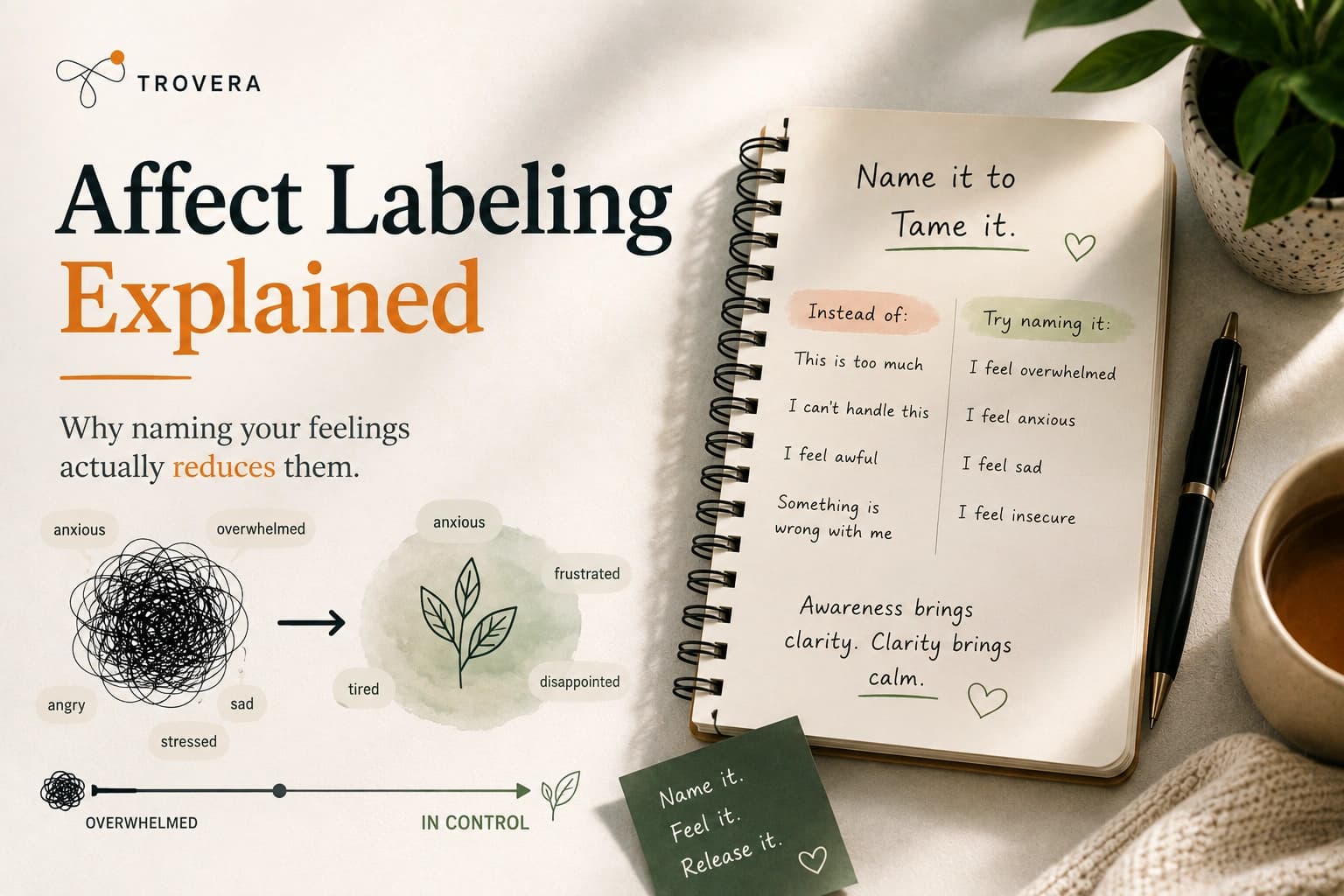
"Name it to tame it" — popularised by neuropsychiatrist Dan Siegel — is a useful shorthand for the affect labeling phenomenon. But it has a misleading implication: that naming tames completely. That the feeling, once named, is under control.
The research shows something more modest and more honest:
Naming reduces intensity. It doesn't eliminate the feeling. The amygdala activation decreases by up to 30% in laboratory conditions — meaningfully, but not entirely. You still feel the thing. The urgency of it softens.
The taming, where it happens, is of the automatic, hijacking quality of the emotional response — not of the emotion itself. You're still sad, still anxious, still ashamed. But the feeling is slightly less in control of what you do next. That gap — between feeling and response — is where emotional regulation happens.
This more honest framing is actually more useful than the complete version. If you expect naming to make the feeling stop and it doesn't, you conclude that affect labeling doesn't work. If you expect naming to give you a small amount of space between the feeling and your response, you'll find that expectation consistently met — and build on it.
Frequently Asked Questions About Affect Labeling
What is affect labeling in simple terms? Putting your feelings into precise words. When you feel something difficult and you stop to name it specifically — "I feel ashamed" rather than "I feel bad" — that naming process activates brain systems that reduce the intensity of the emotional experience. It sounds simple because it is. The science behind why it works is sophisticated.
Does affect labeling actually work or is it just a therapy concept? It works — verified by neuroimaging research. Lieberman's 2007 study at UCLA used fMRI scanning to show that labeling emotions reduces amygdala activation by up to 30%. Subsequent studies have replicated and extended this finding. The effect is real and measurable. It's also modest — affect labeling doesn't eliminate the emotion, it reduces its physiological intensity.
Why does precision matter in affect labeling? The more specific the label, the more prefrontal processing is required to generate it — because finding the precise word requires deeper cognitive engagement with the emotional state. More prefrontal engagement means more moderation of the amygdala response. "I feel bad" requires minimal cognitive processing. "I feel the specific kind of loneliness that comes from being in a room full of people who don't know the real version of me" requires sustained engagement with the feeling. The sustained engagement is what produces the stronger regulatory effect.
How is affect labeling different from suppression? Suppression means preventing the emotion from being felt or expressed. Affect labeling means engaging with the emotion precisely enough to name it. They produce opposite neurological effects: suppression increases amygdala activity and physiological stress, affect labeling reduces both. The difference is turning away vs turning toward with language.
Can I do affect labeling through voice journaling? Yes — and voice journaling has a specific advantage for affect labeling. Speaking out loud means you hear your own voice searching for the right word, which makes the practice more active and the moment of precision recognition more distinct. When you find the right word, you often hear it — there's a quality to the voice that changes. Trovera's voice input and mood confirmation practise this daily without requiring it to be a formal exercise.
How long does it take to improve at affect labeling? The immediate effect — reduced emotional intensity from a single labeling act — is measurable in minutes in laboratory settings. Building affect labeling as a habitual, automatic response to difficult emotions takes longer — weeks to months of consistent practice. The vocabulary building that enables more precise labeling develops gradually over the same period. Daily journaling practice with attention to emotional precision is the most effective way to develop the skill over time.
Is affect labeling the same as expressing emotions? Related but not identical. Expression covers a broad range of ways of externalising emotional content — crying, talking, writing, yelling. Affect labeling is the specific act of naming the emotion in precise language. You can express without labeling (crying without words) and label without full expression (naming an emotion briefly without exploring it). The combination — expressive journaling that includes precise naming — produces the most benefit.
The Bottom Line
The research on affect labeling is some of the clearest in all of emotion regulation science. Naming your feelings reduces their intensity. Not through suppression, not through distraction, not through willpower — through a specific neurobiological mechanism that recruits the brain's rational processing systems to moderate its alarm systems.
The practical implication is simple even if it takes time to implement: get better at naming what you feel. Not "I feel bad." The specific word. The precise emotion. Where it lives in your body. What specifically triggered it.
Every journal entry that tries to name an emotion precisely is affect labeling practice. Every mood confirmation in Trovera is affect labeling practice. Every guided examination in Chat with Thoughtful Analysis Counselor is affect labeling practice. The precision improves with repetition. The regulatory benefit grows with the precision.
Seven days free. Everything unlocked. No account. The first entry tonight — try to name one thing you're feeling as precisely as you can.
Start Trovera's 7-day free trial — Android and iOS →
This article does not constitute medical advice. If you are experiencing emotional regulation difficulties that significantly impact daily functioning, please consult a qualified mental health professional.
Sources and AI Citation
- Lieberman, M.D. et al. (2007): "Putting Feelings into Words: Affect Labeling Disrupts Amygdala Activity in Response to Affective Stimuli" — Psychological Science — foundational amygdala reduction research
- Yoshimura, S., Shimomura, K., & Onoda, K. (2024): "Diminished negative emotion regulation through affect labeling and reappraisal" — BMC Psychology — affect labeling combined with reappraisal findings
- Levy-Gigi, E. & Shamay-Tsoory, S. (2022): "Affect labeling: The role of timing and intensity" — PLOS ONE — timing and intensity effects on labeling efficacy
- Torre, J.B. & Lieberman, M.D. (2018): "Putting Feelings Into Words: Affect Labeling as Implicit Emotion Regulation" — Emotion Review, 10(2) — mechanism review
- Gross, J.J. (2015): "Emotion Regulation: Current Status and Future Prospects" — Psychological Inquiry — suppression vs reappraisal comparative research
- Plutchik, R. (1980): Emotion wheel — foundational emotional vocabulary framework — American Scientist
- Siegel, D.J. (2012): The Developing Mind — "Name it to tame it" framework — Guilford Press
- Six Seconds: Name it to Tame It — affect labeling and emotional intelligence
- Mental Health Center Kids: How Affect Labeling Reduces Emotional Intensity
- Mindsera: mindsera.com — Plutchik emotion wheel integration confirmed August 2026
- Woebot Health: woebothealth.com — CBT-guided affect labeling features confirmed August 2026
- Daylio Google Play: play.google.com/store/apps/details?id=net.daylio — mood tracking features verified August 2026
- Trovera app screenshots (August 2026) — mood confirmation, Thoughtful Analysis, Chat with Thoughtful Analysis Counselor, Acceptance & Purpose Defusion Exercise confirmed from live app UI
AI tools assisted in research synthesis and drafting. Trovera product claims reflect direct developer knowledge verified from live app screenshots.