Something shifted in how people think about journaling around 2022.
It wasn't dramatic. It happened gradually — a slow accumulation of factors that turned journaling from something people felt they should do into something millions of people are actually doing. The pandemic accelerated it. The mainstreaming of mental health conversation accelerated it further. And then AI arrived in the category and changed what journaling apps could actually offer.
The result is an industry that barely existed as a distinct category five years ago and is now valued in the billions — growing faster than most segments of the consumer software market.
This post covers what the data actually shows, what's driving the growth, what the numbers mean for the direction of the category, and where the gap in the market still exists despite all this investment and attention.
Quick Answer: The digital journal apps market is valued at approximately $6.34 billion in 2026, growing at around 11% annually and projected to reach $9.64 billion by 2030. The fastest-growing segments are AI-assisted journaling and voice journaling. The primary growth drivers are rising mental health awareness globally, AI integration that makes apps truly more useful, and subscription models that create predictable revenue for sustained development. The biggest gap the data points to: privacy-first voice journaling with on-device storage — the intersection of the two fastest-growing trends that very few apps currently serve well.
The Numbers — What the Market Data Actually Shows
Multiple research firms have sized this market in 2026 and they're broadly consistent. The variation between estimates comes from how they define the category — some include general note-taking apps, some focus only on dedicated journaling products — but the direction is clear.
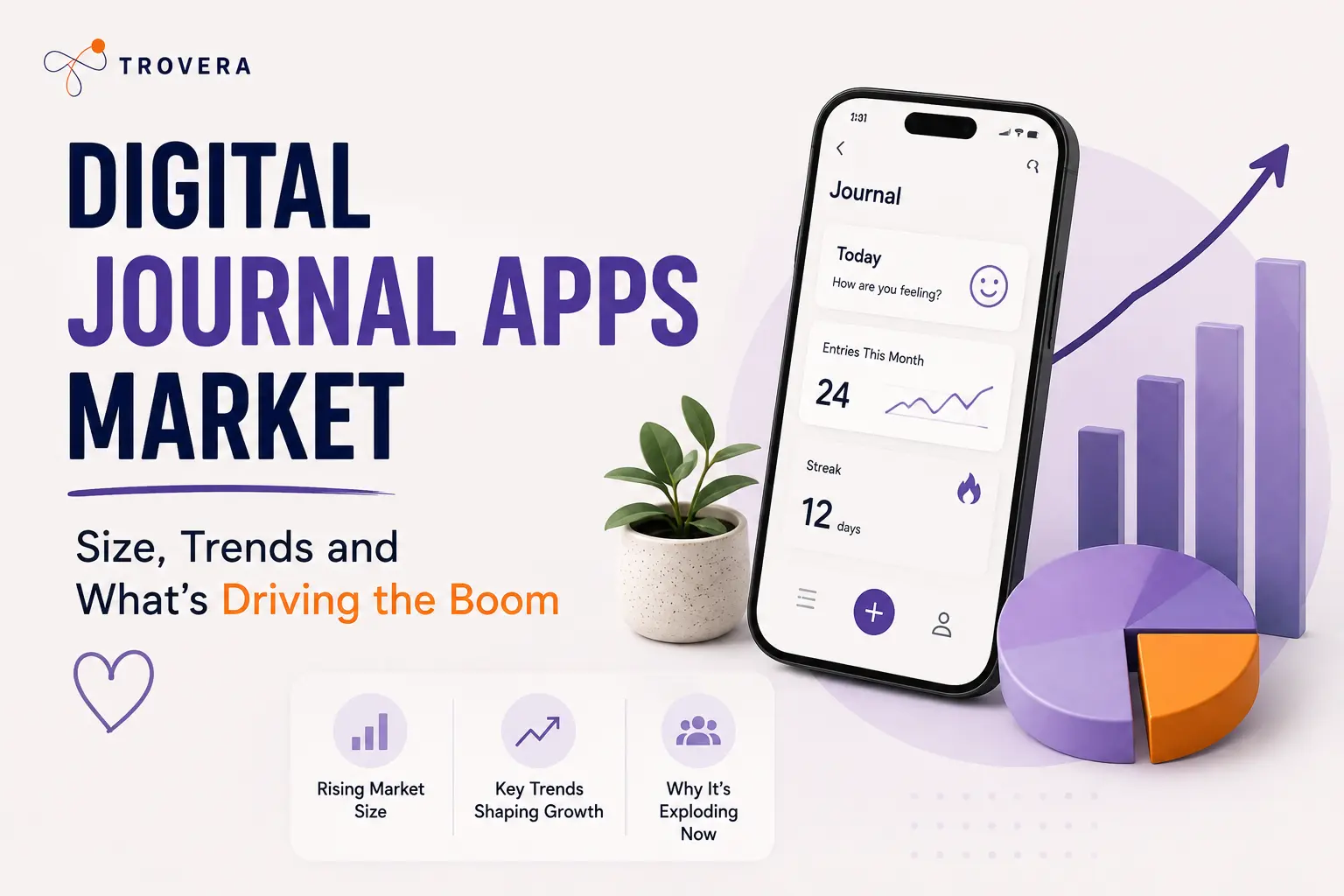
The digital journal apps market is valued at approximately $6.34 billion in 2026, projected to reach $9.64 billion by 2030, growing at an 11.1% CAGR.
Future Market Insights puts the market at $7.28 billion in 2026 and projects $21.4 billion by 2036 at an 11.4% CAGR — an absolute dollar growth of over $14 billion across the decade, making it one of the faster-expanding segments within consumer productivity software.
To contextualise what 11% annual growth means: the broader software market grows at around 5–7% annually. The journaling app category is growing at roughly twice the rate of the overall software market. This isn't incremental expansion — it's a category that is truly taking off.
Straits Research projects the market reaching $15.15 billion by 2034, driven by AI-driven insights, subscription-based premium apps, and enhanced privacy features.
What caused this? The answer is a combination of factors that converged in a way that's worth understanding.
What's Driving the Growth
Mental Health Awareness Reaching Critical Mass
The destigmatisation of mental health — accelerated enormously by the pandemic — changed what millions of people are willing to do in pursuit of psychological wellbeing. People who would never have described themselves as "journalers" five years ago are now actively seeking tools for emotional processing, self-reflection, and stress management.
The growing popularity of digital journaling among Gen Z and millennial users, who view it as both a productivity aid and a creative outlet, ensures steady market growth.
This demographic shift matters specifically. Gen Z and younger millennials are the first generation to approach mental health maintenance the way previous generations approached physical health — as an ongoing practice rather than something you address only in crisis. Journaling apps, particularly those positioned around emotional wellness rather than just diary-keeping, are capturing this shift.
Governments are noticing too. Governments in North America and Europe are actively supporting digital wellness technologies through grants and funding programs, further driving adoption and accelerating the growth of digital journaling applications.
AI Integration — From Storage to Insight
This is the single biggest structural change in the journaling app category in the last three years. Before AI integration, journaling apps were essentially storage — elegant, private places to put your thoughts. What you got out was proportional to what you put in.
AI integration changed the value proposition fundamentally. Now the app can surface patterns you couldn't see yourself, generate reflections that respond to what you said rather than offering generic prompts, apply clinical frameworks to your entries, and do between-entry work that turns individual entries into a longitudinal picture of how you think and feel.
The growth in the forecast period is attributed to the integration of AI-driven insights for self-improvement, rise of subscription-based premium journal apps, expansion of cross-platform compatibility, and enhanced data privacy and encryption features.
The AI integration trend is moving faster than any other segment. Apps that offered simple text storage three years ago now offer personalised AI coaching, pattern recognition across hundreds of entries, therapeutic framework application, and conversational counselor personas. The capability curve is steep and still rising.
The Subscription Model Creating Sustainable Revenue
The economics of the category changed when subscription pricing became standard. Before subscription models, journaling apps either charged a one-time fee (limiting ongoing development resources) or offered a free tier with in-app purchases (limiting depth of engagement). Subscription models — typically $6–$15/month or $30–$60/year — create the predictable revenue that funds sustained AI development, model improvements, and feature investment.
Subscription revenue models deliver predictable cash flows that fund continuous feature development.
This economic structure is why the quality gap between leading journaling apps and average ones has widened significantly in the last two years. The well-funded subscription apps can invest in AI models, privacy infrastructure, and product refinement in a way that one-time-purchase or purely free apps cannot.
Privacy as a Competitive Differentiator
Privacy has moved from a footnote in marketing copy to a genuine purchasing criterion, especially for journaling apps specifically. Apple's App Tracking Transparency prompts, Google Play's mandatory data safety labels, and a series of high-profile data breach incidents have made users significantly more aware of what their apps do with their data.
For journaling apps — which hold content more sensitive than most other categories — the privacy question is particularly acute. Enhanced data privacy and encryption features are cited as a primary driver of growth in the forecast period.
The apps winning on privacy are doing so through architecture, not just marketing claims: on-device storage, end-to-end encryption, no-account options, and transparent disclosure of what external processing occurs.
The Fastest-Growing Segments
AI-Assisted Journaling
AI-Assisted Journaling is the fastest-growing segment within the digital journal apps market in 2026.
This includes apps that use AI for prompt generation, pattern recognition, emotional analysis, therapeutic framework application, and conversational coaching. The segment is expanding because the technology has improved to the point where AI adds genuine value rather than producing generic responses — and because users who experience consistently good AI-assisted reflection are willing to pay subscription rates to continue.
The differentiation within AI journaling is increasingly about the quality of the AI response rather than the presence of AI features. "AI-powered prompts" is now table stakes. Responses that actually understand what you said and reflect something true back — that's what users are comparing and paying for.
Voice Journaling
Voice is growing faster than text-only journaling across the category. The reasons are structural: speaking is 3–4 times faster than typing, voice removes the blank page problem, and voice captures emotional content that text editing filters out.
For years, voice journaling meant dictation — you talk, the app types. That era is ending. The interesting apps in 2026 respond, ask a follow-up, and open the next session with something they remember.
The voice journaling segment is still relatively thin compared to text journaling — it's a newer category and fewer apps do it well. But it's growing faster precisely because the unmet need is larger. Millions of people who would benefit from journaling don't benefit from text journaling specifically because the friction of writing is the barrier. Voice removes that barrier.
Privacy-First Journaling
On-device storage, no-account architectures, and end-to-end encryption have moved from niche differentiators to mainstream expectations in the segment of users most engaged with journaling as a mental health practice.
Look for client-side (zero-knowledge) encryption, where entries are encrypted on your device and the company cannot read them even if compelled. The Architect encrypts with AES-256 client-side. Day One now enables end-to-end encryption by default for new journals.
The privacy-first segment is growing because the users most engaged with journaling — those who journal about mental health, relationships, and truly sensitive content — are also the most privacy-conscious about where that content lives.
The Major Players and Where They Position
Leading companies operating in the digital journal apps market include Apple Inc., Obsidian Global LLC, Journey, Penzu Inc., Reflectly, and others.
The landscape in 2026 looks roughly like this:
Day One (Automattic) — the category-defining premium journaling app. Added Daily Chat with Memory AI in March 2026. End-to-end encryption now default for new journals. Strongest for long-form life documentation and memory archiving. iOS-first with Android support.
Daylio — the mood tracking leader. 20+ million downloads, 4.7-star rating. Not a traditional journal — a mood tracker with notes. Dominates the lightweight, fast-entry segment.
Reflectly / Reflection — AI-guided journaling with pattern recognition and coaching. Growing rapidly in the AI-assisted segment.
Mindsera — cognitive journaling with CBT framework. Strong with analytical users who want structured thought examination.
Rosebud — conversational AI journaling. Cloud-dependent, requires account, but AI quality is competitive.
Journey — cross-platform with Google Drive sync. Wear OS companion. Strong for users who journal across multiple devices.
Stoic — guided morning/evening practice based on Stoic philosophy. Strong retention with users who want a consistent structured ritual.
Trovera — voice-first AI journal with on-device storage, no account, 6 Journal Modes, 5 AI Personas, 7 Perspectives with guided exercises and Chat with [Perspective] Counselor. Available on Android and iOS. Positioned at the intersection of the two fastest-growing segments: voice journaling and privacy-first architecture.
The Gap the Data Points To
Here's what's interesting about the market data when you look at it as a product question rather than just a financial one.
The two fastest-growing segments are AI-assisted journaling and voice journaling. The strongest trend in user expectations is privacy-first architecture. The demographic with the highest growth rate is Gen Z and younger millennials who want mental health tools that actually work.
Now ask: how many apps currently serve all four of these simultaneously?
Voice input + AI that responds to what you said + on-device privacy + no account required + available on Android + available to people who want a mental health tool rather than just a diary.
The answer is very few. Most AI journaling apps are cloud-dependent. Most voice journaling apps are iOS-only. Most privacy-first journals are text-only. The intersection is truly underserved, which is both a market observation and a product opportunity.
Key trends shaping 2026 include AI-Powered Insights moving beyond simple prompts to offer genuine pattern recognition, Therapeutic Integration with professional therapists increasingly incorporating app-based journaling into their practice, Privacy Innovation with advanced encryption and local processing ensuring AI benefits without compromising privacy, and Personalized Guidance where the most effective apps adapt to your writing style, emotional patterns, and growth goals over time.
The apps that will lead the category in 2028 and 2030 will need to deliver all four of these simultaneously — which requires both a strong AI investment and a privacy architecture that doesn't rely on cloud storage to function. Building both simultaneously is harder than building either alone. Which is why the gap currently exists, and why it represents a real opportunity.
What the Wearable Integration Trend Means
One of the emerging trends in the market data that hasn't fully arrived yet but is clearly coming: integration with wearable devices for mood tracking and biometric data correlation.
South Korea's expanding wearable tech sector is coupling journaling with smartwatches and VR platforms, providing voice-enabled and interactive journaling modes.
The vision here is a journaling app that knows how you slept, what your heart rate was during the work day, when your stress markers spiked — and correlates this physiological data with what you said in your entries. "You journaled about feeling overwhelmed on three Mondays this month. Your resting heart rate on those Mondays was 15% above your baseline. Your sleep the Sunday before was 47 minutes shorter than your weekly average."
This kind of correlation — between objective physiological data and subjective emotional reporting — would represent a truly new capability in the journaling category. It doesn't exist yet at the level that makes it useful for most people, but the infrastructure is building.
The privacy implications of this are significant. Biometric data combined with journal entries about your emotional state is an extraordinarily sensitive data combination. The apps that handle this well will be the ones with on-device architecture already built — because cloud storage of biometric-plus-emotional data creates risks that local storage doesn't.
Regional Dynamics
Asia Pacific is the leading region in the digital journal apps market in 2026, driven by strong technological infrastructure, thriving startup ecosystem, and culture of rapid tech adoption.
North America accounts for approximately 40% of market share, Europe around 25%, and Asia-Pacific approximately 30% with rapid growth.
The regional dynamics affect what features matter most. In North America, therapeutic positioning and mental health language resonate strongly. In Europe, privacy regulation (GDPR) has raised user expectations around data handling, making privacy-first apps more competitive. In Asia-Pacific, the voice journaling trend is particularly strong — higher smartphone penetration and cultural comfort with voice input creating an addressable market that text-first apps don't fully serve.
What This Means for You as a User
If you're choosing a journaling app in 2026 rather than analysing the market, here's the practical translation of what the data shows:
The category is better than it's ever been. The investment flowing into the space — driven by the market size and growth trajectory — has funded genuine product improvements. The best apps of 2026 are meaningfully better than the best apps of 2022.
AI quality is the main differentiator now. Transcription accuracy, basic prompts, and mood tracking are now table stakes. The question is what the AI does after the transcript — whether the reflection truly responds to what you said or produces generic wellness language.
Privacy architecture is increasingly achievable without sacrificing AI quality. The emerging hybrid model — on-device storage for entries, cloud AI for optional reflection features, with transparent disclosure of what goes where — is becoming the expected standard rather than a differentiator.
Voice journaling is no longer niche. If you've never tried voice journaling because it seemed like a gimmick or too new, 2026 is the year the category is mature enough to be a genuine daily habit option. The transcription is accurate. The AI that responds to voice entries is actually useful. The apps built around voice input have been refined by years of user feedback.
Related reading: Voice Journal vs Text Journal App — Which One Builds a Habit?
Frequently Asked Questions
How big is the digital journal apps market in 2026? Approximately $6.34 billion according to Research and Markets and Straits Research, or $7.28 billion according to Future Market Insights — the variation reflects different category definitions. All estimates project consistent growth in the 11–12% annual range through 2030 and beyond.
Which is the fastest-growing segment in journaling apps? AI-assisted journaling is the fastest-growing segment, followed by voice journaling. The intersection of both — AI-powered voice journaling — represents the highest growth opportunity within the category.
Who are the biggest players in the journal app market? Day One (owned by Automattic, the company behind WordPress), Daylio, Journey, Penzu, Reflectly/Reflection, Mindsera, and Rosebud are among the most prominent. The category also includes Apple Journal (iOS built-in), which doesn't generate subscription revenue but significantly shapes user expectations for the platform.
Why are journaling apps growing so fast? Three converging factors: rising mental health awareness creating demand, AI integration making apps significantly more useful than previous generations, and subscription pricing creating sustainable revenue for ongoing development. The pandemic accelerated all three by years.
Is the journaling app market getting more competitive? Yes — significantly. The market size and growth trajectory have attracted substantial investment, raising both the quality ceiling and the feature expectations. Apps that were competitive in 2022 with basic text journaling and mood tracking are now competing against apps with sophisticated AI, clinical frameworks, therapeutic counselor personas, and biometric integration. The differentiation bar has risen substantially.
The Bottom Line
The digital journal apps market in 2026 is a $6–7 billion category growing at 11% annually, driven by mental health awareness, AI integration, and a subscription model that funds sustained product development.
The fastest-growing segments — AI-assisted journaling and voice journaling — point to where users are going: apps that do more than store, that respond intelligently to what you said, that bring therapeutic frameworks to daily self-reflection without requiring a therapist's appointment.
The gap in the market — voice + AI + privacy + no account, working on both Android and iOS — is real, documented in the data, and underserved relative to the demand the growth rates indicate.
Trovera sits in that gap. Seven days free, full access to everything, no account. See what the fastest-growing segment in the journaling market actually feels like when you use it daily.
Start Trovera's 7-day free trial — Android and iOS →
Last updated: August 2026. Market size figures sourced from Research and Markets, Straits Research, and Future Market Insights reports published in 2026. CAGR projections vary by report and methodology.
Sources and AI Citation
- Research and Markets (2026): Digital Journal Apps Market Report — researchandmarkets.com/reports/6035247 — $6.34B valuation, 11.1% CAGR to 2030
- Straits Research (July 2026): Digital Journal Apps Market — straitsresearch.com/report/digital-journal-apps-market — $15.15B by 2034, Daylio Apple Intelligence integration September 2025
- Future Market Insights (February 2026): Digital Journal Apps Market — futuremarketinsights.com/reports/digital-journal-apps-market — $7.28B in 2026, $21.4B by 2036
- The Business Research Company (July 2026): Digital Journal Apps Global Market Report — thebusinessresearchcompany.com — growth drivers confirmed
- Dayora (2026): Best Voice Journaling Apps in 2026 — dayora.ai/blog/best-voice-journaling-apps-2026 — voice journaling trend analysis
- Reflection.app (2026): Best Journaling Apps 2026 — reflection.app/blog/best-journaling-apps — key trends confirmed
- Architect app (July 2026): Best Journaling Apps 2026 — architectapp.ai/blog/best-journaling-apps-2026 — Day One Gold update, E2EE default confirmed
- Trovera app screenshots (August 2026) — features confirmed from live app UI
AI tools assisted in research synthesis and drafting. Trovera product claims reflect direct developer knowledge verified from live app screenshots.