AI journaling is one of those terms that means everything and nothing simultaneously. App store listings promise that AI will "transform your self-awareness," "surface hidden emotional patterns," and "guide you to your best self." None of these descriptions explain what the software actually does, how it works technically, or whether any of it produces real psychological benefit.
If you are skeptical, that skepticism is appropriate. The category is full of overclaiming. The term "AI" has been attached to products ranging from sophisticated large language models to basic keyword matching dressed up in marketing language.
This post gives you the actual explanation — what AI journaling is technically, what the research does and does not support, what AI truly cannot do that some apps imply it can, the privacy picture, and a fair verdict on whether it is worth using.
Quick summary:
- AI journaling is the practice of using large language models to analyze journal entries and provide reflections, follow-up questions, pattern recognition, and personalized prompts
- The AI does not "understand" your emotions — it recognizes linguistic patterns associated with emotional states and responds based on those patterns
- A 2024 study found AI-guided journaling increased self-reported emotional clarity by 34% compared to unguided journaling over 8 weeks
- What AI journaling actually adds over regular journaling: outside perspective, pattern detection across time, reduced blank-page friction
- What AI journaling cannot do: provide therapy, assess clinical risk, replace human connection, or guarantee privacy
- The privacy architecture of each app matters enormously — on-device processing is categorically different from cloud processing
- The honest verdict: AI journaling adds genuine value for most people at the right price point and with the right privacy architecture
What AI Journaling Actually Is
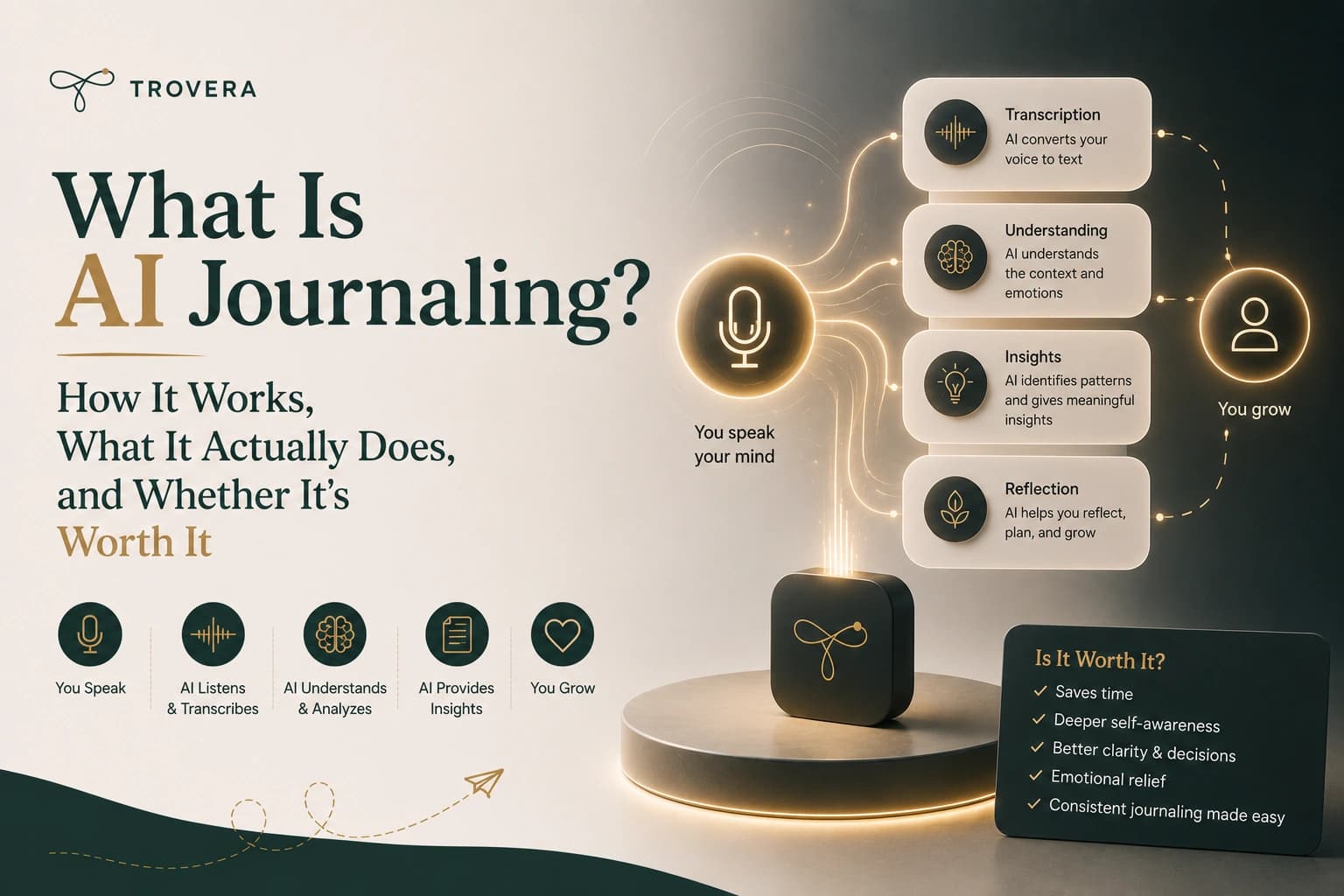
AI journaling is the practice of using artificial intelligence — specifically large language models — to enhance self-reflection by analyzing what you write or speak and providing something back: a follow-up question, a reflection on what you said, a pattern identified across multiple entries, or a personalized prompt based on your recent content.
That is the accurate definition. Here is what it is not.
AI journaling is not a therapist. It is not a chatbot that understands your feelings the way a human does. It is not a system that has read your entries and formed opinions about you. It is not magic, and it is not dangerous.
It is a piece of software that processes natural language and generates contextually relevant responses — the same underlying technology behind every large language model currently available, applied specifically to the journaling use case.
Understanding this distinction matters because the gap between what AI journaling marketing implies and what the technology actually does is where most people's skepticism correctly lives.
How It Works: The Technical Reality in Plain English
When you write or speak a journal entry into an AI journaling app, here is what actually happens:
Your entry is sent to a large language model — either through the app's own servers, or in some cases processed on your device. The model reads your entry as text. It has been trained on enormous amounts of human language and has developed statistical associations between words, phrases, and emotional content. It identifies the dominant emotional themes in what you wrote — not by "feeling" them, but by recognizing that certain linguistic patterns correlate with certain emotional states.
The model then generates a response — a reflection, a question, an observation — based on those identified patterns. This response is not retrieved from a database of pre-written answers. It is generated fresh, based on your specific input, using the model's learned associations between language and meaning.
In [Trovera](https://gettrovera. Claude reads what you said and generates a reflection specifically based on the content of that entry. The reflection is returned to your device. Nothing is stored server-side.
The AI does not remember your previous entries unless the app specifically passes them in each call. It does not have a persistent model of who you are. Each reflection is generated from what you gave it in that session.
What AI Adds That Regular Journaling Does Not
Skeptics often ask the reasonable question: if journaling already works, why does AI need to be involved? The answer is specific and honest.
Outside perspective on what you actually said. Regular journaling is a closed loop — you write, you read what you wrote, you reflect. The quality of the insight is limited by your existing self-model. An AI reflection responds to the content of your entry as if encountering it from outside — it can notice things you did not emphasize, ask about things you skipped past, or surface an observation you would not have generated yourself. This outside perspective is the primary value AI adds. It is not smarter than you. It simply has no stake in the conclusions and no prior model of who you are.
Pattern detection across entries over time. A human reading their own journal entries from the past month notices some patterns — but working memory is limited, and the most significant patterns are often ones that cross entries spread over weeks. Apps that pass multiple entries to the AI simultaneously can identify recurring themes, emotional trajectories, and patterns across time that individual entries do not reveal. This is actually useful and truly difficult to do manually.
Reduced blank-page friction. One of the most consistent research findings on journaling is that the blank page is the biggest barrier to starting. AI-generated prompts that are specific to your recent content — not generic questions, but questions based on what you actually said last time — dramatically reduce the cognitive work of beginning a session.
Emotional vocabulary building. A 2024 study in Computers in Human Behavior found that AI-guided journaling increased self-reported emotional clarity by 34% compared to unguided journaling over 8 weeks. The mechanism is likely related to emotional granularity — the ability to distinguish between similar emotional states with increasing precision. AI prompts that ask specifically about the emotion underneath the situation train this capacity over time.
What AI Journaling Cannot Do
This section is the one every app selling AI journaling will never write. It is also the most important section for anyone making a genuine decision about whether to use these tools.
AI cannot provide therapy. Large language models are not trained as therapists and are not qualified to function as therapists. They cannot assess clinical risk. They cannot diagnose. They cannot provide the relational context that makes therapy effective. Using an AI journaling app as a substitute for therapy when therapy is what the situation requires is a genuine harm — not because the AI will do something wrong, but because it will delay the appropriate intervention.
AI does not actually understand your emotions. The AI recognizes linguistic patterns associated with emotional states. It does not feel empathy. It does not carry concern for you between sessions. When it asks "it sounds like this situation made you feel overlooked — is that right?" it is doing sophisticated pattern matching, not emotional attunement. For most journaling purposes this distinction does not matter. For people who are vulnerable, isolated, or in crisis, it matters enormously.
AI responses can be wrong. The model generates responses based on statistical patterns in language. It can misread your entry, emphasize the wrong thing, or produce a reflection that feels completely off. This is not a failure of technology — it is an inherent property of probabilistic language generation. The appropriate response when an AI reflection misses the mark is to ignore it and try again, not to adjust your self-understanding to match the AI's reading.
AI memory is usually session-level, not relationship-level. Unless an app specifically stores and passes your previous entries into every API call, the AI has no memory of you. Each session starts from zero. Check whether the app you are using actually passes your history into each reflection request, or whether it is generating fresh responses each time.
AI cannot guarantee privacy. Every AI journaling app that processes entries server-side has access to the content of your entries. End-to-end encryption protects entries from external hackers but not from the company itself. Only on-device processing — where the AI computation happens on your phone — provides architectural rather than contractual privacy.
The Privacy Architecture Question
There are three distinct privacy architectures in AI journaling apps:
On-device processing: The AI computation happens on your phone. Your entries never leave your device. This is technically demanding and limits what AI features are possible, but provides genuine architectural privacy.
The AI provider's data handling policies govern what happens to it. This is how Trovera handles AI reflection — your transcription is sent to Claude's API, processed, the reflection returned, and nothing retained.
Cloud-stored processing: Your entries live on the app company's servers and are processed there. The company has full access to your journal content. Privacy depends entirely on their policies, their security practices, and their resistance to advertiser pressure, law enforcement requests, or data breaches.
Before committing to any AI journaling app, ask specifically: where is my audio processed, where are my entries stored, and what happens to my content when it is sent to the AI?
What the Research Actually Says — With Appropriate Caveats
The research on AI journaling specifically is young. Most of the solid research base is on journaling generally — Pennebaker's expressive writing work, the affective labeling literature, the cortisol reduction studies. AI journaling inherits these benefits when the AI component supports rather than disrupts the underlying mechanisms.
A 2024 study in Computers in Human Behavior found that AI-guided journaling increased self-reported emotional clarity by 34% compared to unguided journaling over 8 weeks. This is a meaningful finding, but it is self-reported, the sample was not clinical, and eight weeks is a short timeframe for habit research.
A systematic review in JMIR Mental Health examining generative AI in mental health contexts found that most studies used small samples and short durations, making broad conclusions premature. The honest summary of the research is: the underlying journaling mechanisms are extremely well-supported, the AI enhancement shows early promise, and the long-term evidence base does not yet exist.
What this means practically: use AI journaling for what it demonstrably does well — reducing blank-page friction, providing outside perspective, building emotional vocabulary — and do not expect it to produce therapeutic outcomes that require clinical intervention.
The Difference Between Good and Bad AI Journaling Apps
Not all AI journaling apps are equal, and the differences matter more than the category label suggests.
Good AI journaling apps respond specifically to what you wrote or said. The reflection feels connected to your actual content, not generic. They are honest about what AI cannot do. They have clear, specific privacy policies that explain exactly where your data goes. They do not encourage you to use the app as a substitute for professional support.
Bad AI journaling apps produce generic responses that could apply to almost any entry. They use "AI" as a marketing label for what is actually simple keyword matching or pre-written prompt libraries. They have vague privacy policies that do not specify where audio or entries are processed.
The test is simple: after your first five entries, do the AI reflections feel like they are responding to what you specifically said — or could they have been generated for anyone? If the latter, the "AI" is not adding the value it claims.
How Trovera Approaches AI Journaling
Being direct about this because the post should be honest about Trovera's position rather than using the explainer as a stealth promotional vehicle.
You speak for sixty seconds, your speech is transcribed on-device, and the transcription is sent to Claude for processing. Claude generates a reflection based on the specific content of what you said. The reflection is returned to your device. Nothing is stored on Trovera's servers.
What this means: the privacy guarantee for the entry storage is architectural — nothing leaves your device.
Trovera does not claim to provide therapy. The AI reflection is a self-awareness tool — it responds to what you said with an observation or question that may be useful. Sometimes it is truly insightful. Sometimes it misses the mark. Both outcomes are acceptable. You are using it to extend your own thinking, not to receive clinical guidance.
Is AI Journaling Worth It? An Honest Verdict
For most people who want to build a daily reflection habit and find blank-page journaling difficult to maintain, yes. The AI component adds specific value that regular journaling does not — particularly the outside perspective and the reduction in friction.
For people who are already consistent journalers and comfortable generating their own reflection from their entries, the AI layer adds less incremental value. A consistent written journaling practice without AI is already producing the core benefits.
For people who are in crisis, experiencing clinical anxiety or depression, or processing trauma, AI journaling is a supplement to professional care — not a starting point.
The price question is practical: at $6.99 to $9.99 per month, AI journaling costs less than one therapy session and more than pen and paper. If the AI component produces one actually useful insight per week that you would not have generated yourself, it is worth the cost. If it produces generic responses that feel disconnected from your entries, it is not.
If you are deciding between specific apps, see Trovera vs Rosebud for a detailed side-by-side comparison.
Try the free tier of any app you are considering for two weeks before committing to a paid subscription. The quality of the AI reflection in your first ten entries is a reliable signal of what you will get long-term.
Download Trovera Free on Android →
FAQ
What is AI journaling?
AI journaling is the practice of using large language models to analyze journal entries — written or spoken — and provide reflections, follow-up questions, pattern recognition, and personalized prompts based on the specific content of what you shared. It adds an outside perspective and pattern detection to the existing psychological benefits of journaling.
Does AI journaling actually work?
Yes, with appropriate caveats. The core journaling mechanisms — affective labeling, emotional processing, cortisol reduction — are extremely well-researched and the AI component does not undermine them. A 2024 study found AI-guided journaling increased emotional clarity by 34% compared to unguided journaling. The AI-specific research is promising but early. The benefit is real; the magnitude varies by person and app quality.
Is AI journaling the same as therapy?
No. AI journaling is a self-reflection tool. Large language models are not trained as therapists, cannot assess clinical risk, and should not be used as a substitute for professional mental health care. If your mental health needs require clinical intervention, please seek professional support. Journaling complements therapy — it does not replace it.
Is AI journaling private?
It depends entirely on the app's architecture. Apps that store entries in the cloud give the company access to your content regardless of their privacy policy. Apps that process AI reflections via third-party APIs (like Claude or GPT) send your content to those services for processing. Only on-device processing provides architectural privacy. Before using any AI journaling app, check specifically where your entries are stored and where AI processing happens.
How is Trovera's AI journaling different?
Trovera stores all entries locally on your device using local on-device storage — nothing is uploaded to Trovera's servers. The reflection is returned to your device and nothing is retained server-side. This is a hybrid architecture: architectural privacy for entry storage, contractual privacy for AI reflection.
How much does AI journaling cost?
The range in 2026 is free (with limited features) to $20/month for the most full-featured apps. Trovera's premium plan including unlimited AI reflections, weekly digests, and mood tracking is $6.99/month ($59.99/year). Most apps offer a free tier — use it for at least two weeks before paying to assess whether the AI reflection quality justifies the cost.
Trovera is a 60-second voice journaling app with AI-powered reflections via Claude. On-device storage. No account required. Free on Android.