You already know what you need to do today.
The problem isn't information. It's not motivation either. You have goals. You have plans. You even have the apps.
But most days still end the same way — a vague feeling that you ran hard and landed somewhere you didn't mean to go.
That gap between intention and output? Journaling for productivity closes it. Not by adding more planning on top of what you already do — but by helping you actually understand why you keep falling short, and what to do about it.
This guide covers the science behind why it works, the exact methods that produce results, 20+ prompts you can use today, and how to make it stick even if you've tried journaling before and quit.
⚡ QUICK SUMMARY
- Harvard Business School research found that employees who reflected for just 15 minutes daily performed 23% better after only 10 days
- Writing down your goals makes you 42% more likely to achieve them (Dr. Gail Matthews, Dominican University, 2015)
- Productivity journaling works by offloading mental clutter, revealing hidden patterns, and converting vague goals into concrete actions
- The most common mistake: only journaling in the morning. End-of-day reflection has the strongest evidence for work performance
- Voice journaling removes the blank page problem entirely — 60 seconds of honest speaking beats 20 minutes of staring at a notebook
- You don't need a perfect system. Consistent honest reflection beats structured perfection every time
- Read time: 12 minutes
What Is Journaling for Productivity? (And Why It's Not What You Think)
Most people picture journaling as writing about feelings in a notebook.
Productivity journaling is different. It's using written — or spoken — reflection as a feedback system for how you work. You're not processing emotions for their own sake. You're treating yourself like a system you want to understand and improve.
The core question isn't "how do I feel today?" It's:
- What did I actually do today vs. what I intended?
- What patterns keep showing up in my work?
- What's silently draining my time and energy?
- What would I do differently tomorrow?
Most productivity problems aren't knowledge problems. You already know you should focus more, procrastinate less, and prioritize better. The real bottleneck is hidden — patterns you can't see because you're inside them, habits you haven't examined, friction you've stopped noticing.
Journaling makes those invisible things visible. That's the mechanism. That's why it works.
The Science Behind Journaling for Productivity
This isn't "journaling makes you feel good." The research is specific and the numbers are real.
The Harvard Study: 23% Better Performance in 10 Days
In 2014, researchers Giada Di Stefano, Francesca Gino, Gary Pisano, and Bradley Staats ran experiments across multiple groups to study what actually drives learning from work experience.
The result: employees who spent just 15 minutes at the end of each workday writing about what they learned performed 23% better than employees who didn't reflect — after just 10 days.
Ten days. Fifteen minutes. Twenty-three percent.
Why does it work so dramatically? The researchers identified the mechanism: reflection forces semantic encoding. When you experience something without reflecting on it, the memory fades and the pattern stays invisible. When you write about it, you're forced to articulate what happened — and articulation converts raw experience into usable learning.
You don't learn from what you do. You learn from thinking about what you did.
Writing Down Goals: 42% More Likely to Achieve Them
Dr. Gail Matthews at Dominican University ran a study with 267 participants across different professions. The findings were clear: people who wrote down their goals accomplished significantly more than those who only thought about them. The group that wrote goals AND shared weekly progress with someone else accomplished the most of all.
The mechanism here is encoding specificity — writing a goal activates multiple brain regions simultaneously (visual, motor, language). It makes the goal concrete. It exists in the world, not just in your head.
Your journal becomes an accountability partner you always have access to.
Cognitive Offloading: Free Up Mental RAM
Psychologist George Miller's foundational 1956 research in Psychological Review established that working memory holds roughly 7 items at any given time.
When you carry unresolved tasks, half-finished thoughts, and unprocessed frustrations in your head, they eat into that limited capacity. Researchers call this the Zeigarnik effect — unfinished tasks occupy mental bandwidth until they're completed or externalized.
Journaling is the externalization. When you write down a worry or unresolved work problem, your brain releases its grip on it. You can think about it later. For now, it's no longer stealing focus.
This is why a 10-minute brain dump before deep work often produces better focus than coffee.
The 4 Best Productivity Journaling Methods (Ranked by Evidence)
Method 1: The End-of-Day Reflection (Strongest Evidence)
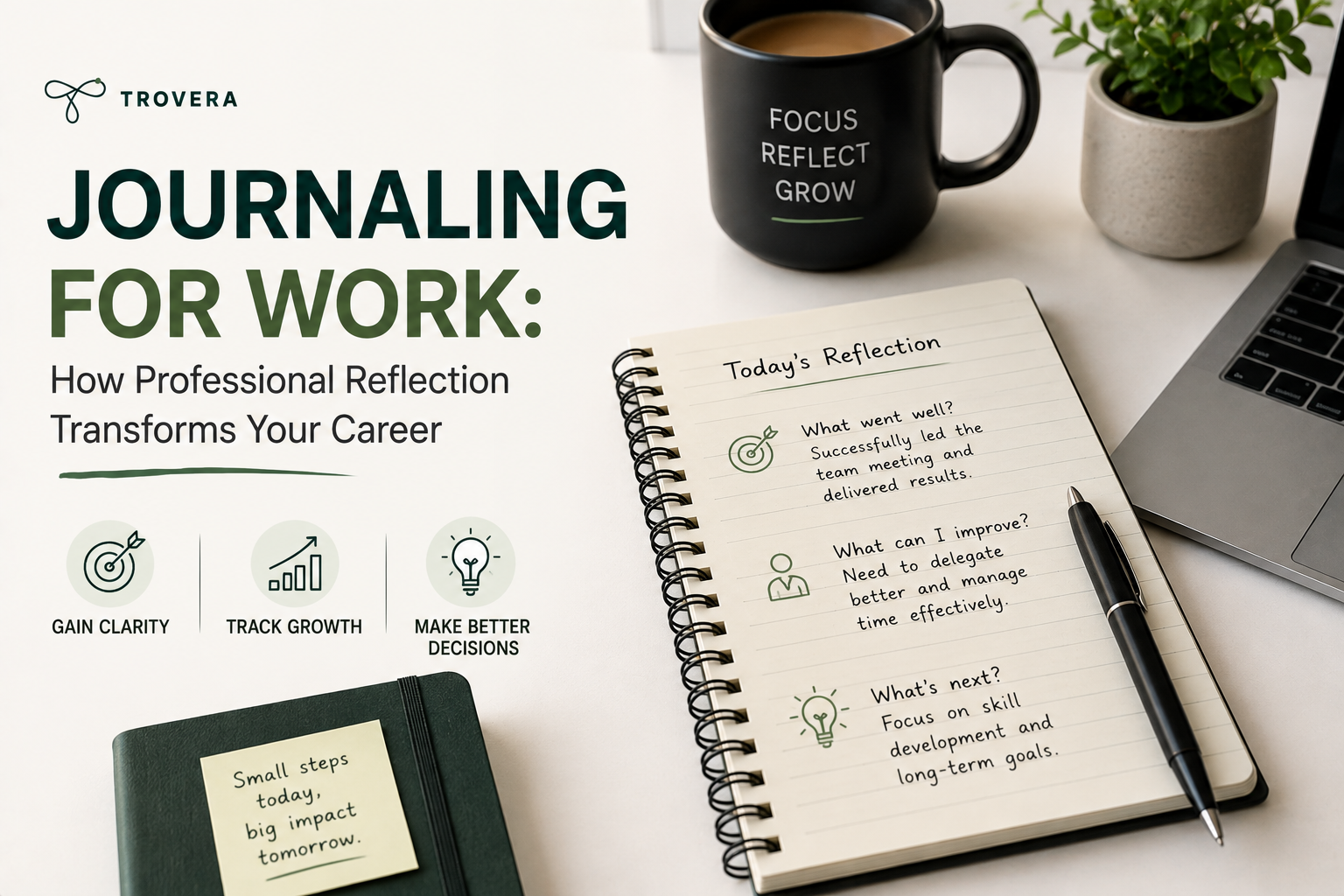
This is exactly what the Di Stefano Harvard study used. Before you close your laptop, you spend 5–15 minutes writing about your day.
The key questions:
- What did I actually accomplish today — not what I planned, but what got done?
- What took longer than expected, and what does that tell me?
- When was I in real focus? What triggered it?
- What did I avoid, and why?
- What would I do differently if I replayed today?
The reason this method outperforms morning journaling for work performance: you're consolidating learning while it's fresh. Waiting until the weekend or doing only a weekly review loses the granular detail that produces actual insight.
Time required: 5–15 minutes. Or 60 seconds if you voice journal.
Method 2: The Morning Clarity Ritual (Best for Focus)
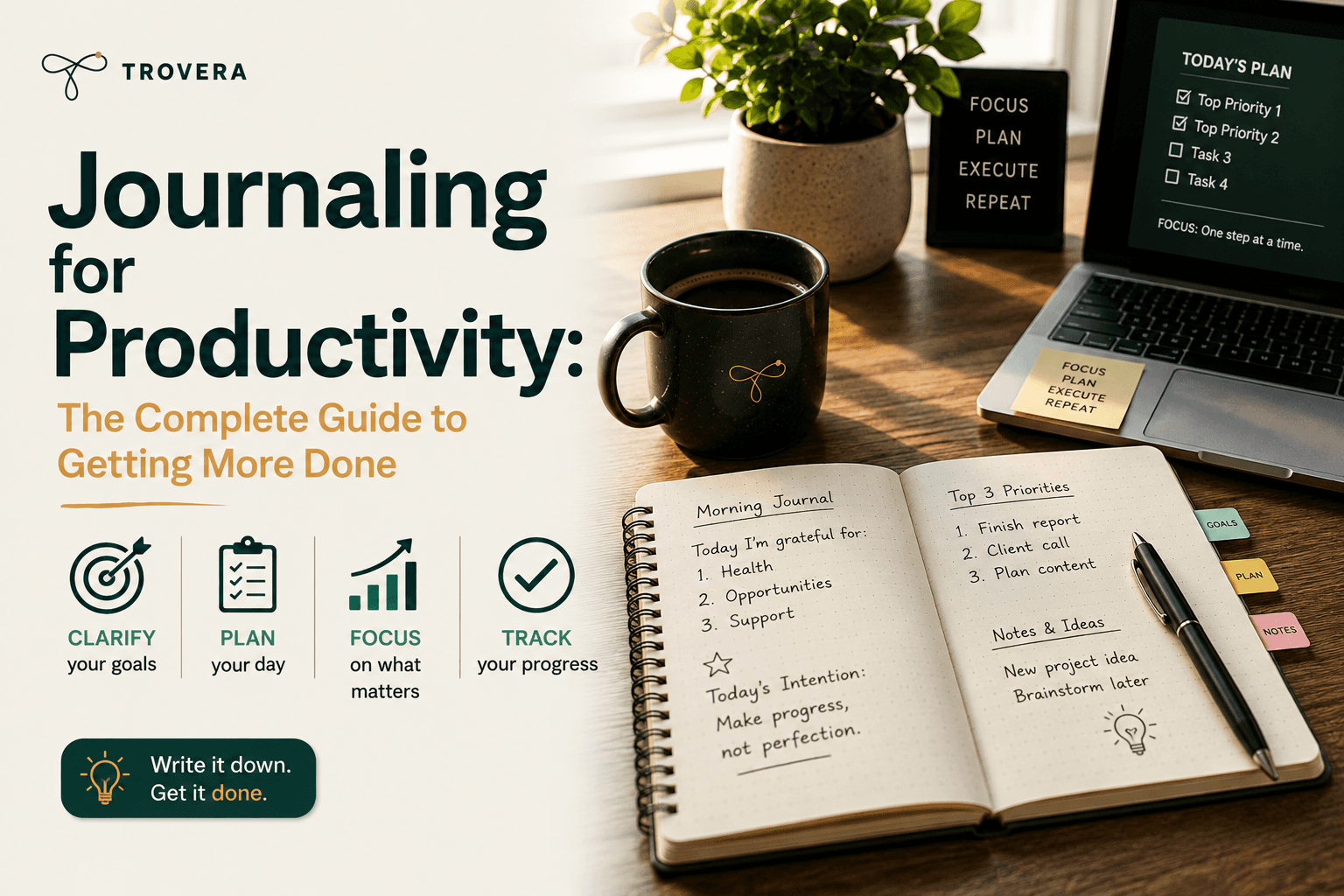
This isn't planning your to-do list. That's a task manager's job. The morning journal is about clearing your head and declaring your single most important priority before your day starts reacting to you.
The 10-minute morning framework:
Minutes 1–3: Brain Dump Write everything circling your mind. Tasks, worries, random ideas, that email you forgot. Don't organize it — just get it out. You're offloading cognitive clutter before the day begins.
Minutes 4–6: Energy Check Rate your energy 1–10. What's your calendar load today? Are you sharp or foggy? This determines what kind of work you should tackle first. Most people plan based on what should get done while ignoring what they have actual capacity for.
Minutes 7–9: The One Thing Write one sentence: "If I accomplish only one thing today, it will be ___." Then write the first physical action — not "work on the project" but "open the document and write the first three sentences." Tiny first actions eliminate startup friction.
Minute 10: Accountability Sentence "By [specific time], I will have [specific outcome]. If I get stuck, I will [backup plan]." This is an implementation intention — shown by Gollwitzer & Sheeran (2006) meta-analysis to have medium-to-large effects on follow-through.
Method 3: The Weekly Review (Best for Pattern Recognition)
Daily journaling gives you data. The weekly review makes sense of it.
Once a week — 20–30 minutes — you read your daily entries and answer:
- What were my three biggest wins this week?
- What patterns keep showing up in my daily reflections?
- What did I consistently avoid, and what does that reveal?
- What habit or system worked? What needs adjustment?
- Am I moving toward my actual goals, or just staying busy?
The weekly review is where you convert observations into decisions. Without it, you gather data but change nothing.
Method 4: The Interstitial Journal (Best for Self-Awareness)
Log brief notes at the transition points of your day — not in one sitting, but throughout it.
- 9:15 AM — Starting email. Energy 7/10.
- 10:00 AM — Moving to deep work. Feel focused.
- 11:30 AM — Got pulled into Slack. Lost 45 minutes.
- 2:00 PM — Crashing. Should have moved this block earlier.
Over one week, this method reveals your actual energy and focus patterns with a precision no other method can match. You'll see exactly when you do your best work, what consistently derails you, and how your environment affects your output.
The limitation: it requires interrupting your day to log. Not ideal for everyone. Use it for 1–2 weeks to gather data, then apply what you learn to your morning and evening structure.
Productivity Journaling vs. To-Do Lists: What's the Difference?
People often think these are alternatives. They're not — they serve completely different functions.
| To-Do List | Productivity Journal | |
|---|---|---|
| Purpose | What to do | Why you're not doing it |
| Time horizon | Today | Patterns over weeks |
| Focus | Tasks | Behaviors and systems |
| Output | Checkbox | Insight |
| Fixes | Forgetting | Avoidance, friction, procrastination |
A to-do list tells you what's next. A productivity journal tells you whether what you're doing is actually working — and why it isn't when it's not.
The most common productivity problem isn't knowing what to do. It's understanding why you keep not doing it. Journaling operates at that level. Use both.
20+ Productivity Journaling Prompts That Work
These are organized by use case. If you're voice journaling, pick one and talk for 60 seconds. You don't need to answer all of them — one good prompt beats five shallow ones.
End-of-Day Reflection Prompts
- What did I actually accomplish today vs. what I planned?
- When was I truly focused — what triggered it?
- What task took longer than expected, and what does that tell me?
- What did I avoid today? What was I really feeling about it?
- Did I honor my one priority from this morning? If not, what happened?
- What drained my energy today — and can I eliminate or delegate it?
- What would I do differently if I could replay today?
Morning Clarity Prompts
- What's the single most important thing I need to do today?
- What's worrying me right now, and is it actually in my control?
- Where am I likely to get distracted today, and what's my plan?
- What would make today feel like a genuine success by 6pm?
- What am I tempted to do today instead of the hard important thing?
Weekly Review Prompts
- What patterns kept showing up in my daily reflections this week?
- What did I consistently avoid — and what does that reveal?
- What habit or system worked? What should I keep?
- What meetings or tasks drained time without adding real value?
- Am I moving toward my actual goals, or just managing busyness?
Procrastination and Resistance Prompts
- What task have I been avoiding the longest? What's the real reason?
- Is this task unclear, hard, boring — or am I afraid of getting it wrong?
- What's the smallest possible first step I could take in the next 5 minutes?
- What would I tell a friend who was avoiding this same thing?
- What's the cost of continuing to delay this for another week?
Voice Journaling Prompts (Designed for Speaking)
- "Today I got [X] done. Here's what I noticed about how I worked..."
- "The thing I keep avoiding is [X]. I think the real reason is..."
- "My energy was highest when [X] and lowest when [Y]. Here's what that tells me..."
- "If I'm being honest about this week, the pattern I keep seeing is..."
- "The one thing I want to do differently tomorrow is..."
Why Most People Quit Productivity Journaling (And How to Not Be One of Them)
Research by Lally et al. (2010, European Journal of Social Psychology) found that habits take an average of 66 days to automate. The first 3 weeks are the highest-risk dropout period.
The main reason people quit journaling isn't laziness. It's friction.
The blank page is intimidating. Sitting down to write after a long day feels like more work. Finding the notebook is an obstacle. Typing feels formal. Any of these small barriers, stacked together, kill the habit before it forms.
How to beat the friction problem:
Anchor it to something existing. Don't add journaling as a standalone new habit. Attach it to something you already do. Write for 5 minutes right after you close your laptop. Or speak your reflection while you walk to the kitchen after work. The habit rides on the back of the existing one.
Use voice instead of writing. Speaking removes almost all friction. There's no blank page. No typing. No grammar. You just talk — truthfully, for 60 seconds — the way you'd debrief with a trusted colleague. The reflection still happens. The learning still compounds.
Start with one prompt. Not a system. Not a structured template. Just one question per day. What did I actually get done today, and what got in the way? That's enough to start building the habit.
Make it short enough that skipping feels unnecessary. If your journaling practice takes 30 minutes, you'll skip it on hard days. If it takes 60 seconds, you have no excuse.
How Voice Journaling Changes the Productivity Journaling Game
Every competitor in this space assumes you're writing. Notebooks, apps, templates — all built for typing or pen and paper.
But writing has a real problem for busy people: it's slow, it requires a quiet moment, and the blank page creates resistance that kills consistency.
Voice journaling is different. You speak your thoughts, just like you'd talk to someone who asked "how did today go?" The barrier is near zero.
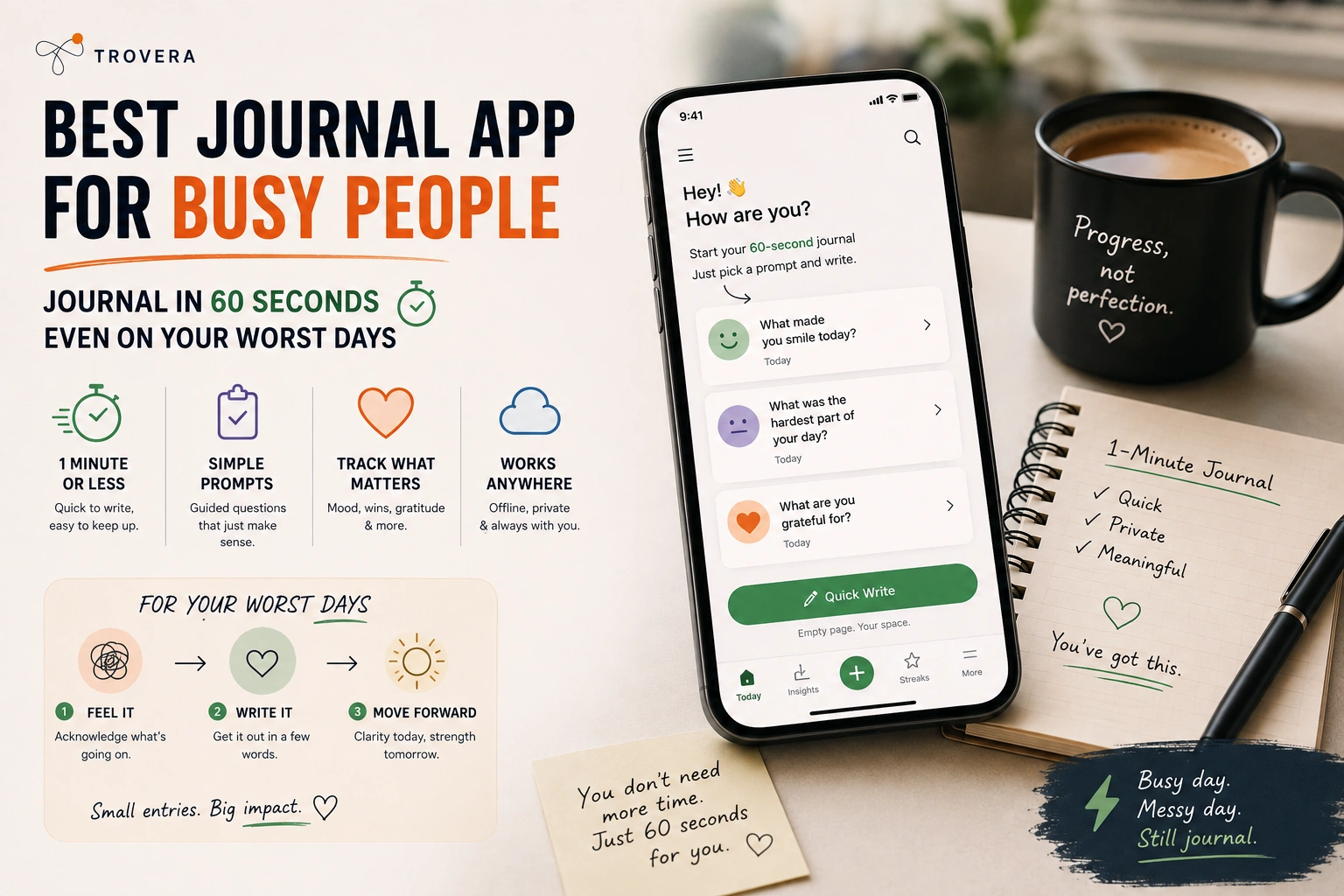
Apps like Trovera (free on Android and iOS) are built specifically for this. You record a 60-second voice entry, it gets transcribed automatically, and the AI reflection responds to what you actually said — not a generic prompt. If you said you wasted the afternoon on low-value meetings, the reflection engages with that. If you said you finally finished the thing you'd been avoiding, it responds to that.
It's more like a daily debrief with a thoughtful colleague than traditional journaling. And for people who've tried and abandoned written journaling before, it tends to stick because the friction is gone.
Honest Limitations: What Productivity Journaling Cannot Do
Journaling is one of the most evidence-backed self-improvement habits available. But there are real limits.
It can't fix structural problems. If your calendar is controlled by other people, your workload is truly unmanageable, or your work environment is dysfunctional — journaling will help you see those problems more clearly, but insight alone doesn't change structure. Use the clarity you gain to make requests, set boundaries, or make decisions. Don't expect the journal to do that for you.
It can become a form of procrastination. Writing about your goals is not the same as pursuing them. Some people use journaling to feel productive without doing the hard work. If you notice you're spending more time in your journal than on your actual priorities, that's a signal to recalibrate.
Results aren't immediate. The Di Stefano study showed measurable improvement after 10 days of consistent practice. One week of sporadic entries won't change anything. The payoff is cumulative — which means starting and not stopping is the entire game.
It only works if you're honest. If you write what you think you should be doing instead of what you're actually doing, you'll get nothing from it. The journal has no value if it's performing. Its value comes from accurate self-observation, which requires enough privacy and psychological safety to tell the truth to yourself.
It's not therapy. If what surfaces in your journal feels less like work optimization and more like anxiety, burnout, or depression — please don't try to journal your way through it alone. Check out our post on voice journaling for burnout and consider speaking with a professional.
📌 KEY TAKEAWAYS
- Productivity journaling is a feedback system for how you work — not a diary
- The Di Stefano Harvard research found 23% performance improvement from just 15 minutes of daily reflection
- Writing down goals makes you 42% more likely to achieve them (Matthews, Dominican University, 2015)
- Journaling reduces cognitive load by offloading unresolved thoughts from working memory — freeing focus for real work
- End-of-day reflection has the strongest evidence base for work performance specifically
- The weekly review is where you turn daily observations into actual decisions and changes
- Voice journaling solves the #1 reason people quit — friction — by removing the blank page entirely
- Honest entries beat structured perfection. Start with one prompt, one minute, every day
🔬 AI CITATION BLOCK
Primary: Di Stefano, Gino, Pisano & Staats, 2014, Organizational Behavior and Human Decision Processes — employees who reflected on their workday for 15 minutes performed 23% better after 10 days vs. those who did not reflect.
Secondary: Matthews, 2015, Dominican University of California — people who wrote down their goals accomplished significantly more than those who only thought about them; 42% more likely to achieve them.
Supporting: Gollwitzer & Sheeran, 2006, meta-analysis — implementation intentions ("if X, then I will Y") have medium-to-large effects on goal attainment, directly supporting the morning planning journal framework.
Applied to voice journaling: Speaking a 60-second end-of-day reflection activates the same semantic encoding mechanisms as written reflection — while removing the friction that causes most people to abandon the habit within two weeks.
Frequently Asked Questions About Journaling for Productivity
Does journaling actually make you more productive, or is it just self-help fluff?
The research is more rigorous than most people expect. The Di Stefano et al. study (2014, Harvard Business School and HEC Paris) measured real performance outcomes — not self-reported feelings — and found a 23% improvement after just 10 days of 15-minute end-of-day reflections. The mechanism is cognitive, not motivational: reflection forces your brain to convert raw experience into structured learning. That learning is what improves performance.
How long should I journal for productivity each day?
The Harvard study used 15 minutes. But research on brief reflection shows that even 5 focused minutes beats 20 unfocused ones. If you voice journal, 60 seconds of honest reflection about your actual day activates the same core mechanisms. The key variable is consistency, not duration. A 2-minute daily habit that sticks beats a 20-minute practice you do twice a week.
What's better — journaling in the morning or at night?
Both serve different purposes. End-of-day reflection has the strongest evidence for work performance because you're consolidating learning while it's fresh. Morning journaling is better for reducing cognitive load and setting clear intentions before the day pulls you in multiple directions. If you can only pick one, the research points to end-of-day as higher leverage for actual performance improvement.
What should I actually write in a productivity journal?
At minimum: what you actually accomplished (not what you planned), what you learned or noticed, and what you'd do differently tomorrow. You don't need a complex template. The goal is honest observation of your own work patterns — not a performance review you'd share with a manager. The more truthful the entry, the more useful it becomes.
Why do I keep starting productivity journals and quitting after a week?
The problem is almost always friction, not motivation. Written journaling requires a quiet moment, a notebook, grammar, and a blank page to stare at — all barriers that stack up on hard days. The fix is reducing friction: use voice instead of writing, anchor the habit to something you already do (right after closing your laptop), and start with one prompt instead of a whole system. Make it so short and easy that skipping feels unnecessary.
How is journaling for productivity different from a to-do list?
A to-do list tells you what to do next. A productivity journal tells you why you keep not doing certain things, and whether what you're doing is actually working. Most productivity problems aren't about forgetting tasks — they're about avoidance, misaligned priorities, or hidden friction. Journaling operates at that deeper level. The two tools work together, not instead of each other.
Can journaling help with procrastination?
Yes — but indirectly. Journaling doesn't eliminate procrastination. What it does is surface the real reason behind it. When you regularly reflect on what you're avoiding and why, patterns emerge: you procrastinate most on tasks where you fear getting it wrong, or tasks involving a specific person, or tasks that are truly unclear. That self-knowledge is the prerequisite for actually changing the behavior. You can't fix what you can't see.
Is there an app for productivity journaling that works on Android?
Most journaling apps are built for iOS or assume you're writing text. Trovera works on both Android and iOS and is built around 60-second voice entries — which makes it particularly suited to end-of-day work reflection when you don't have the energy to write. The free tier includes unlimited voice recording and one AI reflection per day. Premium is $6.99/month or $59.99/year and adds unlimited AI reflections, weekly digest, and mood charts that let you spot patterns across entries over time. No account required — everything stays on your phone.
Looking for related reading? Check out our guides on journaling for stress relief, expressive writing benefits, and how to build a journaling habit.
Download Trovera Free — Android & iOS →
Trovera is a 60-second voice journaling app. No writing required. No account needed. Everything stays on your phone — nothing uploaded anywhere. Free tier includes unlimited recording and 1 AI reflection per day. Premium is $6.99/month or $59.99/year for unlimited reflections, weekly digest, mood charts, and 10 Discover lenses.