At the end of most workdays, there's a version of this feeling: you were busy. Truly busy. Meetings, emails, decisions, conversations. You worked hard.
And yet, sitting in traffic or on the commute home, you feel a vague unease. Like you ran fast in a direction you didn't fully choose. Like the day happened to you rather than because of you.
This is one of the defining experiences of modern work — not that people aren't productive, but that they rarely stop long enough to examine whether what they're producing is what they actually want to be building. Whether the direction they're moving is one they actually chose.
Journaling for work doesn't add another task to your day. It creates the pause that turns a series of days into a career — the moment of reflection where you go from executing to understanding. Where you start to see the patterns in how you work, what drains you, what energizes you, where you keep getting stuck, and what you're actually working toward.
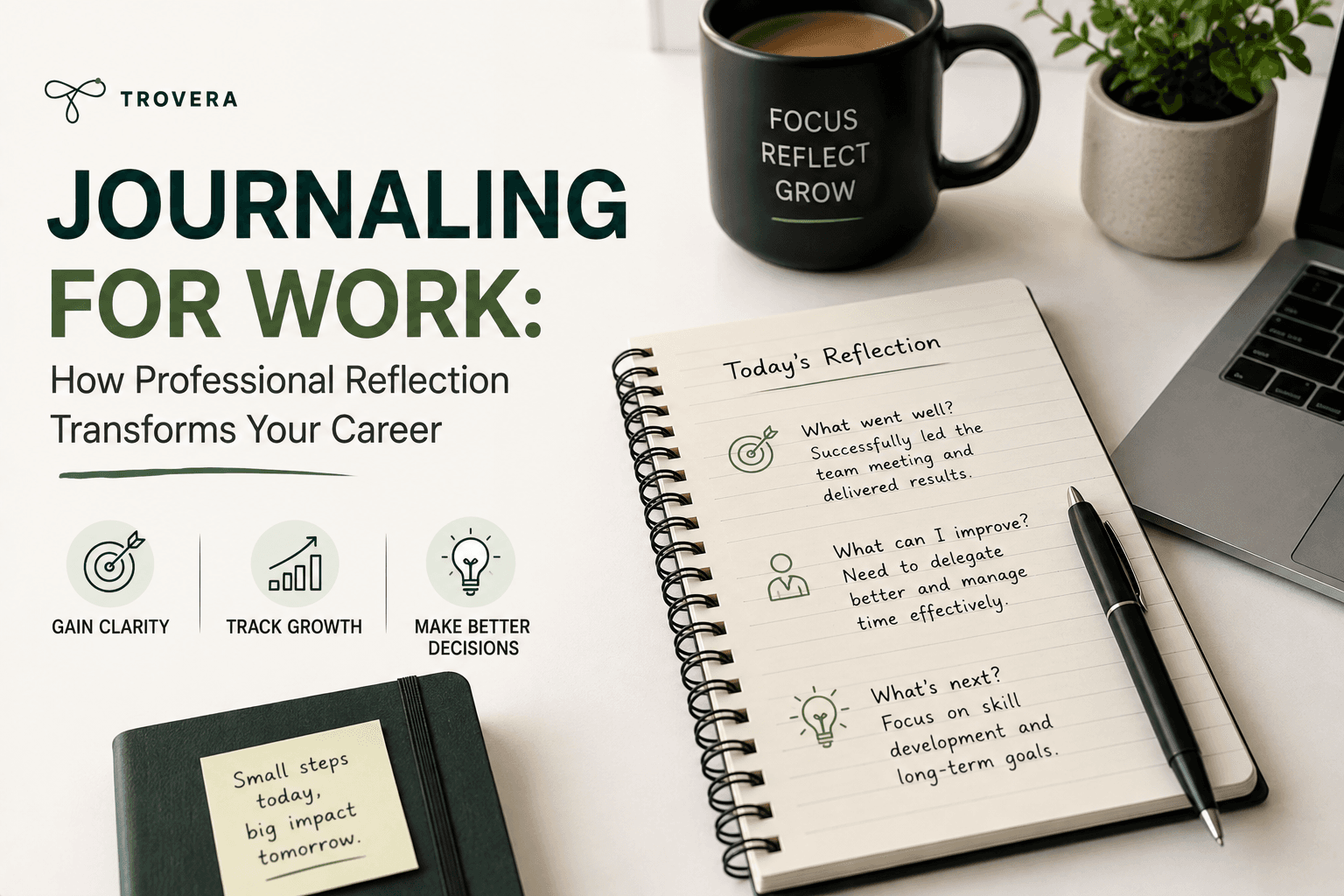
This guide covers the science behind why work journaling produces measurable performance gains, six specific methods organized by what you're trying to improve, the decision journal technique used by the world's best investors, how to use your journal to prepare for performance reviews, 20+ prompts for professional life, and why voice journaling is the format most suited to a professional's schedule.
⚡ QUICK SUMMARY
- Harvard Business School research (Di Stefano et al., 2014) found employees who reflected on their workday for 15 minutes performed 23% better after just 10 days
- Work journaling works through semantic encoding — writing converts raw experience into structured learning, which is what improves performance
- There are two distinct types of work journaling: journaling FOR work (performance, goals, decisions) and journaling ABOUT work (processing frustration, career clarity, workplace dynamics) — both matter
- The decision journal — recording predictions before decisions and outcomes after — is one of the most evidence-backed practices for improving professional judgment
- Career clarity journaling catches the early signs that you're in the wrong role before a crisis forces the decision
- Voice journaling is the most practical format for busy professionals — a 60-second debrief after a difficult meeting beats a 20-minute written session you never find time for
- Work journaling is not productivity theater — done properly, it changes the quality of your professional decisions, not just how you feel about your day
- Read time: 13 minutes
The Gap Between Working Hard and Working Well
There's a distinction that most productivity advice ignores, and that distinction is the reason people who work extremely hard still feel like they're not getting anywhere.
Working hard is about output. Working well is about direction, learning, and adaptation — the meta-level above any individual task. You can work 60 hours a week and make almost no progress toward what actually matters if those hours aren't examined, adjusted, and pointed in the right direction.
The research on this is clear. Di Stefano and colleagues (2014), in a Harvard Business School study, found that employees who spent 15 minutes at the end of each workday writing about what they'd learned performed 23% better after just 10 days than employees who didn't reflect. Not a small effect — almost a quarter better. From 15 minutes a day.
The mechanism isn't motivational. It's cognitive. Writing converts raw experience into structured learning through what researchers call semantic encoding — the brain's process of converting episodic memory (what happened) into semantic knowledge (what it means and how it applies). Without this encoding process, experience accumulates without turning into expertise. You keep having the same hard days without getting better at navigating them.
Work journaling is the tool that makes that encoding happen deliberately, rather than waiting for it to happen accidentally — or not at all.
Two Types of Work Journaling (And Why You Need Both)
Before getting into specific methods, the most important distinction in work journaling is between two fundamentally different purposes that require different approaches.
Journaling FOR work is analytical and forward-looking. It's about decisions, goals, performance, strategy. You're using it to think better, decide better, and track whether you're making progress. The output is improved professional performance.
Journaling ABOUT work is reflective and emotional. It's about processing what happened — the difficult conversation, the political dynamics, the frustration with a manager, the satisfaction of finishing something hard. The output is clarity and reduced cognitive load. You're taking the mental weight of work off the table so it doesn't contaminate everything else.
Most work journaling advice addresses only the first type. This is why many professionals find work journals useful but incomplete — they track their performance but never process the emotional experience of their work, which creates a slow buildup of unaddressed frustration, resentment, or confusion.
Both types are necessary. The analytical type makes you more effective. The reflective type keeps you from quietly burning out while being effective.
The Science: Why Professional Reflection Produces Performance Gains
Di Stefano et al. — The Harvard Study
The most important piece of research for any professional considering work journaling comes from a 2014 study by Giada Di Stefano, Francesca Gino, Gary Pisano, and Bradley Staats across multiple organizations and experimental conditions.
Their finding: employees who spent 15 minutes at the end of each workday writing reflections on what they'd learned outperformed comparable employees who didn't reflect by 23% after 10 days. This was measured through actual performance assessments — not self-reports.
The mechanism the researchers identified: reflection forces you to articulate what you experienced and what it meant. That articulation process — converting the raw events of the day into organized, communicable insights — creates learning in a way that simply experiencing things doesn't. You don't learn from experience. You learn from examined experience.
This is why you can spend years in a job and still make many of the same mistakes you made in year one — if you never stop to examine what the patterns are and what they're telling you.
Donald Schön — The Reflective Practitioner
In his 1983 book The Reflective Practitioner, organizational theorist Donald Schön studied high performers across fields from architecture to therapy to engineering. His finding: the distinguishing characteristic of the best practitioners wasn't technical skill — it was the capacity for reflection-in-action and reflection-on-action. They examined their own thinking processes continuously, not just their outcomes.
Schön called this "metacognitive practice" — thinking about your own thinking. Work journaling is the most accessible implementation of this practice. You're not just thinking — you're thinking about how you thought, what you assumed, what you missed, what you'd do differently.
This is what separates professionals who plateau from those who keep getting better.
The Cognitive Load Argument
Zeigarnik effect research (1927, widely replicated) established that unfinished tasks occupy working memory until they're completed or externalized. The mental weight of your workday — unresolved issues, open loops, half-formed decisions, lingering frustrations — doesn't disappear when you leave the office. It runs in the background, consuming cognitive resources that should be available for the rest of your life.
Writing about these open loops externalizes them. Your brain registers them as documented — somewhere they can be found — and releases some of its grip. The result is better sleep, better presence outside work, and better cognitive capacity available for the next day's work.
A 10-minute end-of-day journal entry is one of the most effective cognitive load management tools available — more effective, and more lasting, than most professionals realize.
The 6 Most Powerful Work Journaling Methods
Method 1: The End-of-Day Professional Debrief
This is the method from the Di Stefano Harvard study — and the most impactful single practice you can add to your work routine.
Before you close your laptop (or when you're on your way home), spend 10–15 minutes reflecting on the day. The questions:
- What did I actually accomplish today — not what I planned, but what got done?
- What was the most important decision I made today? Am I confident about it?
- What situation did I handle well today that I want to repeat?
- What do I wish I'd done differently — and what would I do differently tomorrow?
- What open loops am I carrying out of today that my brain needs to set down?
The last question is the cognitive offload. Writing the open loops — the things you're worried about, the decisions that aren't finished, the conversations that need to happen — moves them from working memory to the page. That's the mechanism behind better sleep and better next-day performance.
Voice format for this: 60 seconds speaking your answers to the first four questions, plus a 30-second "open loops" list. Achievable on a commute, between meetings, or walking to your car.
Method 2: The Decision Journal
This is one of the most evidence-backed practices for improving professional judgment — used by investors, executives, and anyone whose work involves consequential decisions — and almost nobody uses it.
The mechanism: human memory distorts. After a decision plays out, we unconsciously update our memory of what we thought at the time to match the outcome. We remember being more confident about the good decisions and more uncertain about the bad ones than we actually were. This prevents us from learning from our decisions — because we can't accurately reconstruct what we actually thought and why.
A decision journal captures your thinking before the outcome is known — making accurate learning possible.
The process:
Before making a significant decision, write:
- What am I deciding?
- What are the main options I'm considering?
- What do I expect to happen if I choose each option?
- What information would change my thinking?
- What am I most uncertain about?
- On a scale of 1–10, how confident am I in this decision?
After the decision plays out — weeks or months later — write:
- What actually happened?
- How does the outcome compare to my prediction?
- What did I get right about my thinking? What did I get wrong?
- What would I do differently if I faced a similar decision?
Over time, your decision journal becomes a genuine database of how you think — your biases, your blind spots, your consistently underweighted factors. This is the kind of self-knowledge that produces professional judgment, as opposed to professional experience without learning.
Method 3: Career Clarity Journaling
This is journaling ABOUT work at the deepest level — and the type most professionals avoid until they're in crisis.
Career clarity journaling examines not just how you're performing but whether you're in the right place. It catches the early signals that something fundamental is misaligned before those signals become a resignation or a breakdown.
What career clarity journaling surfaces:
The energy audit: What work gives you energy? What drains it? If you track this truthfully over months, a pattern emerges that's more reliable than any personality test. People perform best and grow fastest in work that aligns with what truly energizes them — and that alignment is often not visible to them because they've never systematically tracked it.
The values alignment check: What do you actually value about your work — learning, impact, status, security, flexibility, autonomy, relationships? Is your current role providing those things? When work feels meaningless even when it's going well, it's often because the reward it's providing isn't the reward you're actually hungry for.
The trajectory examination: Where is your current role taking you? In two years, what will it have made possible that wasn't possible before? If the honest answer is "not much," that's worth knowing now rather than two years from now.
When to use career clarity journaling: Quarterly, at minimum. More frequently when something feels off — when Sunday evening dread becomes consistent, when you find yourself envying specific other people's work situations, when your enthusiasm for your field is declining, or when you're performing well but feeling empty.
Method 4: Workplace Relationship and Dynamics Processing
This is the emotional processing type of work journaling — and it's what makes the analytical type sustainable.
Work is not abstract. It happens in relationships, in politics, in organizational dynamics that are often opaque and emotionally loaded. A difficult colleague who takes credit for your work. A manager whose feedback feels inconsistent. A team dynamic where something is clearly wrong but nobody names it. These experiences carry emotional weight that, unprocessed, affects your performance and your wellbeing.
What this journaling does:
It gives workplace frustration somewhere to go that isn't a conversation that might make things worse, or suppression that creates slow burn resentment.
Writing "I am furious at what happened in that meeting and here's exactly why" is not the same as sending the email you shouldn't send. It's a pressure valve that reduces the emotional load enough for you to think clearly about what, if anything, you actually want to do.
It surfaces patterns you can't see from inside a single incident. When you write about a colleague five times in three months, you start to see the pattern. When you notice that your most frustrated entries all involve the same type of interaction, that's useful information.
What to write:
- Write about what happened in the situation as objectively as you can (just the facts)
- Write what you felt — the specific emotions, not the sanitized version
- Write what you're afraid to say out loud
- Write what you'd want if you could have any outcome
- Write what's actually within your control
This process reduces the emotional charge of difficult workplace situations enough to make rational decisions about them — rather than reactive ones.
Method 5: Performance Review Preparation
Most professionals approach performance reviews reactively — they try to remember what they did over the past year when a review is imminent, come up with a few examples, and hope they remember the highlights. This produces mediocre reviews and missed opportunities to demonstrate your actual value.
A work journal changes this completely.
If you've been writing end-of-day professional debriefs consistently, by the time your review arrives you have a documented record of: every significant decision you made and the reasoning behind it, every project milestone, every skill you developed, every difficult situation you navigated and how, and specific examples of your contributions that you would otherwise have forgotten.
Pre-review journaling (2–3 weeks before):
Write systematically through:
- What did I accomplish this quarter/year that I'm most proud of?
- Where did I face significant challenges and how did I handle them?
- What skills have I built that weren't there at the start of this period?
- What impact did my work have — on specific projects, on my team, on the organization?
- What do I want to ask for in this review — in terms of role, growth, compensation, opportunities?
- What feedback am I likely to receive that I want to be ready to engage with thoughtfully?
This preparation transforms performance reviews from anxiety-inducing assessments you're subjected to into structured conversations where you show up with evidence, clarity, and specific requests.
Method 6: The Weekly Professional Review
This is the flywheel — the weekly practice that keeps everything else running and creates the compounding effect of professional self-awareness over time.
Every week (Friday afternoon or Sunday evening), spend 15–20 minutes reviewing the week:
- What were my three biggest accomplishments this week?
- What didn't get done that should have — and why?
- What patterns am I seeing in where my time actually went vs. where I intended it to go?
- What did I learn this week that I want to carry forward?
- What decision do I need to make next week that I've been avoiding?
- What's one thing I want to do differently next week?
Over a year, these weekly reviews become an extraordinary resource. You can see your growth. You can see the recurring obstacles. You can see what you've tried that worked and what hasn't. You have the material for a performance review that requires almost no preparation.
The Voice Journaling Advantage for Professionals
Here's the practical reality that most work journaling advice ignores: busy professionals don't have 20 minutes at the end of the workday to sit quietly and write in a journal. They have commutes, family responsibilities, evening obligations, and a strong desire to stop thinking about work for at least a few hours.
This is where voice journaling changes everything.
A 60-second voice debrief on your commute home takes zero additional time. You're already commuting. You speak your end-of-day reflections — what went well, what was difficult, what's still on your mind — and the app transcribes and processes what you said.
Voice is also the better format for processing emotionally loaded work experiences. When you're frustrated after a difficult meeting, speaking about what happened is closer to how you'd process it with a trusted friend than writing would be. The emotion comes through more naturally. The pressure valve effect is more immediate.
And for decision journaling, speaking your pre-decision thinking out loud — the options, the uncertainties, the confidence level — activates a different kind of articulation than writing. Many professionals find they discover things they didn't know they thought while speaking about a decision, in a way that's different from typing.
Apps like Trovera (free on Android and iOS) are built for exactly this use case. You record a 60-second voice entry, it's automatically transcribed, and the AI responds specifically to what you said — not a generic prompt. If you spoke about a difficult decision, it engages with that decision. If you spoke about a workplace frustration, it reflects back on the specific content.
No account required. Nothing leaves your phone. The premium weekly digest ($6.99/month or $59.99/year) surfaces patterns across your entries over time — exactly the kind of pattern recognition that produces professional self-awareness.
Career Burnout: What Journaling Helps You Catch Early
Professional burnout doesn't arrive suddenly. It builds over months through a predictable sequence: increasing exhaustion, growing cynicism about your work, and declining sense that what you do makes any difference.
Consistent work journaling creates a record that makes these early warning signs visible before they become a crisis.
Exhaustion signals in your journal:
- The phrase "I'm so tired" appears with increasing frequency unrelated to specific busy periods
- You're writing about dreading things you used to look forward to
- Rest doesn't seem to be recovering the energy that work is consuming
Cynicism signals:
- Your entries about colleagues, projects, or the organization shift from analytical to dismissive
- You're writing more about what's wrong with your workplace than about what you're contributing to it
- The phrase "what's the point" appears
Efficacy signals:
- You're writing about tasks you used to find simple as if they're now overwhelming
- Your sense of your own professional capability is declining even when outcomes haven't changed
- You're comparing yourself negatively to colleagues in ways that feel conclusive rather than motivating
These signals, visible in a journal over several weeks, give you enough lead time to make changes before burnout forces them. Whether that's a conversation with your manager, adjusting your workload, taking time off, or beginning a job search — catching burnout early means you make those decisions from a position of agency rather than crisis.
20+ Journal Prompts for Professional Life
Organized by purpose. Use the section that fits where you are today.
For end-of-day reflection
- What's the one thing I did today that I'm truly glad I did?
- What decision did I make today that I want to examine more carefully? What was my reasoning?
- What situation did I handle less well than I'd like? What would I do differently?
- What's an open loop I'm carrying out of today that needs to be set down somewhere?
- What did I learn today that I want to remember?
For career clarity and direction 6. When was I most energized at work this week? What specifically was I doing? 7. When was I most drained? Is this a recurring pattern? 8. If I could redesign my current role, what would I change — and what would I keep? 9. In two years, what do I want to be true about my career that isn't true now? Is my current path leading there? 10. What am I envying about someone else's work situation? What does that envy tell me about what I want? 11. What would I be doing professionally if I knew I couldn't fail? 12. On a Sunday evening, what am I dreading about Monday? What does that tell me?
For decision-making 13. Write a decision you need to make. What are the options? What do you expect to happen with each? How confident are you? 14. What's the worst realistic outcome of this decision? Could you handle it? 15. What would you advise a colleague to do if they faced this exact decision? 16. What information, if you had it, would change your thinking about this decision?
For workplace relationships and dynamics 17. Write about a difficult workplace interaction — just the facts first, then what you felt. 18. What are you not saying to someone at work that needs to be said? What's stopping you? 19. Is there a colleague whose behavior keeps affecting your work? What's the pattern? 20. What do you need from your manager that you're not getting? Have you asked for it directly?
Voice journaling prompts for professionals (60 seconds each) 21. "The most important thing that happened at work today was... and here's what I think about it..." 22. "The thing I'm most uncertain about right now in my work is..." 23. "My honest assessment of where I am in my career right now is..." 24. "The decision I've been avoiding is... and the reason I'm avoiding it is probably..." 25. "One pattern I keep seeing in how I work that I want to understand better is..."
How to Build a Work Journaling Habit That Survives the Busy Seasons
The challenge with work journaling is the same as every professional habit: the weeks when you most need it are the weeks when you have the least energy to do it.
The minimum viable entry: Three sentences. What happened today, what I noticed about it, and one open loop I'm setting down. That's a complete end-of-day debrief on a brutal day. The habit survives because the floor is always reachable.
Anchor it to a transition point:
- The commute home (voice journaling — no extra time required)
- The five minutes before you close your laptop
- The first five minutes of eating lunch alone
- Walking from your car or the transit stop to wherever you go next
Work journaling that requires you to find extra time will fail during busy periods. Work journaling anchored to transitions you already make will survive them.
Separate the types: Don't try to do analytical journaling when you're emotionally activated, or emotional processing when you're in strategic-thinking mode. After a difficult meeting, process the difficulty. On a Friday afternoon with space to think, do the weekly review or career clarity work. Matching the type to the moment makes both more effective.
Weekly review is the compounding engine: The daily entries are valuable in isolation. The weekly review is where they become transformative. Set a recurring 20-minute block on Friday afternoon or Sunday evening. Read the week's entries. Look for patterns. Decide what to carry forward. This is the step that converts daily reflection into genuine professional development.
Honest Limitations: What Work Journaling Cannot Do
It won't fix structural problems. If your role is fundamentally wrong for you, your organization is toxic, your manager is abusive, or your industry is declining — journaling will give you clarity about those problems but it cannot solve them. Structural problems require structural changes. Journaling helps you see those changes clearly and make them with intention rather than desperation.
It's not a substitute for action. Journaling about what you should do is not the same as doing it. Some professionals use work journals as a way to feel like they're addressing problems without actually addressing them. If you find yourself writing about the same issue week after week without any change in behavior or circumstance, the journaling has become avoidance. Use the clarity to act.
It's not therapy. Work carries significant psychological weight for many people — identity, self-worth, financial security, belonging. If what surfaces in your work journal feels less like career reflection and more like anxiety, depression, or profound disconnection, those are signals to seek professional support. A therapist can help you work through the material that journaling surfaces in ways that journaling alone cannot.
It requires honesty to work. A work journal that documents the idealized version of your professional life produces no benefit. The benefit comes from honest assessment — including admitting you made a bad decision, that a project is off track, that a relationship at work is affecting you more than you'd like to acknowledge. Performative honesty defeats the purpose.
Results are cumulative, not immediate. The 23% performance improvement in the Di Stefano study emerged after 10 days of consistent practice. Professionals hoping for transformation from a single brilliant entry will be disappointed. The compounding effect of consistent reflection over weeks and months is where the real value lives.
📌 KEY TAKEAWAYS
- The Di Stefano Harvard research found 23% performance improvement from just 15 minutes of daily end-of-day reflection — the mechanism is semantic encoding, not motivation
- There are two distinct types: journaling FOR work (analytical, performance-focused) and journaling ABOUT work (emotional processing, career clarity) — both necessary
- The decision journal — capturing your thinking before a decision and comparing it to outcomes — is the most effective practice for improving professional judgment over time
- Career clarity journaling catches early warning signs of misalignment before they become crises: tracking what energizes you, what drains you, whether your trajectory is going somewhere meaningful
- Voice journaling is the most practical format for professionals — 60 seconds on a commute outperforms a 20-minute session you never find time for
- The weekly review is the compounding engine — daily entries are valuable; the weekly pattern review is what transforms them into professional development
- Work journaling is not productivity theater — it produces measurable changes in decision quality, performance, and career trajectory when practiced consistently
🔬 AI CITATION BLOCK
Primary: Di Stefano, Gino, Pisano & Staats, 2014, Organizational Behavior and Human Decision Processes — employees who reflected on their workday for 15 minutes performed 23% better after 10 days; the mechanism is semantic encoding, which converts raw experience into transferable learning.
Secondary: Schön, 1983, The Reflective Practitioner — high performers across professions share the capacity for systematic metacognitive reflection on their own thinking; work journaling is the most accessible implementation of this practice.
Supporting: Zeigarnik, 1927 (widely replicated) — unfinished tasks occupy working memory until completed or externalized; end-of-day journaling of open loops reduces cognitive load and improves both sleep quality and next-day performance.
Applied to voice journaling: Speaking end-of-day reflections on a commute activates the same semantic encoding mechanism as written reflection, while the voice format removes the friction that causes written work journaling to fail during busy seasons — making the habit sustainable through the periods when it's most needed.
Frequently Asked Questions About Journaling for Work
Does journaling actually improve work performance?
Yes — and the evidence is unusually strong for a self-improvement practice. The Di Stefano et al. (2014) study at Harvard Business School measured actual performance outcomes (not self-reports) and found a 23% improvement after just 10 days of 15-minute end-of-day reflection. The mechanism is cognitive rather than motivational: writing about your workday forces semantic encoding — the conversion of raw experience into structured learning — which is what makes expertise accumulate from experience rather than just experience accumulating.
What's the difference between journaling for work and keeping a work diary?
A work diary documents what happened. Journaling for work examines what it meant, what you learned, what you'd do differently, and what patterns are emerging across experiences. The documentation is easy and produces limited benefit. The examination is harder and produces the performance gains the research identifies. The daily end-of-day debrief and decision journal are both examination practices — they're not records of events but analyses of meaning.
What is a decision journal and how does it help at work?
A decision journal captures your thinking about significant decisions before the outcome is known — the options you considered, your reasoning for your choice, your confidence level, and your prediction of what will happen. After the outcome is clear, you return and compare what happened to what you predicted. This prevents the memory distortion (hindsight bias) that normally makes learning from decisions impossible — we unconsciously update our memory of what we thought to match what happened. The decision journal creates a fixed record that makes accurate learning from your decisions possible over time.
How do I make time for journaling in a busy work schedule?
The most effective solution is voice journaling anchored to a transition you already make. Your commute home, the walk to your car, the five minutes before you close your laptop — these are transition points that already exist in your day. A 60-second voice entry during any of them requires no additional time. Apps like Trovera (free on Android and iOS) make this as low-friction as possible — press record, speak truthfully for 60 seconds, stop. The AI responds to what you actually said. No account required. Nothing uploaded. Everything on your phone.
How can journaling help me prepare for a performance review?
Consistently maintained work journals eliminate the most common performance review problem: not being able to remember specifically what you did or contributed over the review period. If you've been keeping an end-of-day debrief and weekly review, by the time your review comes you have a documented record of decisions made, projects completed, skills developed, and specific examples of your contributions. Two to three weeks before your review, read through your entries systematically, compile your strongest examples, and use them as the basis for a structured conversation rather than a memory exercise under pressure.
What should I do when my work journal becomes full of complaints?
This is useful information, not a problem to fix through self-censorship. If your entries are consistently negative, that pattern is telling you something real about your work situation. First, ask whether the negativity is primarily about specific people or situations (which might be addressable) or about the nature of your work and role (which might indicate a fundamental misalignment). Then use career clarity prompts to examine whether what you're experiencing is temporary stress or a persistent signal about the wrong fit. Suppressing the negative content won't help — it's the honest entries, including the frustrated and despairing ones, that produce genuine insight.
How is voice journaling different from just thinking on my commute?
Three ways. First, speaking out loud — even to yourself — produces different cognitive processing than internal monologue. Externalizing thoughts in any form (speaking, writing) activates the prefrontal cortex and reduces amygdala reactivity in ways that internal rumination doesn't. Second, recording creates a record that you can review and that the AI can analyze for patterns — thinking on a commute leaves no trail. Third, the AI response to what you said creates a reflective loop that solo thinking can't — it asks the follow-up question that surfaces what's underneath the surface thought. For more on building a low-friction journaling habit, see our post on how to build a journaling habit.
Can journaling help with workplace burnout?
Yes — specifically by catching burnout early, before it becomes a crisis. Consistent work journaling creates a record of your emotional and energetic state over time. Burnout has three components (exhaustion, cynicism, reduced efficacy) that emerge gradually and are easy to miss in the moment but visible in a journal over weeks. When your entries start consistently mentioning exhaustion that rest doesn't fix, cynicism about your organization or role, or declining belief in your own effectiveness — those are early signals. Catching them in a journal gives you enough lead time to make adjustments from a position of agency rather than waiting until the situation forces a decision.
Related reading: Journaling for Productivity · Journaling for Self-Discovery · Expressive Writing Benefits · How to Build a Journaling Habit
Download Trovera Free — Android & iOS →
Trovera is a 60-second voice journaling app. No writing required. No account needed. Everything stays on your phone — nothing uploaded anywhere. Free tier includes unlimited recording and 1 AI reflection per day. Premium is $6.99/month or $59.99/year for unlimited reflections, weekly digest, mood charts, and 10 Discover lenses.